Julie Ershadi - Bryn Mawr College

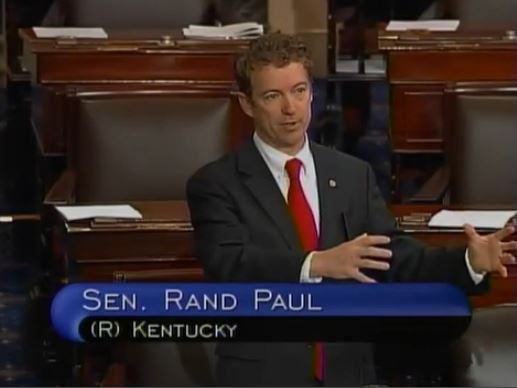
Sen. Rand Paul struggled to woo young people and minorities during his speech at the historically black Howard University on Wednesday morning. Nevertheless, a libertarian student group on the scene said many students signed up for its email list after the speech.

The Kentucky senator met with skepticism and confrontation from students in the audience. As he entreated his listeners to see that the Republican Party championed equality for blacks in the early days of abolition and emancipation, two Howard students ran to the front of the auditorium and hoisted a large white tarp with the words “Howard University does not support white supremacy” on it.

Brian Menifee, a senior mechanical engineering major at Howard and a member of the leftist campus group Political Education Action Committee, had pulled the sign from his backpack. As he and a companion were pulled away in a scuffle with campus police, Menifee could be heard saying, “Get the fuck off of me!” and “I stand up for my rights.”

Paul emphasized his view that racism and segregation are abhorrent realities of the country’s history. He also denied ever opposing the Civil Rights Act of 1964 when confronted during the question-and-answer session about the controversy he faced in 2010 for questioning Title II of that law, which prohibits private businesses from denying customers on the basis of race.

“What gets lost is that the Republican Party has always been the party of civil rights and voting rights,” Paul said. “It is an uphill battle for me to convince you that we haven’t changed, but that’s part of me being here.”

Other students at Howard conveyed their own doubts about Paul’s olive branch.

Equilla Clark, a senior accounting major at Howard, learned of Paul’s visit through an official campus-wide email but was not attending the speech.

“I was kind of turned off because it was a Republican,” she told The College Fix.

“It wouldn’t benefit me to go,” she said. “If it was a Democratic senator coming here, probably more people would be talking about it.”

Besides the protesters, at least one group at Howard on Wednesday came in support of Rand Paul’s visit.

Four activists from the libertarian campus-based organization Young Americans for Liberty wore “I Stand with Rand” stickers and carried sign-up sheets for the group’s email newsletter.

Paul, though a Republican, is an outspoken advocate of limited government and remains popular among libertarians.

Edward King, director of programs and operations for YAL, said, “Our goal was to go there and find people who agree with us philosophically.”

YAL ended up filling 10 pages of email sign-ups. Howard students appear to make up 70-80 percent of the names, King said.

Julie Ershadi is a graduate of Bryn Mawr College

Click here to Like The College Fix on Facebook.  /  Twitter: @CollegeFix

{ 0 comments }

How many libertarian rock stars does it take to make a roomful of economics and political science majors get up and dance?

Not a single one, as it turns out.

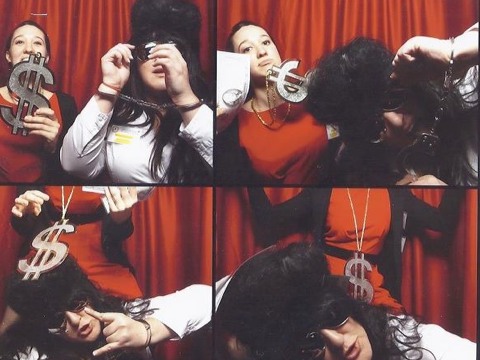
Dorian Electra Fridkin Gomberg, the keynote performer at this year’s International Students For Liberty Conference (ISFLC), said, “I don’t call myself a libertarian at all anymore, that’s just what other people call me for convenience.”

With somewhere around 1,300 free-market enthusiasts turned out for the conference, the singer and songwriter had a full house as audience on Saturday night. A small crowd got up to dance during the performance of Fast Cash, one of her most recent songs with a video on YouTube.

“That was unprecedented fun,” Dorian Electra said. “I could live off that feeling of everybody just losing it and going crazy.”

The 20-year-old junior at Shimer College and her team have produced her songs and accompanying videos under the patronage of various fellowships, awards, and internships, including a 2012 internship with production company Emergent Order and a 2009-2010 fellowship with Students For Liberty, the host organization of last weekend’s conference.

Emergent Order is also behind the production of a pair of videos that portray early 20th-Century economists Friedrich A. Hayek and John M. Keynes rapping the tenets of their respective conflicting theories. Together, the “Keynes vs. Hayek” videos have been viewed 6.3 million times since they first appeared on YouTube in 2010 and 2011.

Both Dorian Electra and Emergent Order seek to educate with the work they do.

Dorian Electra loves hearing about students and teachers who have used her videos in their classroom, she said.

When asked at the Students For Liberty conference her reason for making her videos, she said, “Definitely turning people on to the ideas.”

With 1,344 YouTube subscribers and 362,491 views on her videos, Dorian Electra maintains something of a following, though it can’t be determined whether her fans are after the ideas, the music, or both.

“It is fun to occupy this weird space of feeling like a rock star, but the only reason I’m rock star is this venue, in this small world of libertarians,” she said.

Fix contributor Julie Ershadi is a graduate of Bryn Mawr College.

Click here to Like The College Fix on Facebook.

Image Source: dorianelectra.com

{ 2 comments }

Libertarians might be just as worried about demographics as conservatives and Republicans are right now.

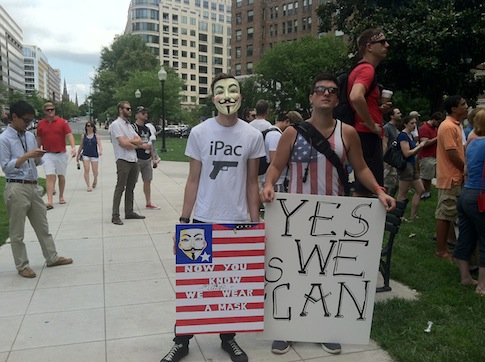
Something between 1,200 and 1,400 students, alumni, and supporters gathered at the Grand Hyatt hotel in downtown Washington, D.C. for the 2013 International Students For Liberty Conference (ISFLC 2013) this weekend. One of the dominant themes of conversation, from the escalators to the ballroom, was how to entice more ethnic, social and cultural minorities to embrace libertarianism.

In a 2011 survey by the Pew Research Center, 67 and 85 percent of respondents who identified as libertarian also identified as male and white, respectively.

In the mainstream politics, the demographic statistics delineating the Democratic ticket’s back-to-back triumph in the past two presidential elections now form a crucible for the Republican Party’s survival. Similarly, at the conference activists from across the libertarian spectrum — anarchists, minarchists, voluntaryists, classical liberals, so-called big-L Libertarians who vote and campaign with the titular national party, and Republican-like conservatives — mulled over the dearth of other kinds of diversity among their collective ranks.

Of 96 breakout sessions, at least 7 dealt in some way with drawing different social groups into the free-market fold. Examples include a lecture on the libertarian tradition in black American history, 2 separate panels on the apparent lack of women who identify as libertarian, and panels on classical liberal approaches to the politics of immigration and homosexuality in American society.

The lineup was not a total departure from the last conference, but alongside panels on the familiar subjects of Rawlsian political theory and Austrian economics, the focus this year doubled down on strategies for promoting libertarianism as it pertains to the very social groups who turned out the most for Obama in 2012.

As Brandon Cestrone, the field executive and director of data for Young Americans for Liberty (YAL), put it while speaking from the stage before the closing ceremony, “If we don’t grow, we die.”

YAL is a pro-liberty organization active on college campuses nationwide and partners with the similar Students For Liberty (SFL), the organization that puts on the international conference every year since 2008.

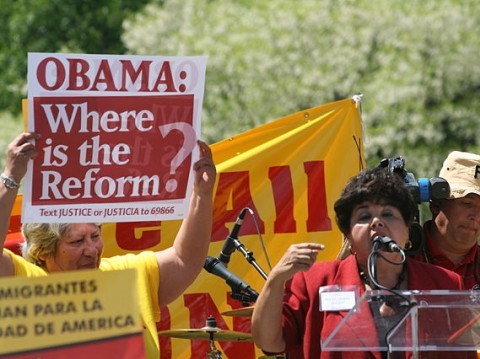
Cestrone’s warning echoes the post-election hyperventilation of Republicans, such as House Majority Leader Eric Cantor of Virginia, who see rebranding and expanding as necessary for their party’s survival, with a policy focus on immigration reform.

In keeping with the current focus on demographics, this year’s CPAC schedule shows 3 events on immigration: a book signing with former Florida Gov. John E. “Jeb” Bush, a screening of the film Border War: The Battle Over Illegal Immigration, and a panel entitled “Respecting Families and the Rule of Law: A Lasting Immigration Policy.”

Fix Contributor Julie Ershadi is a graduate of Bryn Mawr College.

Image by Arasmus Photo / Wikimedia Commons

{ 0 comments }

A rising libertarian group on college campuses around the country wrapped up its pre-election debate series at American University in Washington, D.C. on the evening of Nov. 1.

Sarah Harvard, president of the Young Americans for Liberty chapter at American University (AU), said, “The whole main idea of this event is a lot of American students are not satisfied with the presidential debates. A lot of questions were left unanswered, or they were dodged, or they weren’t even asked.”

According to the organization’s website, Young Americans for Liberty (YAL) is the largest and fastest growing pro-liberty organization on college campuses in the United States. The Nov. 1 debate at AU was filmed by C-SPAN and hosted in an auditorium in the campus’s Kreeger Building.

“I’ve always had this passion for people-formed policy, economic issues, and civil liberties and I feel like libertarians pull a lot of weight to that,” she said.

“I was actually a borderline socialist before being a libertarian,” she said.

Harvard is a 2nd year transfer student at AU and a contributor to the 6-month-old online magazine Define: Liberty. Her tipping point into the liberty movement took place when President Barack Obama signed the National Defense Authorization Act of 2012 (NDAA).

Jack Hunter, a columnist at The American Conservative and the moderator for YAL’s campus debate at AU, began the debate with a question about that same act of Congress. He asked Bill Scher, the liberal representative on the debate panel and author of Wait! Don’t Move To Canada!: A Stay-and-Fight Strategy to Win Back America, how he justified the NDAA’s provisions for the indefinite detention of Americans suspected of terrorism.

“I don’t accept the premise of the question,” Scher said.

“There isn’t really a singular liberal foreign policy vision, nor is there a conservative one,” he said.

Scher said that Obama ended the systematic use of torture that existed under former President George W. Bush, but he did not outright answer Hunter’s question about the NDAA.

The debate lacked a discussion of gun laws or a dissenting voice on the war in Iraq, which all three panelists agreed was a mistake. The panelists still covered a wide range of issues largely or entirely left out of the presidential debates, including the war on drugs, the drone campaign, the Federal Emergency Management Agency and other public works as compared to private enterprise.

Coming via a delayed public transit system, conservative and Editor at The Daily Caller News Foundation Jim Antle arrived 1 hour and 11 minutes late to the debate and said, “Well, I think my experience getting here has kind of altered the composition of the panel. I’ve become now a radical anarchist as a result of this process.”

Members of the audience laughed.

“I’m now in favor of privatizing all streets in addition to all forms of public transportation. I don’t see how it could be a more disorderly process than what now exists,” he said.

By way of summary, Tim Cavanaugh of Reason magazine and Suck.com fame said, “After 8 years of Bush and 4 years of Obama, I’m not really sure what conservatives or liberals stand for.”

(Click here to watch a video of the entire debate at C-SPAN.org.)

Julie Ershadi is a graduate of Bryn Mawr College.

Click here to Like The College Fix on Facebook.

{ 0 comments }

Grassroots activists took their support for the Republican presidential ticket to a key swing state Oct. 28.

Both candidates President Barack Obama and GOP challenger Mitt Romney canceled their campaign events in Virginia due to the impending hurricane arrival. Nevertheless, a small but dedicated contingent hopped on a charter bus, sponsored by the Republican National Committee, and spent Sunday phone-banking and knocking on voters’ doors as part of a greater Get Out The Vote effort, which hinges on in-person interaction between activists and voters.

Michael Short, the communications director for the Republican Virginia campaign, said, “There is no substitute for person-to-person contact. It is by far the most effective means of reaching voters and getting them to cast a ballot for your candidate.”

Since April, the Republican message has reached nearly every person of voting age in the state by knocking on doors and making phone calls. The 15 activists deployed on Sunday alone knocked on 1500 doors and made 3200 phone calls, according to the campaign office’s end-of-day statistics.

The race remains tight, but multiple activists on the trip said they’re confident Romney will win.

Grant J. Grissom, one of the volunteers on the trip, said, “We definitely stand a good chance. The polls are starting to inch closer together.

“I’ve been saying almost the entire time since he was nominated that Romney, out of anyone in the Republican camp even back in ‘08, has a chance of beating Obama, it’s Gov. Romney,” he said.

Laurel Howanitz, another campaigner, said, “If you had asked me a couple of months ago, I would have had a different answer, but I think the momentum has really taken off in Romney’s favor.”

“There’s something about momentum,” she said. “There’s a lot to be said for it.”

“If you can light a fire under the base support, then you get people who come out on a Sunday,” she said between knocking on doors in Fredericksburg and neighboring communities.

Grissom, Howanitz and the other 13 volunteers on what the RNC calls the Swing State Bus Deployment spent the Sunday afternoon checking off houses on their walk lists, inventories by which campaign offices keep track of information on voters in specific precincts.

The campaign then uses what it learns from one-on-one conversations to target specific households and encourage occupants to make it to the polls on Election Day.

Virginia State Senator Bryce Reeves stopped by the campaign office on Sunday to thank the activists. “The volunteers you see coming in here that are homegrown, for the last 3 years they have been working hard,” he said.

“That’s how this election will be won,” he said.

Nothing works better than one-on-one interactions, especially when voters are growing numb to the onslaught of television and radio political ads, he said.

Fix Contributor Julie Ershadi is a graduate of Bryn Mawr College

(Image: NASA / Wikimedia Commons)

Click here to Like The College Fix on Facebook.

{ 1 comment }

At the House Financial Services Committee hearing today, sole witness Federal Reserve Chairman Ben Bernanke sparred for the last time with Rep. Ron Paul before the Congressman’s retirement from his career in public service, which began in 1976.

Paul has long been a vocal critic of the Federal Reserve. In his remarks and questions for Bernanke today, he reiterated his position that the privacy the Federal Reserve seeks is in fact “secrecy.” He re-emphasized the need for transparency of the Fed and its decision-making with banks.

Transparency and accountability, Paul said, are paramount to altering the economic situation, which Bernanke himself called “unsustainable.”

“I would argue that we are quite transparent,” Bernanke said, citing Government Accountability Office audits, which do not cover monetary policy, the annual financial statement, quarterly press conferences, and provisions in the Dodd-Frank Act.

Still, Paul maintained his stance that continuing on the same path is a mistake when he said, “We’re in deep doldrums and yet we never change policy. Welfare continues to expand exponentially and the wars never end.”

It may have been a gloomy tone to set for his last hearing as a Congressman, but the other members present repeatedly thanked him for his years of service to his principles and his country, referring to him warmly as “Dr. Paul.”

Fix Contributor Julie Ershadi is a graduate of Bryn Mawr College.

Click here to Like The College Fix on Facebook.

{ 0 comments }