Bible

On the evening of April 10, several students sat tucked away in an Episcopal church just north of the University of North Carolina – Chapel Hill. Their heads were bowed; their thoughts – ethereal.

The students were taking part in a weeklong “UNC 24/7 Prayer” at the university, an annual observance designed to lift up lives, families, careers – and the campus community – to the Lord.

About 250 students signed up for one-hour prayer slots that launched April 4 at 9:30 p.m. and ran day and night through April 11.

Although there was no official “theme” for the week, one Bible verse repeated in both email invitations and on handouts for students inside the church read:  “I will set my eyes on them for good, and I will bring them back to this land. I will build them up, and not tear them down; I will plant them, and not pluck them up. I will give them a heart to know that I am the LORD, and they shall be my people and I will be their God, for they shall return to me with their whole heart.” (NIV – Jeremiah 24:6-7).

In stark contrast to the thoughts and prayers of students who took part in the observance on the evening of April 10, another campus event unfolded nearby that was entirely temporal in nature.

The university’s Student Union played host to a workshop called “Orgasm? Yes, Please!” The event was advertised to students with the tagline: “Learn how to have AMAZING sex and enter to win a sex toy!” A variety of condoms, lubricants and sex toys were doled out during the workshop thanks to the generosity of two adult sex shops near the campus: Adam & Eve and Cherry Pie, organizers stated.

At least one student who took part in the prayer week event the evening of April 10 asked God to touch the hearts and minds of the students who were nearby learning about how to pleasure themselves and put on condoms properly.

That both activities took place at the same time was coincidental, but it does illustrate the vast chasm between the priorities of students at UNC Chapel Hill, something that is likely mirrored at universities across the nation.

The hundreds of students who participated in UNC 24/7 Prayer were not asked specifically to pray for their campus community, but without a doubt – that was among the topics broached in the silence of their hearts and minds, said one of the observance’s organizers, Nathan Tilley.

“We want it to be a way that God works in and through students to make His Kingdom to become present here on campus,” Tilley told The College Fix. “Who knows what effects might come from a week of intensified prayer?”

Tilley added that praying on and for the campus makes sense.

“This is our ‘city’, so to speak,” he said. “We live on or near campus, we work or study here, and we have the majority of our social and extracurricular life in or around the university community.”

The recent observance marked the seventh consecutive year the weeklong student prayer effort has occurred at UNC Chapel Hill. Members of about 15 campus ministries took part, including Cornerstone, InterVarsity, Every Nation, Reformed University Fellowship and others.

Each student signed up for at least one one-hour time slot, although many took on more than one slot.

The Episcopal church just north of campus, Chapel of the Cross, opened its doors to host the students as they gathered – sometimes individually and other times in groups.

Students were welcome to make themselves at home in the chapel, where books on Christianity, several translations of the Bible, and markers and paper were laid out at the ready. Also on hand were guides for students with various suggested Bible verses and instructions to “take time to quiet your mind and heart, and ask the Lord to help you to focus as you spend this hour in prayer.”

“Ask Him to meet you here, to guide you in prayer, and for your heart to be open and ears to hear what He would say to you during this time.”

Fix contributor Jessica Adams is a student at UNC – Chapel Hill.

CLICK HERE to Like The College Fix on Facebook.

IMAGE: INN University Ministries/Flickr


{ 0 comments }

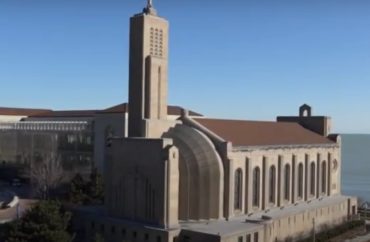
MEADVILLE – Allegheny College’s Ford Memorial Chapel was transformed into a boudoir of sorts Wednesday night, as professional sex educators advised students in attendance how best to touch themselves and their partners to reach orgasm in what was billed as an educational seminar.

The chapel, built and dedicated in 1902, is where Catholic mass and non-denominational services are conducted every week at the private liberal arts college in northwestern Pennsylvania. But all that took a back pew to Wednesday’s festivities, dubbed “I Heart the Female Orgasm” and hosted by a variety of student groups on campus.

The two sex educators, Marshall Miller and Kate Weinberg, talked students through a variety of masturbation techniques during the event.

“Sometimes it can be difficult finding your G spot by yourself, because it involves inserting a finger or fingers inside the vagina into the front wall of the body, and that kind of results in an awkward, kind of clawlike hand position,” Weinberg said, demonstrating with a pawing motion as the audience giggled. “Obviously, there are better ways you can position your body. Or if you’ve got a partner, you can get your partner to insert their finger or fingers inside your vagina in the front wall of your body in a sort of a J curve.”

Miller also weighed in, noting “some (women) find that if they change the angle or position, they can find some way of rubbing against their partner’s body, against the base of his penis or pubic bone, and with rubbing to have enough stimulation to orgasm in intercourse.”

In statements to The College Fix, the college’s chaplain defended the event’s location, calling its theme “responsible,” and a campus spokesperson said it offered a “great message.”

While the chapel is hosting services in conjunction with Lent, on Wednesday the building turned into a sexual marketplace of sorts, as student groups sold buttons, t-shirts and hats bearing the program’s name inside the chapel itself after the event concluded. They also sold the book written by program coordinators Marshall Miller and Dorian Solot titled “I Heart Female Orgasm: An Extraordinary Orgasm Guide.”

Meanwhile, the sex educators had also told students masturbation is not a sin.

“Some people figure out masturbation and orgasm as teenagers, some people figure it out later than that,” said Weinberg, describing her lifelong fascination with pleasuring herself. “And some people figure it out earlier than that. Like preschool age. I was part of that last category.”

Weinberg also weighed in on a portion of the Book of Genesis in regard to masturbation.

“So this primary anti-masturbation story is about this guy, Onan. … And Onan refused to sleep with his brother’s wife, so he spilled his seed on the ground — that’s how it’s defined — and for that, God struck him dead,” she said.

But Weinberg said she believes that because Biblical scholars debate the exact meanings of many portions of the Bible, it permits a wide variety of sexual activity.

“A lot of Bible scholars say that’s the primary anti-masturbation story, but I don’t really see it,” she continued. “Onan wasn’t struck dead for masturbating. He was struck down for not sleeping with his brother’s wife. So the masturbation wasn’t the sin. So obviously, you know, the Bible is something that is interpreted in a lot of different ways.”

During the event, Weinberg and Miller played the famous fake orgasm scene from “When Harry Met Sally” on a projected screen, and also displayed different anatomical diagrams depicting women’s genitals.

“If you’ve got a vagina, your genitals are tucked pretty neatly inside your body. It’s a pretty handy place to keep one’s genitals, really. But because of this, many heterosexual women have never seen another woman’s vagina or vulva,” Weinberg said. “If you’ve got cool dangly parts down there, if you’re voluptuous, if one side’s longer than the other, if your va-jay-jay’s got some character, some personality, it’s not a sign that you’re abnormal and deformed. It’s a sign that you’re a healthy adult woman.”

Weinberg later held up two books titled I’ll Show You Mine and Petals, encouraging students to flip through them after the program: “We’ve got two amazing books up here with pages and pages of art photographs of vaginas and vulvas.”

The event was hosted by Allegheny’s student government and Allegheny College’s Reproductive Health Coalition, along with Young Feminists and Queers and Allies. It was funded by student activities fees.

Student reaction to the seminar was mixed.

One Christian student, Shannon McAvinchey, 20, said the school’s student government supported Christian groups on campus and were not trying to intentionally offend Christian students by hosting the event in the chapel. At the same time, however, she said some students’ attitudes towards Christians troubled her.

“I guess what frustrates me most is when you say you’re a Christian, your views are automatically not so much disrespected as dismissed,” McAvinchey said.

Other students, however, were excited on their way to the chapel, chatting and laughing happily.

“I have needs!” one girl said.

“I have condoms! Jesus!” her friend shrieked.

Officials at the college took a blasé attitude toward the event.

Chaplain Jane Ellen Nickel, who conducts non-denominational Christian services each Sunday and manages the office of Spiritual and Religious Life, said in an email to The College Fix that she saw nothing wrong with the event, and hoped students would feel comfortable attending a religious service there later.

“I don’t have a problem with it being held in the chapel. The program advocates responsible, respectful decision-making regarding sexual behavior, and includes the option waiting for marriage, a message that resonates with many students of faith. While the name may have some shock value, the event itself is consistent with our policy of opening the building to campus groups. We would love it if students at such an event experience the chapel as a welcoming space, and then feel encouraged to attend a religious service or program.”

Another campus administrator told The College Fix he had no problem with the event’s location.

“They have a great message about caring relationships,” said Dean of Students Joe DiChristina in an e-mail. “I appreciated their approach.”

Fix contributor Katie McHugh is a student at Allegheny College.

CLICK HERE to Like The College Fix at Facebook.

IMAGE: Allegheny College Ford Memorial Chapel

{ 1632 comments }

It was a victory for the first amendment on December 8, when the American Center for Law and Justice successfully defended a Kansas State student’s right to read a Bible quote during his graduation speech.

KSU-Salina student body president Brett Cooper was informed by a senior administrator that his proposed reading of Jeremiah 29:11 was in conflict with the KSU “Principles of Community” and considered “not appropriate for a person who considers themselves of the Muslim, Jewish, Hindu, Buddhist, or of no faith.”

The verse, to give it some context, is: “For I know the plans I have for you,” declares the LORD, “plans to prosper you and not to harm you, plans to give you hope and a future.”

Despite the fact that the university’s “Principles of Community” include the “right of each person to freely express thoughts and opinions,” and state that a “diversity of views enriches our learning environment,” the administrator told Cooper that “that this is not an issue of free speech. This is an issue of unintended consequences and of mutual respect for others.”

Initially, the university offered Cooper a compromise. If he exchanged the word “LORD” for “higher power,” he would be allowed to give his speech. Instead, Cooper contacted the Washington D.C.-based American Center for Law and Justice (ACLJ), which quickly fired off a letter to KSU.

In a letter the ACLJ reminded KSU officials that “The Supreme Court has never held that the graduation context is some magic talisman that justifies otherwise prohibited censorship of students’ religious expression. Thus, while there may be legitimate Establishment Clause concerns when the school specifically endorses religious speech, when a student speaks, the Court has made it clear that that speech is protected by the First Amendment, and may not be censored based on its religious viewpoint.”

The university hastily backed down and Cooper was allowed to read the verse in its original form.

On its website, ACLJ called the school’s reversal “an important victory.”

“Brett was speaking as an individual, not as a state official, and individuals have their own free speech rights even when giving public speeches,” explained ACLJ senior counsel David French in an email. “The university’s censorship appeared to be purely aimed at his religious viewpoint, and viewpoint discrimination against private speech is almost always unlawful.”

Sophia Lawhead is a student at the University of Oregon.

{ 3 comments }