For nearly 100 years, members of the men’s social group The Tejas Club at the University of Texas have called each other “braves” as a show of kinship and to pay homage to East Texas Indians, but one professor recently told club members they’re racist because of the practice.
Professor Robert Jensen, who caused controversy last November when he called Thanksgiving a “white supremacist” observance and likened the Founding Fathers to Nazi Germany, told members of the men’s student club at one of their weekly coffee klatches that calling each other “braves” in effect celebrates what Jensen called the genocide of Native Americans.
“(It’s) inappropriate, and in fact is racist,” Jensen said Monday in an interview with The College Fix. “The United States as a nation exists as a result of one of the most, if not thee most, extensive genocidal campaigns in recorded human history. The European conquest of what is now the continental United States resulted in the extermination of virtually all indigenous people in the United States.”
Jensen said he believes the tradition should change, that the club’s members are acting racist, whether they think they are or not.
“A lot of us who are white are unconsciously racist throughout our lives in all sorts of ways,” he said. “We are not always aware of what we are doing.”
Jensen, 54, is a journalism professor who has taught at the university for 21 years.
Jensen’s comments to Tejas Club members were made on March 21 as an invited guest speaker for one of the group’s weekly coffee meetings, which aim to facilitate conversations and intelligent debate among students on a variety of topics. Often, high-profile guests are invited to speak.
Each year, The Tejas Club co-hosts a “Week of Women” coffee with the Orange Jackets, a women’s service organization at the University of Texas, and it was at that annual event that Jensen made his controversial remarks.
He was asked to speak primarily on pornography’s connection to sexism and racism, which he did. But toward the end of the talk a female student in the audience asked Jensen what he thought about The Tejas Club’s practice of calling each other “braves.”
The way a Tejas Club member describes it, it was then that Jensen went “on a ten-minute tirade regarding the persecution of Native Americans,” states an email to The College Fix from the club’s president, Chris Fellows.
“He concluded with ‘your organization is racist’ and promptly ended his talk, rejecting all questions and opportunities for dialogue,” Fellows stated. “Members of Tejas approached Mr. Jensen to discuss his accusation, but he found all points to be ‘bullshit.’ After it became clear that rising tempers made civil discourse impossible, Mr. Jensen was politely asked to leave three times. The Tejas Club’s reaction wasn’t a response to Mr. Jensen’s views on sexism or racism, but on his combative and aggressive approach.”
“We’re disappointed that the outcome of this event wasn’t a conversation about women’s issues, as it should have been. And we certainly don’t think solutions to racism or sexism have been achieved, but we will continue to host coffees regarding these topics until they are.”
Jensen said he was just doing what he thought was right.
“Whether it was a tirade or not is subjective, they are welcome to their interpretation,” he said. “I told them I thought it was important for white people to hold each other accountable for racist practices.”
The Tejas Club, however, works to promote a variety of causes that support diversity and equality. Founded in 1925, members today participate in pro-diversity events on campus, and host the weekly coffee meetings, open to the entire university community.
“In December, it hosts a holiday party for underprivileged children,” the group’s website states. “Throughout the year, the Braves participate in community service projects. … Recently, the club has partnered with the University’s Counseling and Mental Health Center to further suicide prevention and awareness with our fellow students.”
As for the history of the “braves” moniker, the club’s website states: “Friendship is the most important attribute of a Tejas Brave. In fact, Tejas is derived from the Native American word for ‘friend’ or ‘ally.’ … (Original members) began to call themselves the Tejas and referred to each other as braves, with the intention of emulating the friendliness of the East Texas Indians.”
While Fellows declined to comment to The College Fix specifically about Jensen’s racism accusations, Jensen said he recalls some of the young men on March 21 arguing that the “braves” nickname honors Native Americans. But Jensen said that explanation does not cut it.
“I do remember some of the men saying they feel they are honoring Indian people with this practice, and that is a standard response for people who use Indian nicknames and mascots,” he said. “I don’t think there is a strong argument there. … I think it’s important for the United States to come to terms with its history. … This is a culture that is in deep denial about its own barbarianism.”
Jennifer Kabbany is associate editor of The College Fix.
CLICK HERE to Like The College Fix on Facebook.
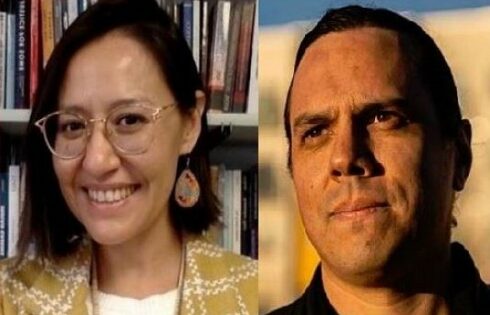
IMAGE: Shown is Professor Robert Jensen/Credit – Jason Cato
{ 5 comments }


Another 
Ward Churchill’s Last Stand: Supreme Court or Bust
by Ian Tuttle - St. Johns College on January 10, 2013
Until the improbable rise of Elizabeth Warren, he was America’s most famous fake Native American—and, like Massachusetts’ newest senator, a “diversity hire” at the University of Colorado at Boulder.
There he taught “ethnic studies” for nearly two decades, from 1990 to 2007, turning his podium into a bully pulpit for an assortment of vogue leftwing causes.
But it was when he referred to the “technocratic corps at the very heart of America’s global financial empire”—that is, the several thousand workers in the World Trade Center—as “little Eichmanns” who deserved death on September 11 (for their participation in “power lunches and stock transactions, each of which translated … into the starved and rotting of flesh of infants” abroad) that he called down upon himself the opprobrium of an entire nation and demonstrated—if any doubt remained—that some of the stupidest people around have advanced degrees.
In a more just world, Ward Churchill would have been tossed from the academy for sheer silliness. In 21st-century America, it took a faculty committee, the university’s Board of Regents, and eventually the Colorado Supreme Court. In September 2012, the state’s highest court finally decided that the Regents were within their rights to fire the professor unanimously found guilty by a committee of colleagues of “multiple acts of plagiarism, fabrication, and falsification.” And to think: the faculty committee only wanted him suspended.
In December, Churchill appealed his case to the Supreme Court.
Call him Lie-a-watha. With more than a dozen books and several articles to his name, not to mention a cushy tenured job secured after just one year as an associate professor (he somehow skipped the usual six-year probationary period), Ward Churchill managed to spend years on the dole of a major public university, where, drawing on a background in radical politics and a knack for tall tales (mainly about himself), he became a leading “Native American” voice in academia.
When, the day after his termination, Churchill filed suit in state court against his former employer, he began what must be, to-date, the century’s most specious claim of academic “repression.” But with titles like Marxism and Native Americans to his name, he rallied a colorful—if predictable—group of supporters: Noam Chomsky and Howard Zinn, two other professors whose fame outstrips their accomplishments, declared their support for Churchill, as did the ACLU, unrepentant Weather Underground terrorist-cum-academic Bill Ayers, and convicted cop-killer and former Black Panther Mumia Abu-Jamal (who issued not one but two statements of support). Their testimonials are available at the website of the “Ward Churchill Solidarity Network.”
But if Churchill managed to turn his case into a cri de coeur for professors’ First Amendment rights, hoisting “academic freedom” like an oriflamme, it was only a matter of time until he was forced into retreat. Even in Churchill’s pseudo-discipline, professors are expected to write their own politically correct hokum—but he could not manage even that standard.
Yet it should have come as little surprise. Besides the never-proved claims of Creek and Cherokee ancestry, in the résumé submitted to the University of Colorado in 1980 Churchill claimed that, while in Vietnam, he “wrote and edited the battalion newsletter and wrote news releases.” Seven years later, he told the Denver Post that he had attended paratrooper school, been part of an elite Long-Range Reconnaissance Patrol in Vietnam, and run “point” in a combat unit. U.S. Army records support none of these claims. Churchill was trained as a film projectionist and light truck driver.
But his radicalism is no yarn. In the same 1987 interview, Churchill claimed he hung around the offices of Chicago’s Students for a Democratic Society, befriended Black Panthers, and taught members of the Weather Underground how to make bombs. True or not, he was a star guest at the 2009 trial of Herman Bell and Anthony Bottom, two members of the Black Liberation Army accused of killing San Francisco Police Sergeant John Young in 1971 and suspected of involvement in several other terror attacks on police in the 1970s.
And yet, despite hugs from Lynne Stewart (convicted of aiding terrorism) and face-time in the documentary When They Came for Ward Churchill—as if CU Boulder’s then-president Hank Brown came in brown shirt and jackboots—Churchill’s legal road is likely at an end, and he is quickly fading from memory.
The essay in which his inflammatory 9/11 remarks appeared, “ ‘Some People Push Back’: On the Justice of Roosting Chickens,” is now available at sites like Kersplebedeb.com, which advertises itself as “a one-person project devoted to producing and distributing radical books and pamphlets and agit prop [sic] materials”; it hosts links to “anti-police” and “queer revolt” material. Churchill is rapidly becoming a footnote in monographs of September 11 analysis.
But, unfortunately, Churchill is only one example of the faux-intellectualism that has come to define the university dominated by niche “studies”: ethnic studies, black studies, LGBTQ studies. You name it, there’s an aggrieved Ph.D. teaching it—or at least pointing out the systematic persecution perpetrated by white/male/heterosexual/colonial/capitalistic norms.
Still, if it is no longer possible to boot a professor who spends class time justifying the Oklahoma City bombing and whose published work likens the American treatment of Native Americans to the crimes of the Khmer Rouge, Ward Churchill’s moment in the national limelight was a much-needed reminder that, in too many places, the professors are off the reservation.
Fix contributor Ian Tuttle is a student at St. John’s College.
IMAGE: Steve Rhodes
Click here to Like The College Fix on Facebook.
{ 7 comments }