FEATURED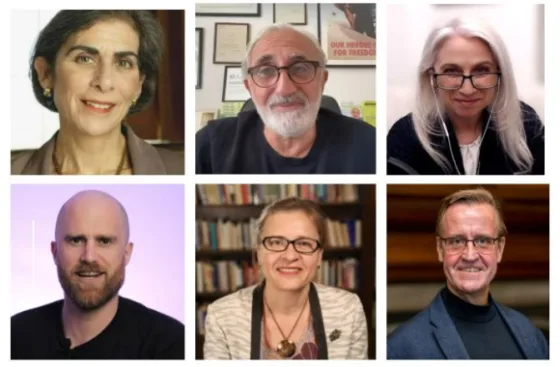
ANALYSIS
If you ever wondered what you would get if you locked some of academia’s most notorious thought criminals in a room for a day to discuss society’s contentious topics, the Freedom of Intellectual Navigation Conference at the University of Chicago provides the answer.
Co-organized by University of Chicago professors Dorian Abbot, Harald Uhlig, Peggy Mason, and Rachel Fulton Brown, the Nov. 7 event featured spirited debates on contentious topics plaguing the academe.
“Each of the parasitic ideas, postmodernism, cultural relativism, social constructivism, radical feminism, they all have a similar original goal, which is to pursue some noble objective” — even if the cost is the “murder and rape” of truth, said Gad Saad, author of “The Parasitic Mind,” during a panel discussion.
Saad was joined by fellow academic compatriots Bryan Caplan, Amy Wax, Anna Krylov, Sally Satel, Garett Jones, and J. Michael Bailey, all of whom have previously expressed verboten views, sometimes incurring serious professional or personal consequences.
Covered topics ranged from Saad’s notion of suicidal empathy to Wax’s defense of bourgeois values to attempts by Bailey to better understand autogynephilia.
“The speakers are chosen specifically to address issues that are not being addressed on many campuses, thereby demonstrating the special intellectual atmosphere at the University of Chicago. Attendees will be electrified by the chance to openly discuss topics and consider perspectives they may never have been able to on campus,” Abbot wrote on the Heterodox STEM Substack.
And, with speakers and attendees alike, partially sequestered together under what Abbot jokingly referred to as “anti-Hotel California rules,” the event offered ample opportunity for those present to engage with one another in vibrant discourse without fear of cancellation.
During a panel discussion comprised of Saad, Caplan, Wax and Bailey, and largely focused on the role of the elites and their ideas in society, Caplan noted there is “this original great guilt about the treatment of black Americans and then there’s this hope that the Great Society and anti-discrimination laws are going to totally change that.”
However, Caplan added, when the changes brought about by these programs failed to meet expectations, those who favored them were left asking themselves “What’s going on?” and had to choose between a genetic story, a cultural story, or a “We didn’t do enough” story.
Wax, a University of Pennsylvania law professor, suggested there is an “equalitarian fetish [that] goes way back in the American character.”
“I think there is an obsession with everyone is equal, we need to make them all equal, equality is the most important value,” Wax said. “Therefore, if you blame someone or if you judge someone, you’re kind of creating this hierarchy. You’re looking down on people somehow, so it’s very unfashionable.”
Saad said, “I think the fetish…of equality is a form of [an] infantile sort of folk psychology, and that’s why in every generation you have new people that think socialism, if properly implemented, will be the good thing.”
When the discussion turned to matters related to immigration and the compatibility of non-Western cultures with Western ideals, Saad noted, “There is something to be said about whether certain ideologies, if they come into the West and take a foothold in the West, whether all of the beautiful virtues that we love will be allowed to flourish or not.”
Added Wax: “I think there is a toxic romanticism about cultural assimilation, the third world, the global south that is really, to me, inexplicable.”
“When, you know, students or other people tell me…magic dirt works, the minute [immigrants from such regions] hit the United States they’re going to become wonderful and believe in all of our … traditional Anglo-American values and be just like the founders and all this, I say, ‘Then why are their countries such a shit hole?'” Wax said.
“I know that’s not a nice thing to say,” she added. “But it is a good question.”
A separate panel officially made up of Krylov, Satel, and Jones, but often with additional input from Wax, discussed the precarious position in which universities now find themselves as they navigate student protests, an increasingly antagonistic relationship with the federal government, and growing uncertainty regarding the role of the university within society.
Early in the discussion, in response to a question regarding student protests, Krylov, a USC chemistry professor, noted many universities have long had clear policies that could have been used to rein in the excesses of campus protests, including the disruption of normal university operations and the harassment of Jewish students.
However, Krlyov said, she believes these policies were often ignored due to a confluence of factors including the commercialization of education, the treatment of students as paying customers that need to be kept satisfied, an incentive system that rewards weak leadership, and an obsession with social justice.
Yet, what should be done about such problems turned out to be a matter of considerable debate among those present.
One UChicago alumna and parent in the audience argued that higher education is effectively a consumer product and that parents can and should put pressure on administrators when the delivery of that product is disrupted.
Others in the audience suggested foreign-born and scholarship students might be over-represented among campus protesters and that reducing the number of the former while making the latter pay some nominal amount toward their education could curb future protests.
Multiple people, both speakers and attendees, also expressed reluctant support for portions of President Donald Trump’s “Compact for Academic Excellence in Higher Education,” but simultaneously voiced reservations about how it would increase government bureaucracy’s role in higher education.
“We have a kind of emergency of capture in our higher-ed establishment,” Wax said. “[The institutions] want to be able to do whatever the hell they want. But truck drivers and store clerks are paying taxes. … Taxpayers are funding these institutions.”
“So I think it does give [the government] a certain degree of leverage,” Wax said. “There are tremendous dangers here. The administration can change. Whatever. But something has to be done.”
Similarly, Krylov expressed her own concerns, pointing out how other government efforts to influence university policy through programs such as Title IX have proven highly toxic, but also said she was losing hope that universities could be reformed without outside intervention.
“Maybe the only thing to do is to have some people to come from the top with a big club and beat universities into doing the right thing again,” she said.
Yet, at the same time, Krylov and others also said they worried how this would affect international students, STEM programs, and university life more broadly.
“In STEM programs, especially at the graduate level,” Krylov said, “you cannot do anything without a constant and significant influx of foreign students because we just don’t have enough American students who are interested and skilled [enough] to pursue STEM.”
Jones, a George Mason University economics professor, later noted, “I think societies independently figure out that it’s really good when you’re building a university to find the best people in the world, partly because the professors love it, right? They like teaching smart people. They like teaching the smartest people they can.”
In a somewhat tongue-in-cheek manner, he added, “If you have a choice between a bunch of local folks who are as dumb as a box of rocks or some smart people from around the world, that’s how you get professors to work for below market wages.”
Wax added: “Okay, professors love smart students. Is [higher education] a jobs program for professors? Is that the central purpose here?”
MORE: Majority of sanctioned professors said they did not receive support from union, report finds