FEATURED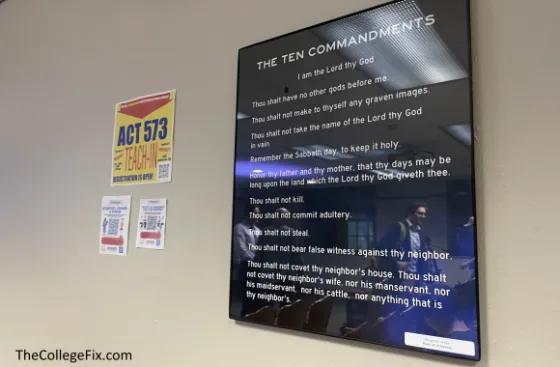
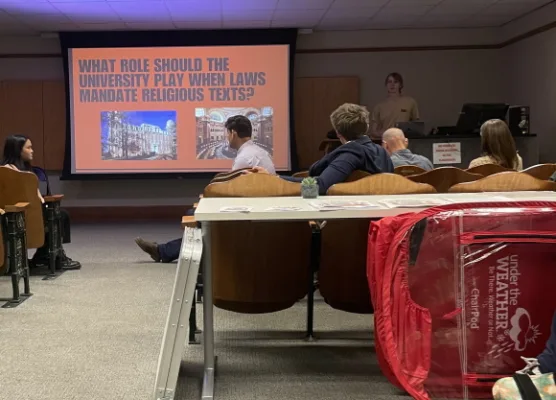
Several speakers at a recent teach-in hosted at the University of Arkansas questioned why administrators didn’t just ignore a law mandating the Ten Commandments be hung on campus, arguing the legislation is unconstitutional.
In mid-October, the University of Arkansas began installing framed posters of the Ten Commandments in hallways and classrooms in compliance with a new Arkansas law, which was passed earlier this year and requires that copies of the Ten Commandments be displayed in public schools.
The teach-in was hosted by University of Arkansas student Nathan Gray, who has hung posters on campus stating: “Attention all students: Stone v. Graham was a court case in which the Supreme Court of the United States ruled that a Kentucky statute ordering the display of the 10 Commandments was unconstitutional and in violation of the Establishment Clause of the First Amendment, because it lacked a nonreligious, legislative purpose.”
The event drew several faculty, students, and community members, whose main argument, though not always clearly stated, seemed to be that administrators could have simply ignored the law and not displayed the posters, like some other school districts have done, in part because the law is not enforceable.
Several speakers said Chancellor Charles Robinson hasn’t addressed the controversy, and the only statement from the school is that officials intend to comply with state law. Two students in the audience questioned this, saying, the law is “not in effect” and “the law is optional.”
One of the main speakers at the 90-minute event was Stephen Caldwell, associate professor of choral activities, who sponsored the U. Arkansas faculty senate resolution opposing the state law.
He suggested campus leaders should not comply with an unconstitutional law.
“You can reverse engineer the question and replace it with another law,” he said. “So let’s say the Arkansas legislature passes a law that says women are no longer able to attend school. Clearly illegal, right? Clearly unconstitutional via a 14th Amendment violation. Would the university then put that law into effect? I would think absolutely not, it’s ridiculous to say such a thing, but that’s ultimately what we are faced with here.”
Caldwell also cited Stone v. Graham as precedent, arguing Arkansas lawmakers “passed a law they knew was illegal, and the university is knowingly and willingly complying with a law that they know is illegal on its face.”
Fliers handed out at the event stated the university “chose to comply despite uncertainty and no clear penalty.”
Caldwell said his fight is personal. Caldwell, on behalf of his minor child, is among the plaintiffs who have filed a lawsuit in federal court against the Fayetteville School District, with representation from the American Civil Liberties Union of Arkansas.
“Where I became an activist is when the state came after my kid,” he said. “When they are coming after my kid, I now have a different role to play because there is no ability to stand up for his constitutional rights except me.”
“What I want for myself, for my family, and for my son is to be left alone and to be afforded the rights as a parent to raise my child with the religious freedoms that are afforded equally under the 14th Amendment to all other parents in this state and in this country,” Caldwell said.
“And what that poster represents, especially the first four commandments, especially the first, ‘Thou shalt have no other gods before me,’ is a command from the state, from the institution, from the school district, from the University of Arkansas,” he said. “It says that if you are not a Protestant Christian, you are not welcome here.”
When asked about the national motto, “In God We Trust,” which is also required to be displayed as part of the law, Caldwell said because Congress adopted it as the national motto, “there is a greater secular purpose to that,” which, according to him, is why it has been deemed constitutional.
He said he does not believe the same argument applies to the Ten Commandments.
ACLU and the Freedom from Religion Foundation warned school districts across the state not to comply with the law because if the law is ultimately deemed unconstitutional, then the individual district will be on the hook for any monetary damages for violating students’ constitutional rights, he said.
“Many, not all, took that as a very serious thing, and decided we are not going to put up the Ten Commandments until the legal process is complete,” Caldwell said.
He cited Farmington as one of the Arkansas school districts awaiting further legal clarification before hanging the posters.
In early October, U. Arkansas spokesperson John Thomas told The Fix, “While we respect that there are differing opinions on Act 573, the practice of the University of Arkansas is to comply with the law.”
At the teach-in, some speakers also explored the historical context of public displays of the Ten Commandments, claiming they are a relatively modern phenomenon.
“If you don’t recognize the name Cecil B. DeMille, he made a movie called ‘The Ten Commandments,’” said John Thorlin, assistant professor of law.
“The reason I’m bringing it up is because there is a fascinating connection to these modern Ten Commandments displays. There is no history or tradition of displaying the Ten Commandments in public places. As much as we may talk about it as a historical document, the actual showing of the Ten Commandments is a new thing.”
“And what does it date to? Well, Cecil B. DeMille wanted to promote his movie ‘The Ten Commandments,’ and he sent out as promotional material copies of the Ten Commandments to be shown and displayed in public and treated as some venerated thing. So that history and tradition dates back to the 50’s.”
No speaker voiced a case in favor of the display of the Ten Commandments at the teach-in.
The posters, purchased and donated with private funds, have slowly appeared in more and more classrooms since October.
“More are coming,” Caldwell said. “Over winter break, the rest of the 500-plus posters will be installed. The first day of the spring semester, there will be a poster in every single classroom across campus.”
MORE: U. Arkansas begins hanging Ten Commandments across campus to comply with state law