
 FEATURED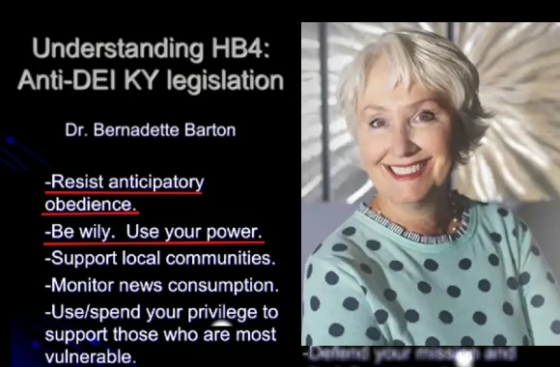
Key Takeaways
- A professor at Morehead State University urged her colleagues to resist complying in advance with Kentucky's DEI ban during a May presentation to the Faculty Senate.
- Barton told faculty to 'be wily' and 'resist anticipatory obedience'; but she didn't respond to multiple requests from The College Fix asking about these comments.
- The law prohibits DEI offices and programs at public higher education institutions, and prohibits discrimination based on race.
A Morehead State University professor told her peers to “be wily,” “use our power,” and not comply “in advance” with a new Kentucky law banning diversity, equity, and inclusion practices in universities.
Bernadette Barton (pictured), a sociology professor and gender studies director, made the remarks during a presentation to the University’s Faculty Senate on May 1, which The College Fix reviewed online.
House Bill 4 passed in March when the Republican-supermajority Kentucky Legislature overrode Democrat Gov. Andy Beshear’s veto. The law went into effect on June 30.
The law bans DEI offices and programs at public higher education institutions and prohibits “differential treatment” “on the basis of an individual’s religion, race, sex, color, or national origin,” according to the Kentucky General Assembly website.
During her presentation, Professor Barton told the Faculty Senate that she had “been involved in organizing efforts against HB4”; she also urged her peers to “resist anticipatory obedience.”
In attendance were high ranking Morehead State faculty, as well as representatives of the Student Government Association.
On a presentation slide titled “Moving Forward,” Barton said, “I think we should just be doing what we do, and then finding out if there’s an issue and dealing with it then.”
She then quoted, in her words, “an expert on fascism” and “his advice about not obeying in advance.” The quote alluded that the Kentucky state government was acting in a “repressive” manner due to the curbing of DEI in higher education.
On her next slide, “What We Can Do,” she told faculty to “resist anticipatory obedience.”
“I suggest we be wily and use our power where we can,” Barton said.
Near the end of her presentation, she stated, “I encourage people to use your voice and engage in grassroots diversity work that’s happening … in campuses all across [the] commonwealth.”
Barton additionally urged faculty members to personally get involved in advocating against the law.
“For those of us who are privileged by being white, or being male, or being heterosexual, able bodied, it would be wonderful if we could use and spend our privilege to support those who are more vulnerable,” she said. “One way to do this is to harness our connections with local people and use our social capital.”
She recommended using “diversity work” in “advising” and joining the United Campus Workers union that has a local Kentucky chapter.
The College Fix contacted Barton by email three times over the past month asking for more details on her presentation, including what she meant by “wily,” “overcompliance,” and not “complying in advance.” She did not respond.
The Fix also contacted Morehead State’s media relations office several times, asking similar questions, but it did not respond.
However, conservative education leaders expressed concerns.
Jonathan Butcher, acting director of the Center for Education Policy and senior research fellow at the Heritage Foundation, called Barton’s presentation “shocking.”
“Her recommendations to violate the law actually call for racism to continue through disguising DEI,” he told The Fix. “Taxpayers should demand that there is no place for racism like this in state university systems or anywhere else.”
Butcher said Kentucky lawmakers are working to enforce civil rights by banning DEI.
“DEI is racially discriminatory — advocating for racial preferences in higher education,” he said in a recent email, later adding, “Kentucky officials acted in the interests of all students, all skin colors by rejecting DEI.”
The College Fix also reached out to state Rep. Jennifer Decker, R-Shelby, the primary sponsor of HB4, for her views on Barton’s presentation and overall compliance with the law. She did not respond.
A spokesperson for Sen. Steve Rawlings, R-Boone, also did not respond to The Fix’s requests for comment.
Last week in a statement, Rawlings praised the Goldwater Institute, a conservative thinktank, for calling on the University of Kentucky to follow the DEI ban. The institute found that the public university had not yet adopted an institutional neutrality policy, one of the requirements of the law.
“It is vitally important for all public institutions to adhere to state law and to ensure laws are being followed in both letter and spirit,” Rawlings stated.
Meanwhile, another conservative advocacy leader said that passing the law was just one step toward ending DEI.
American Council of Trustees and Alumni fellow Steve McGuire said more time and actions are necessary to “cultivat[e] a spirit of free inquiry and intellectual diversity on campus.”
He did note that Barton’s concerns about “possible infringements on academic freedom and free speech under anti-DEI laws” are fair.
But “counseling everyone on the faculty to ‘spend your privilege’ or ‘engage in grass roots diversity work’ goes beyond those concerns and reveals a sense of political entitlement that will not disappear overnight,” he told The Fix via email.

