
 BUZZ
BUZZ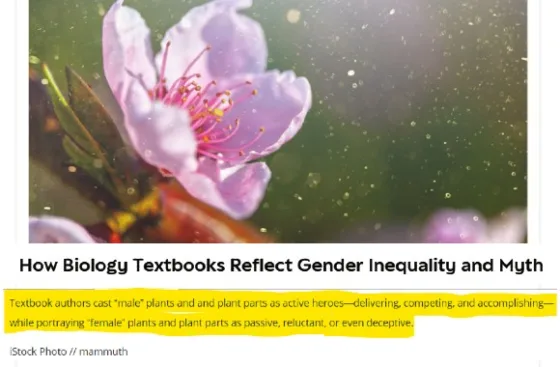
‘… when textbook authors rely on everyday narratives about women and men to explain plant sex, they make myths about gender difference appear inevitable and natural,’ scholars claim
The most popular college biology textbooks reinforce “conventional gender stereotypes” in their descriptions of plant reproduction, two Michigan State University professors wrote in a new academic article published this week.
The article, “How Biology Textbooks Reflect Gender Inequality and Myth,” appears in Contexts, a quarterly sociology magazine published by Sage Journals.
The lead author, Stef Shuster, is a sociology professor at Michigan State University whose research focuses on “gender, medicine, and feminist science, knowledge, and technology.” Co-author Shahnaz Masani is a professor of physiology at Michigan State, and the third author, Nicole Wonderlin, is a postdoctoral fellow in biology at the University of Texas Austin.
“When textbook authors rely on everyday narratives about women and men to explain plant sex, they make myths about gender difference appear inevitable and natural,” the article states.
For the study, the authors analyzed chapters describing plant reproduction in the top 15 introductory biology college textbooks published between 2018 and 2021.
“In the books we analyzed, biologists describe plant reproduction through dominant cultural ideas about masculinity and femininity that characterize various traits as naturally strong or valuable while casting others as weak or secondary,” they wrote.
Often, “male plants and plant parts” were described as “active heroes—delivering, competing, accomplishing,” but female plants and plant parts were portrayed “as passive, reluctant, or sometimes even deceptive,” they wrote.
For example, the textbooks described pollen grains (male) “as traveling long distances and overcoming obstacles to reach a potential mate and ensure reproduction.”
Additionally, the textbooks “describe pollen grains as developing a tough, waterproof coat that shields these cells during their journey to the female part of the plant,” according to the study.
This, according to the authors, reinforces the stereotype that “real men should not only be strong, but tough and ready to face difficult challenges.”
The authors continued:
… biology textbooks often portray female plant parts as protecting and supporting developing cells, just as norms of dominant femininity emphasize nurturing and caregiving roles among women. Such books depict carpels as vase-shaped organs that produce and nurture developing reproductive cells by offering them sustenance. Carpels have veins of vascular tissue that deliver nutrients from the parent plant to support development. Thus, in the rare moments when textbook authors describe female plant parts as active or consequential, they specifically underscore their nurturing roles.
The problem is that “when textbook authors rely on everyday narratives about women and men to explain plant sex, they make myths about gender difference appear inevitable and natural,” according to the authors.
“These patterns reflect broader systems of power and inequality that we often take for granted as normal or commonsensical,” they wrote.
A few textbooks are doing it right, the authors wrote – although they did not mention which ones. The article did not name any of the textbooks that they analyzed.
In their analysis, they found a few that “acknowledge[d] that plant structures play coordinated and interactive roles. For example, scientists consider pollen tube growth essential for pollen grains to reach an ovule. A small number of texts explain how chemical signals produced by cells inside the ovule guide the tube. In these instances, biology textbooks present plant parts as participants in a more dynamic and reciprocal process.”
Diana Fleishman, an evolutionary psychologist and former professor at the University of New Mexico, first noticed the study and called it out on X.
“Oh, you see a tranquil field of dandelions? Bigot!” she wrote sarcastically.
Other scholars responded with similar incredulity, one stating that “The madness keeps going further and further,” and another commenting, “Sociology is lost, but y’all knew that.”
MORE: NYU’s ‘Climate Action’ event has students ‘meditate’ with plants

