
OPINION
Andrew Gillen | Minding the Campus
One of the best parts of last year’s reconciliation bill was the introduction of an accountability rule called the Do No Harm rule that will cut off student loans for programs where students earn too little after graduation. The bar is very low. For undergraduate programs, graduates will only need to earn more than a comparable high school graduate who did not attend college, and for graduate programs, students need to earn more than those with a bachelor’s degree.
Programs that fail to meet this benchmark for two out of three years would lose access to the federal student loan programs. Nevertheless, there are many programs that do not clear this very low bar. The Department of Education estimates that about six percent of programs would fail this test, and therefore lose access to federal student loans. Undergraduate certificate programs are the most likely to fail at 29 percent. By comparison, only 1.2 percent of bachelor’s degree programs will fail.
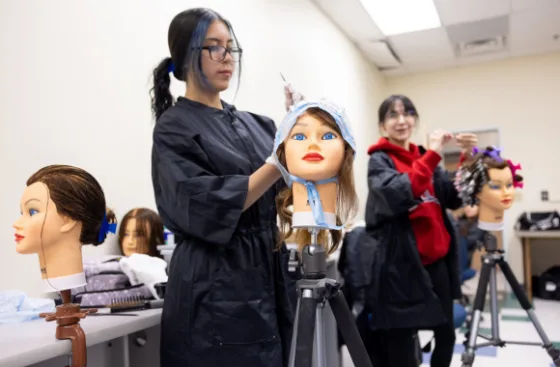
Among certificate programs, failures are further concentrated in specific fields, such as culinary services, where all programs are expected to fail, and cosmetology, where 92.5 percent are predicted to fail. Cosmetology schools have responded by launching an intense lobbying campaign to either keep this new rule from being implemented or get new legislation that exempts cosmetology from the rule.
Their lobbying should be ignored for three main reasons.
First, their claims can be quite misleading. Elizabeth Faye and Stacy Wells argue that the “beauty and wellness industry represents one of the last true pathways to middle-class prosperity.” But recall that a program only fails if its graduates earn less than a comparable worker with a high school diploma.
As Preston Cooper notes, the typical graduate from a cosmetology program earns $27,000, an income that most would not consider a pathway to prosperity. They also claim that the regulations “threatens to close 92% of beauty and wellness schools.” This is not the case. Programs that fail the earnings test are not forced to close; they simply lose access to the student loan program. Moreover, as Rachel Fishman and Ewaoluwa Obatuase point out, it is possible for these programs to maintain access to Pell grants in some cases.
The second reason to ignore the lobbying by cosmetologists is that many cosmetology schools already forgo participating in the federal aid programs. For example, in Texas, there are 824 cosmetology and barber schools, and only 117 (14 percent) of these participate in the federal aid programs. The existence and persistence of cosmetology schools that do not participate in the federal aid programs provides definitive proof that taking away access to student loans will not mean the end of cosmetology. Indeed, scholars have found that “these institutions can and do survive, and even thrive, alongside their aid-eligible counterparts.”
Third, the main effect of federal aid for cosmetology programs is to increase prices. Research by Stephanie Riegg Cellini and Claudia Goldin compared cosmetology programs that participated in the federal aid program to those that didn’t and found that the programs that utilized federal aid charged more. For example, in Florida, the state with the most comprehensive data, cosmetology programs that were eligible for aid charged 82 percent more than similar programs that did not utilize federal aid, which was roughly equal to the amount of federal aid their students received. In other words, federal aid didn’t make cosmetology programs more affordable for students; it padded the bottom line of cosmetology schools.
The bottom line is that Congress and the Department of Education did the right thing in establishing the Do No Harm rule to limit access to student loans for programs with low earnings outcomes. The accountability this rule imposes is eminently defensible on principle, easy to meet in practice, and yet effective in weeding out many financially predatory programs.
Congress and the Department should ignore any special interests, including cosmetology schools that are seeking to escape meeting even this low accountability threshold.
This column was originally published on May 20, 2026 at Minding the Campus and is reprinted with permission.

