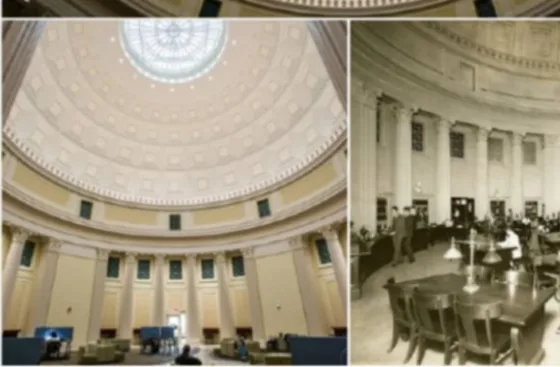
‘For MIT to be closing three of its four major libraries, demonstrates a significant retreat from [its] commitment to truth and knowledge’
This summer marks the closure of two libraries on the Massachusetts Institute of Technology campus – a loss lamented by researcher and alumnae Elizabeth Cavicchi in a recent faculty newsletter.
“For universities across time, the library was the heart, research center, and substance of the knowledge and processes of education that any university contributed to, built on and extended,” Cavicchi began in a column for the May-June issue.
The prestigious university announced the closures of its Barker and Dewey libraries this spring, citing a $300 million budget deficit, The College Fix reported at the time. MIT blamed the cuts, in part, on the Trump administration’s new 8 percent tax on university endowments.
The budget cuts also include library staff and the purchases of print books and journal subscriptions, the Boston Globe reported in March.
A third campus library, the Rotch, is “not yet closed” but is expected “to suffer the same fate” soon, Cavicchi wrote.
A December article in The Tech, MIT’s student newspaper, reported that “the staffing of the Rotch Library will be reduced in June 2027” and an employee taskforce is “planning Rotch’s future in light of reduced staffing.”
To Cavicchi, the closures represent a significant loss to the learning environment where she has studied and worked for decades.
Students miss out on significant experiences when paper texts are replaced by digital files, she wrote: “When texts are accessed solely by digitized means, without experiential basis in the original volumes, organization and material contexts, the learner is cut off from the process, extent and relationships that ground and constitute human works and knowledge.
“Those original works on paper, now being stored in dark spaces away from learner – or even staff-access, are the irreplaceable core and heart of human knowledge, history and expression,” she wrote.
Cavicchi continued:
Libraries were oases, spaces apart from the stresses, deadlines, demands of this school, where one could reflect apart, go to a familiar bookshelf, read in companionship with others and be challenged by human voices new, unexpected and concerned for nature, learning and truth. The MIT Librarians and MIT Libraries Circulation desk were available, interested and open to assist for whatever confused questions, incomplete references, tangential details or specific analyses we might be working on or stumped by [see MIT 1912, third quote below]. There were always other places to look, another staircase to climb, or resources to consider. MIT Libraries could open to anywhere and also facilitate rethinking of one’s own understanding and local contexts.
For MIT to be closing three of its four major libraries, demonstrates a significant retreat from that commitment to truth and knowledge, to engaging students and faculty with voices, works and researches across time and the present. It’s shocking that the 1916 MIT Dome, designed by Architect William Welles Bosworth to hold “the finest engineering library in the world” [still quoted in display in the Building 10 corridor] is now empty of students, staff and closed to the library experience. The MIT Dome has become a shell empty of meaning. There is not a single book or journal in the Reading room under the dome!
Read her full column in the MIT Faculty Newsletter.