BUZZ
BUZZ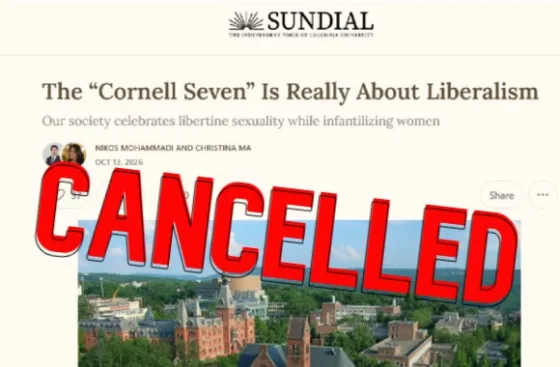
Op-ed argues the facts of Cornell case are being neglected in favor of “preferred” narrative
A Columbia University student group canceled a “press freedom” event Wednesday after two student journalists’ op-ed on the Cornell rape case sparked backlash, according to the Columbia Spectator.
The “Who Gets to Tell the Story? Press Freedom & the Public Square” event was supposed to include a panel of student journalists from various publications on campus. These included the editor-in-chief of The Sundial, which published the controversial op-ed earlier this week.
Hours before the event, the Columbia Open Discourse Alliance, a student “free speech and open dialogue” group, announced the decision to cancel, The Columbia Spectator reports.
“We felt that we couldn’t host a conversation about who gets to tell a story at this sort of a moment when so many survivors felt that their stories were under attack or weren’t being believed,” alliance president Aum Desai told The Spectator.
Safety also was a concern, Desai said. The alliance specifically named the op-ed as a reason for the decision to cancel.
“We did so not in spite of, but because of our commitment to free expression,” Desai said.
The Sundial is an independent student newspaper dedicated to free expression, and it published two opposing op-eds Tuesday about the Cornell situation.
The one that prompted backlash was written by Sundial deputy editor Nikos Mohammadi and writer Christina Ma.
They argued that the online “frenzy” over “Jane Doe’s” gang rape allegations by Cornell University fraternity brothers “neglects any and all facts of the case which disagree with the ‘preferred’ narrative, and infantilizes women.”
Ma and Mohammadi argued that personal responsibility should accompany women’s sexual liberation.
“In a liberal society, women are allowed to make bad decisions, ones that may later reveal themselves as deleterious,” they wrote. “The discourse, nonetheless, seems to omit the possibility that consensual sex, to the woman participating in it, can later reveal itself as traumatic and immoral.”
Writing at UnHeard, Mohammadi said the backlash over their op-ed shows that “cancel culture” is not really gone from academia.
“I’m a junior at Columbia University, and I’ve spent the past 48 hours under a barrage of messages … urging me to commit suicide or demanding that my career and life be destroyed,” he wrote, continuing:
Even the Columbia Open Discourse Alliance, or CODA, of which I was once a board member, has condemned us. The group wrote in a statement that “CODA exists because we believe in free expression and the open exchange of ideas, including ideas we disagree with.” But, you know, not really.
Desai with the Columbia Open Discourse Alliance told The Spectator that it wants all voices to “‘feel safe to come forward and be heard.’ In situations where there are survivors who don’t feel comfortable speaking up in a space, Desai said that that the event ‘in and of itself’ was enough to warrant its cancellation.”
But Mohammadi disagreed, calling the free speech group’s decision to cancel “distressing.”
“It is distressing that students can believe that they are in favor of ‘multipartisan ideas,’ ‘open discourse,’ and ‘journalism’ — all while silencing dissenting voices on topics that are less comfortable. Members of my generation, who were mere children when the first wave of cancel culture crested, appear to have learned nothing where it really matters,” he wrote at UnHeard.
The Cornell controversy recently was sparked by a high-profile lawsuit filed by a former student alleging she was drugged and gang raped at a Chi Phi fraternity house in 2024, The College Fix previously reported.
MORE: Cornell cancels drone show because of sexual assault fallout