
 FEATURED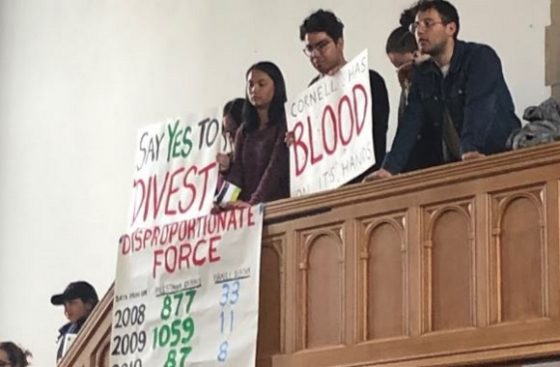
OPINION: Ivy League student leaders’ ‘hyper-focused hatred of Israel’ needs to stop
As Iranian missiles and drones strike Gulf capitals, hitting Saudi Arabia, the UAE, Bahrain, Kuwait, Qatar, and Oman alongside Israel, one might expect the self-appointed moral authorities of Cornell University’s student government to have something to say.
After all, here is a theocratic regime launching an unprecedented military assault against its own neighbors, the very same Arab and Muslim populations these activists claim to champion.
This same regime massacred thousands of its own citizens in January when they dared to protest. Iran executes LGBTQ+ individuals under its penal code, including through public hangings. And it has carried out executions at a scale unseen since the late 1980s.
Yet Cornell’s student assembly has nothing to offer: no resolution condemning Tehran for bombing Gulf states. Instead, as if on autopilot, the students are pressing forward with yet another round of anti-Israel resolutions, targeting the Jewish state even as it defends itself alongside its Arab neighbors against the region’s true aggressor power.
If Cornell’s student government truly cared about human rights in the Middle East, its resolutions would be aimed squarely at Iran, not Israel. That they aren’t tells you everything you need to know about what actually drives this movement.

On March 12, this body passed a resolution by a vote of 17-2-5 demanding that Cornell cut ties with its partner institution, Haifa’s prestigious Technion (Israel Institute of Technology), which was recently rated the top Artificial Intelligence research institution in Europe or Israel.
Cutting ties with this body would end a productive relationship with one of the top universities in the world for technology and entrepreneurship, ranking alongside Berkeley, Harvard, and Stanford, according to one major ranking. The Technion is responsible for 50% of Israel’s high-tech founders, 50% of the country’s engineers, and at least four Nobel laureates.
Eliminating a fruitful partnership with such a flagship would do an incredible disservice to Cornell’s students, cutting them off from one of the industry’s pioneers.
At the same meeting, the student government passed another resolution, 19-2-3, condemning the university administration for making world leaders available to speak to their hyper-privileged student body.
In particular, they cited one of Israel’s major female leaders, Tzipi Livni, former foreign minister and onetime head of the country’s moderate-progressive opposition. The resolution, in its original form, also condemned the university for providing a platform to the late former U.S. Vice President Dick Cheney. This provision was removed before final passage.
Clearly, in the sponsors’ eyes, Cornell’s students would be better off with fewer academic options and fewer opportunities to interact with meaningful real-world actors.
Sadly, Israel-bashing is hardly a new vice for Cornell’s student government. All the way back in the 2013-14 school year, the Cornell Student Assembly tabled a nonbinding resolution calling for divestment from Israeli companies.
Similar resolutions were rejected in 2018-19 and tabled indefinitely in 2024. The Cornell student government has tabled or rejected resolutions calling for divestment from Israeli companies during the 2013-14, 2018-19, and 2024-25 academic years.
In 2025, Cornell’s graduate student union passed a particularly egregious resolution calling for Palestinian “resistance” by “any means necessary,” implicitly blessing violence against civilians. It accused the university of complicity in genocide, and told Jews at Cornell that they were impermissibly “weaponizing antisemitism.”
Cornell’s willingness to entertain this parade of anti-Israel stunts has been very damaging for its Jewish community. An AMCHA Initiative study showed that antisemitism is far more prevalent at schools with active BDS campaigns. Cornell is home to about 3,500 Jewish students, more than 20% of the student body.
The last few years at Cornell have sadly seen a wave of anti-Jewish activity, well beyond the confines of student government. After the Oct. 7, 2023 Hamas attack on Israel, Cornell was forced to cancel classes over antisemitic threats. One student allegedly threatened to shoot, stab, and rape Jewish students, and attack the kosher dining hall. And a Cornell professor said that he was “exhilarated” by the Hamas attack, which included the kidnapping of 12 Americans.
In August 2024, anti-Israel extremists smashed glass windows and committed acts of vandalism at Cornell’s main administrative building on the first day of school, using slogans like “Israel bombs, Cornell pays” and “Blood is on your hands.”
In September 2024, more than 100 anti-Israel activists disrupted and shut down a campus career fair featuring defense contractors. Ultimately, Cornell faced a major federal civil rights probe over alleged failure to protect its Jewish and Israeli students, which ultimately cost it about $60 million to settle in November 2025.
Winston Churchill defined “a fanatic” as “one who can’t change his mind and won’t change the subject.” If the student government can’t change the subject from its hyper-focused hatred of Israel, then the administration must take action to protect Jewish students.
Shabbos Kestenbaum is a political commentator at PragerU and a former lead plaintiff in a civil rights lawsuit against Harvard University.

