
 FEATURED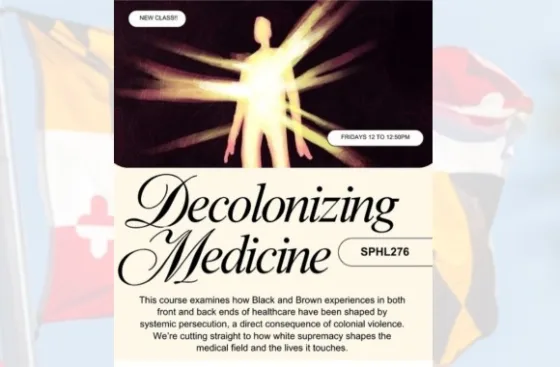
Focusing on race, gender brings ‘division into the clinical setting,’ physician says
Physicians are raising concerns over new course offerings at the University of Maryland that incorporate identity politics into various public health and medical programs at the public institution.
“Decolonizing Medicine: Steps to Actionable Change” is a one-credit undergraduate public health course, first taught in the spring of 2025 and offered again this semester.
Designed for students studying medicine, public health, or health policy, it covers how “colonial legacies” impact “global health systems” and the “concept of ‘the White body'” as the standard in medical training, according to the university registrar’s catalog. The “student-facilitated discussion-based” course also is open for registration for the current spring semester as a two-credit elective.
However, outside medical educators and field experts raised concerns about the impact of these identity politics-based courses. The College Fix spoke recently with Dr. Jane Orient, executive director at the Association of American Physicians and Surgeons.
“The title of the course as well as the description reflects the ideological view of oppressors (white colonialists) versus the oppressed (people of color), a fundamental anti-white racist view,” Orient said. “The statement that modern medicine has been shaped by ‘colonialism’ makes no sense to me … Modern medicine was shaped by scientific advances.”
Orient also expressed her concerns over the politicization of medical education and deviating from high standards of empirical data and hard science. “The purpose of medicine, according to the late Donald Seldin, is to relieve pain, reduce disability, and postpone death. It is not about social reform,” Orient said to The Fix.
“Framing medicine through Marxist concepts of oppression is destructive of the art and science of medicine,” Orient added. “Doctors are not called to judge their patients’ worth or to engage in cultural revolution.”
Dr. Kurt Miceli, medical director at Do No Harm, a nonprofit that works against the politicization of medicine, raised similar concerns.
“Framing medicine primarily through an identity‑based lens can lead future doctors to see patients through ideological categories rather than as individuals with specific clinical needs,” Miceli told The Fix in a recent interview.
He added that ideological framing is counterproductive in medical and public health education, because it removes the focus from the “rigorous biological knowledge” and “scientific depth and clinical practice time students need to become safe, competent clinicians.”
These ideologies do not “advance students’ ability to understand disease or deliver good quality care” but rather bring “division into the clinical setting,” he said.
According to the course syllabus, assignments include weekly discussion posts, papers, projects, and an ethnographic research study that aligns with “decolonizing” modern medicine.
Some of the lecture topics of the course include: medicine as “a tool of empire” and “colonial surveillance,” the “colonial erasure of indigenous healing practices,” and “racialized” and LGBTQ+ healthcare in “post-colonial contexts.”
While not a core program requirement, the course is offered along with other public health and medicine electives, such as “HLTH424 Lesbian, Gay, Bisexual & Transgender Health.”
Dr. Dina Borzekowski, the class advisor, referred The Fix to Anyi Tahi when contacted for comment. Tahi, a third-year student and undergraduate assistant in the nutritional science department, did not respond.
Meanwhile, Dr. Orient with the Association of American Physicians and Surgeons told The Fix that the ideological division of identity politics in public health education undermines the essential equality of patient-centered medical care.
“The Hippocratic ethic holds that doctors should do their best for each patient and not harm any of them,” Orient said. “Identity politics implies that some are to get less than your best to achieve some sort of social goal or to right hypothetical past harms.”
Dr. Miceli with Do Not Harm told The Fix that the ideological education risks reducing clinical rigor, adding that “a focus on social critique to the point of political indoctrination bears a significant cost, particularly when it becomes a vehicle for a political agenda.”
“It must never be allowed to overshadow or replace the scientific foundation clinicians rely on to deliver effective patient care in an objective, compassionate manner,” Miceli said. “Medical education should center on rigorous, evidence‑based training that prepares future clinicians to practice medicine rooted in science, not ideology.”
MORE: ‘Dystopian’: Academics develop tool to help IVF parents decide which embryos to destroy

