FIX EXCLUSIVES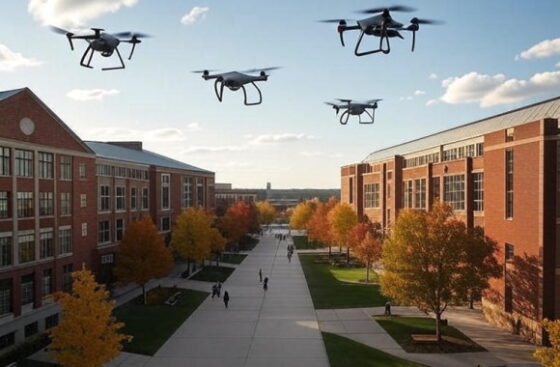
Thousands of cameras. A fleet of drones. Gun shot detection devices. Stationary and vehicle-mounted automatic license plate readers.
A major metropolitan city? No, the University of Illinois Urbana-Champaign.
The University of Illinois Urbana-Champaign’s Real-Time Information Center furnishes the institution’s Division of Public Safety with a number of technologically sophisticated tools that have some privacy experts alarmed.
The drones, gunshot detection devices, automatic license plate readers, and campus-wide system of roughly 3,000 security cameras are among the tools currently utilized at the campus, which enrolls about 59,000 students.
Social media monitoring programs and “AI-driven video analytics software” are also among the technologies being evaluated for possible future implementation, according to a document sent by Urbana Police Chief Larry Boone.
He sent it to city officials as they deliberate a proposed city ordinance to establish stricter approval, oversight, and transparency requirements for Urbana’s own acquisition and use of the kinds of surveillance tools being used by the university’s Real-Time Information Center.
According to the document, the Real-Time Information Center provides a wide array of services designed to enhance public safety, streamline operations, and support law enforcement agencies.
Regarding the facility’s impact on crime, a March 2025 post on UIUC’s Division of Public Safety website states tools used by the Real-Time Information Center assisted in locating evidence that led to the arrest of a suspect in a sexual abuse case.
Additionally, although predating the center’s establishment, a February 2023 Division of Public Safety post highlighted how university police utilized automatic license plate readers, or ALPRs, devices that indiscriminately identify vehicles and track their movements, to find stolen vehicles and make arrests in cases involving scooter thefts, a non-fatal hit-and-run, and an attempt to pull the pants off of a woman as part of a “prank.”
However, Councilman Christopher Evans said he has reservations about the Real-Time Information Center, expressing concerns that people are unaware of the facility’s capabilities and his frustration over difficulties obtaining information about it through FOIA requests.
“This is a very secretive program,” he told The Fix via email.
Communications with Evans also suggested a lack of clarity among local officials regarding whether Urbana and Champaign law enforcement are involved in the campus center’s operations or have access to its tools.
As a member of the Urbana City Council, Evans has been a staunch opponent of attempts by Urbana police to acquire technologies such as automatic license plate readers and told The Fix he supports restrictions outlined in Urbana’s proposed surveillance ordinance.
Broadly, he said he is concerned the “police, the military, and the government [are] going toward a tighter, more intrusive, more unregulated surveillance state.”
The College Fix emailed Chief Boone regarding his thoughts on the Real-Time Information Center and whether his department was involved in the facility’s operations or management. Boone did not reply.
In response to a similar email, the Champaign Police Department provided a statement noting it “is not involved in the operations or management of the University of Illinois Real Time Information Center, and do[es] not have direct access to any specialized tools utilized by its personnel.”
Regardless of what entity is operating the facility, though, privacy advocates say there is reason for concern.
David Maass, director of investigations at the Electronic Frontiers Foundation, told The College Fix in a telephone interview the University of Illinois’ Real Time Information Center “is not what we expect from a university. Usually, this is what we expect from like a mid-size city.”
Having helped document university and municipal surveillance programs for the foundation, Maass said it is not uncommon to see cameras on campuses that are intended to prevent rapes or capture information when such crimes occur.
However, having thousands of cameras, a fleet of drones, gun shot detection devices, and both stationary and vehicle-mounted automatic license plate readers go well beyond the norm and provide reason to worry.
Someone getting hurt during an unnecessary interaction with law enforcement spurred by bad intelligence is a rare but possible worst-case scenario, said Maass. However, he said, there are more common problems that come with these kinds of surveillance programs.
“Nothing in here is unintrusive,” Maass said, referring to the document sent by Boone. “There are things that are more intrusive than others, possibly. But, in general, this is a very intrusive system.”
“Social media monitoring is totally inappropriate. … They shouldn’t be gathering intelligence on students. They shouldn’t be gathering public sentiment,” Maass said. “That is outside of what a police department should be doing on campus.”
Technology that can identify a particular student and track their movements across campus would also be inappropriate and could facilitate stalking, said Maass, although he acknowledged he could not tell if UIUC was using such tools.
The potential surveillance of students for their political beliefs or engagement in First Amendment-protected activities was another concern, Maass noted, later adding campus surveillance, in general, can have “an overall chilling effect on campus life.”
Another general problem with campus surveillance, said Maass, is that oftentimes students lack any meaningful mechanism to object.
“When it comes to a school, students don’t get to vote for the dean. Students don’t get to vote for the administrators,” he said.
The College Fix reached out via email to UIUC’s Department of Public Safety and the school’s director of executive communications and issues management with several questions regarding the center and the capabilities of specific technologies it uses, but did not receive a response.
MORE: AI expert calls for financial aid overhaul after bots steal at least $13M in California