FEATURED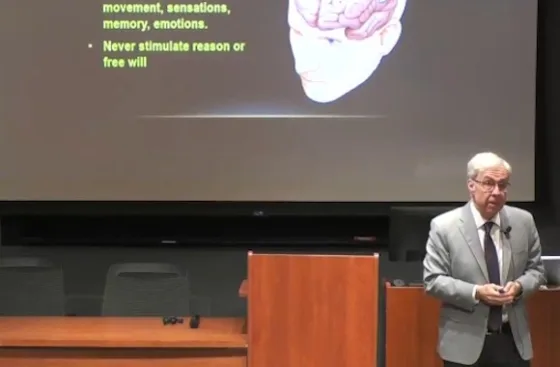
Professor of neurosurgery details unexplainable phenomena regarding mind-brain relationship during recent Cornell University guest lecture
“The human brain is incredible, mysterious, and powerful. But it’s not what makes us who we are. The soul does that.”
Such words are rare at a secular institution like Cornell University, yet a recent guest lecture at the Ivy League school centered on exactly that premise.
Dr. Michael Egnor delivered a talk titled “The Immortal Mind: A neurosurgeon’s case for the existence of the soul,” drawing from his recently published book of the same name.
The Jan. 28 lecture, sponsored by the Heterodox Academy Campus Community at Cornell, focused on how near-death experiences support “the conclusion that the mind can function during complete loss of brain function.”
It was part of the Cornell Heterodox group’s wider speaker series called “Does God Exist?”
Dr. Egnor is a professor of neurosurgery and pediatrics at Stony Brook University. He has served as the director of pediatric neurosurgery, is an award-winning brain surgeon, and was named one of New York’s best doctors by New York Magazine in 2005, according to his bio.
Egnor began his talk at Cornell by noting that he started his career as a materialist and atheist. Being raised in a secular environment, he said he “worshipped science” as a child.
But as he advanced in his career as a neurosurgeon, he said he observed that the “textbooks were all predicated on a rather straightforward materialist understanding of the relationship between the mind and the brain.”
The textbooks, however, didn’t account for what he witnessed in practice.
Egnor shared several stories of unique cases, such as a woman born with only two-thirds of her brain missing, yet she grew up to be completely normal, made the honor roll in junior high, and is now a businesswoman in Manhattan.
Another woman he cited was born without cerebral hemispheres and a cerebral cortex, which is where textbooks teach consciousness originates. Yet she is completely conscious, he said.
In another example, Egnor operated on a woman with a left frontal lobe tumor while she was awake to protect her speech center. For hours, he held a conversation with her as he removed part of her frontal lobe. According to his textbooks, he said, that should not have been possible.
He said these experiences left him asking: Does the brain fully explain the mind?
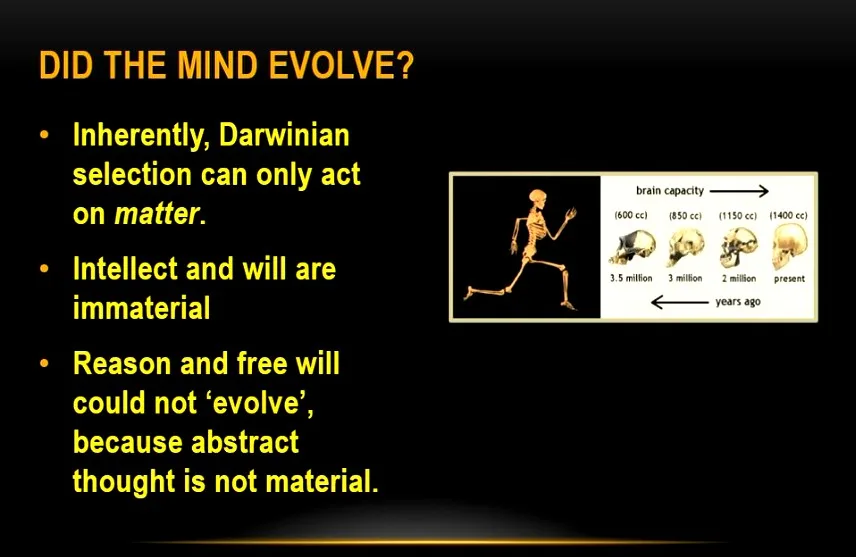
Egnor cited the journey of Wilder Penfield, a prominent neurosurgeon, as similar to his own. Penfield had grappled with the question, “Does the brain explain the mind completely?” Penfield concluded it did not, and Egnor embarked on the same journey.
Egnor explained that Penfield had once observed: “There’s no seizure that will make you do a motorsport, or there are no free will seizures where you will contemplate moral law against your will. … Isn’t that odd that most of the stuff that goes on inside our mind is never evoked by an electrical discharge in the brain?”
Egnor took to his own research, fact-checking the claims Penfield had made about 70 years prior. He said he found Penfield’s claims to be true, telling his audience at Cornell: “There’s not a single report in the medical literature of any seizure ever evoking reason or free will.”
“Movement, perception, memory, and emotion” are the only four things stimulated by a seizure, he said, adding brain mapping confirms this.
Over 400,000 brain mapping operations have been performed over the past century in the U.S., and “never in the medical literature has there been a report of brain matter that evoked reason or free will,” he said.
The conclusion that the brain does not explain the mind completely led to the question: Does the soul exist? Egnor said yes: “The human brain is incredible, mysterious, and powerful. But it’s not what makes us who we are. The soul does that.”
“If you want to find out how we’re connected to God in an intimate way, in a breathtakingly beautiful way, that science shows us, realize that reason and free will are God’s fingerprints in us,” Egnor said. “What neuroscience shows us are those fingerprints that you can’t evoke, you can’t stimulate, you can’t cut — that’s reason and free will, and that’s God in us.”
Randy Wayne, an associate professor in Cornell’s School of Integrative Plant Science, told The College Fix that the “Does God Exist?” lecture series seeks to challenge the status quo.
“Clues of the immaterial necessary for understanding the [nature] of the natural world are often overlooked at universities where materialism is the reverse orthodoxy,” Wayne said via email.
Additional series lectures included Rice University Professor James Tour for a talk titled “Scientists are clueless on the origins of life: A talk by an academic scientist who loves Jesus.”
Well-known conservative authors Spencer and Andrew Klavan also gave talks titled, respectively, “If God exists, what then?” and “What Does It Mean to Believe in God?”
Biochemist Michael Behe also gave a talk titled “The argument for intelligent design in biology.”
MORE: Cornell hosts talk on ‘argument for intelligent design in biology’