FEATURED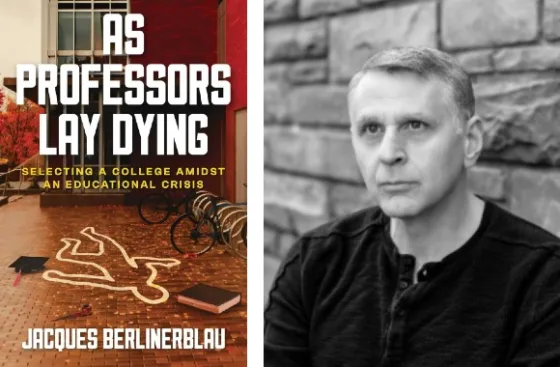
OPINION/ANALYSIS: Professor Jacques Berlinerblau writes about administrative bloat, ideological imbalance, tenure, and a de-emphasis on teaching
Students should think about their professors more.
That advice is not meant to be arrogant or self-aggrandizing. But Professor Jacques Berlinerblau believes it’s helpful in understanding how to pick a good college – and gain a better understanding about the current state of higher education.
Berlinerblau, an author and professor at Georgetown University’s Center for Jewish Civilization, recently spoke with The College Fix over the phone about his new book, “As Professors Lay Dying: Selecting a College Amidst an Educational Crisis.”
Berlinerblau, who said he’s “neither right nor left” politically, emphasized that the problems with higher education are complex and multifaceted. It’s not just professors, not just administrators, students, or politics.
Geared toward students and parents, the book is meant to be an entertaining, humorous, and thoughtful exploration of the current state of higher education, focused on professors.
It looks at tenure, administrative bloat, the dominance of “radical Left” faculty, the de-emphasis on teaching, misconceptions from the Right (he believes, for example, that most professors are not indoctrinating students), and more.
The College Fix: Let’s start with your elevator pitch. Why should students and parents read your book?
Berlinerblau: Because nobody is focusing on the crucial link that makes the college equation work or fail, and that’s professors. And I’m always a little bewildered as to why there is so little accurate information about the lives of professors that is factored into the selection process that American high school juniors and seniors are engaged in when they apply to college.
They just never think about the professors, and what they do know about the professors is just wrong, outdated, inaccurate, imprecise. So, I wanted to write a book which really explains to people who we are, for better or for worse.
TCF: The book is actually a revised version of one you wrote a decade ago. Why publish a new version?
Berlinerblau: Because everything I predicted 10 years ago came to pass.
After publishing the first version, a lot of people in my field felt personally attacked, which is absolutely fine. That’s why I have tenure. “How dare you air our dirty laundry?” That was what I got from a lot of professors. The cool professors were like, ”Oh my God, you just nailed it.”
Professors are headed toward demise as a vocation. I feel vindicated because I was saying this 20 years ago. I was shit-talked and told I was a contrarian and paranoid. It’ll never happen, we will always have tenure.
And every major trend is pointing the direction of tenure is going to be either non-existent or down to about 10 percent of a college faculty within the next 20 years. So it’s very sobering to have lived your life committed to one way of working and realize very few people are going to be able to work this way in the future. From the book, “Without tenure there can be no academic freedom.”
TCF: In the introduction, you write that students are being inadequately educated. You referenced a recent study that found for most undergraduates “gains in critical thinking, complex reasoning and written communication are either exceedingly small or empirically nonexistent.” Isn’t this, in essence, at the core of what a college education is supposed to do?
Berlinerblau: Absolutely. I always talk to my students about walking out of a class not stoked and angry and pissed. I ask them to think about how. Why did this person who I think is reasonable make this argument, which I think is unreasonable, right? So what we’re trying to induce in our students is critical thinking and thoughtfulness. And there are a lot of reasons why we have failed at this.
The college classroom was supposed to be a place where you could safely engage complexity. No longer – and for multi-causal reasons: administrative bloat, untrained and apathetic professors, poorly paid professors, anti-intellectualism.
TCF: One thing you mention is a “decades-long devaluation of undergraduate instruction.” Why has teaching been de-emphasized?
Berlinerblau: It took me a long time to understand how to reach these kids. And nobody incentivized me to do it.
In fact, people said to me, ‘You’re at an elite R1 university. Why are you wasting your time on this, man? Go teach graduate students. Go do more research.’ It’s that ethos which is one of the drivers of undermining critical thinking skills. When the professors in the classroom are apathetic or tuned out – and here’s another reason, are just so poorly paid and miserable if they’re adjuncts – that they just can’t do the work. And the work takes tremendous energy. I’ve been teaching undergraduates for 35 years.
Teaching young people these very complicated subjects and being fair and thinking about what their understanding and presenting complicated ideas, whether it’s John Stuart Mill or Emile Durkheim, whoever it might be, that’s hard. It’s a lot of work.
And I think, one, a lot of us abnegated the work. And, two, our administrators didn’t reward us for doing that work. They didn’t demand that we do this.
TCF: Your points about tenure earlier also factor into this. Now, administrative bloat is another issue you brought up in the book. It’s something we’ve also investigated at The College Fix. What do you think caused this, and what are the effects?
Berlinerblau: In the ‘60s, I think what happened is a union formed between faculty and students. And at the elite universities, they banded together. They stormed presidents’ offices. They protested about Vietnam, etc. And I think what administrators learned from that was never again. Never again would students and professors have this organic link where, if they wanted to, they could shut down a university.
So in the ‘70s, ‘80s and ‘90s, we see the massive expansion of a class of administrators, and this is at the expense of the hiring and retention of faculty, especially on those ever costly tenure track lines.
Administrative bloat has created a wall between scholars and their students.
TCF: You write about “quantity and balance” being a problem when it comes to the ideological leanings of professors, especially the “domination of the radical Left at elite liberal arts faculties.” You also make a distinction between liberal professors and those who are “radical Left.” Talk more about that.
Berlinerblau: One thing that I have been unequivocally clear about is we don’t have conservative professors in the humanities. That’s really important. We have them in business schools, right? We have them in theological seminars. We have them in STEM.
We do not have them at elite schools in the humanities. This is really bad for American higher education that we got so imbalanced. In Chapter 9, I write about this.
The imbalance is bewildering. The liberals are graying out and dying out. Your typical elite American college faculty is not liberal or conservative. It’s mostly these post-colonial far-Left scholars.
There’s no oxygen to breathe for people that don’t want to work within their paradigms. And that was the mistake we made as the professorate. The Right has, I think, overdone its response to the problem. But I also understand why they’re so upset. Their opinions are just not reflected.
TCF: You mentioned wanting to talk about a thought you had regarding the Charlie Kirk situation.
Berlinerblau: First, I was horrified by this. To me, it’s just one of these images that you cannot get out of your head.
But something I was thinking is, if we had conservative professors on campuses, guys like Charlie Kirk wouldn’t be invited. Let me explain.
People misunderstand what a university is. We’re not about free speech per se. We’re about academic free speech. I mean, activists and protesters can be there, but that’s really not what universities were built to do. Universities were built for the dissemination of knowledge by credentialed experts to the next generation.
So all the issues that Kirk was exploring have been explored by credentialed scholars. And that’s what I would want to hear on a college campus.
What I’m saying is that if you had adequate or proportional representation of conservative scholars in liberal arts faculties across the country, then you wouldn’t need to bring conservative non-scholars to campus to this degree. The differences between scholarly and non-scholarly discourse are immense. What I find odd is how academic spaces have been transformed into spaces where very different types of speech acts take place.
TCF: A final question. What are some things that you would challenge students to do better?
Berlinerblau: Read books. The screen has massacred the page.
I teach some of the brightest kids in the world at Georgetown. But I’m noticing year after year, they almost have this allergy to physical books. I had to explain to them what the library was the other day. ‘No, you don’t only go there to study. You’re supposed to sit in front of a stack for hours and pull books off the shelf and find the ones that you like.’
I also want them to write more and explore the joys of failing at writing and then succeeding at writing.
Editor’s note: The interview has been edited for length and clarity.