
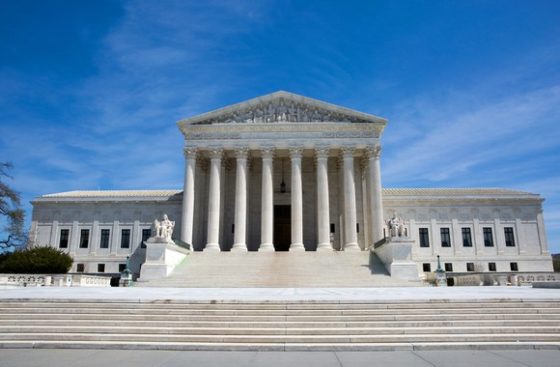
The Supreme Court case Trump v. Barbara has given a platform to a growing number of conservative legal scholars to challenge the mainstream view of birthright citizenship and support President Trump.
The court heard arguments over President Trump’s executive order on birthright citizenship on April 1 and will rule in the coming months whether it violates either the Constitution or federal naturalization law.
The order prohibits federal agencies from recognizing citizenship for children born in the United States after Feb. 20, 2025, if their mother is unlawfully present and the father is neither a citizen nor a lawful permanent resident, or if the mother’s presence is temporary and the father lacks that status.
Enforcement of the order was paused by the lower courts, leading to the battle now before the Supreme Court.
The Birthright Citizenship Clause of the Fourteenth Amendment grants citizenship for “all persons born or naturalized in the United States, and subject to the jurisdiction thereof.”
Over the months following the Court granting the case, eighteen briefs have been filed in support of the administration.
“That several prominent law professors have come out over the past year, including a few in the past month, in varying degrees of support for the Trump Administration’s birthright citizenship executive order, shows that their position is serious,” University of Minnesota law Professor Ilan Wurman told Fox News Digital in April. “The Supreme Court cannot simply rely on the conventional wisdom. It will have to show its work.”
Wurman, author of an amicus brief that supports the order, said in an interview with The College Fix that he was surprised at the ambiguity of the justices during oral arguments.
“What stood out to me is how some of the justices really did not seem to engage with the enormous legal scholarship on the topic. This is a generationally important case and they should do all the reading they can before rendering a decision,” he said via email.
Dan Backer, counsel of record for the Coolidge Reagan Foundation’s amicus brief in support of the order, told The College Fix that the question is “whether our nation has magical dirt.”
“If you can walk across an imaginary line to give birth and the child, just being born inside the lines on our magical dirt, gains all these amazing rights, privileges, and benefits that she wouldn’t if born 10 feet away, is silly,” he said.
“The dirt isn’t magical. Citizenship is a meaningful status, and we use Birthright citizenship, ‘born inside the lines’ as a proxy for convenience, but that convenience doesn’t work when the lines are crossed by people who it was never intended to apply to,” he told The Fix.
Part of the divide Backer sees among scholars on the right comes from libertarian ideology.
“Libertarian-minded scholars tend to dislike borders and think in terms of principles of governance and individual liberty first,” he said. “Conservative-minded ones tend to frame that in the context of cultural institutions and shared national heritage that aligns them more closely with the administration argument. Also, smart people like to argue about smart things, even if it’s an outlier position.”
He said this phenomenon may lead to the wrong decision in this case.
“I worry about the potential for a grand compromise that throws up its hands to protect those here now illegally and their children, while pretending that they can meaningfully, in a practical, operational sense, deny it to future illegals including those that flood the gates in the meantime, out of fear at the complexity of having to figure out whose birthright claims are and are not legitimate now,” he said.
“If birthright citizenship doesn’t exist, that’s a lot of people you have to reckon with. The Court is not a good mechanism to work out those kinks. The complexity of managing the outcome of the right decision may lead to the wrong decision.”
Chris Hajec, director of litigation at the Immigration Reform Law Institute, went beyond the administration’s arguments in his brief.
“Our position – that United States v. Wong Kim Ark held that aliens physically present in the country are subject to the jurisdiction provided that they have the permission of the United States to reside here – is somewhat more expansive than Trump’s executive order,” he told The Fix.
While the order only addresses children of aliens “unlawfully present,” Hajec’s brief extends to other situations.
“Our view would include foreign students, temporary workers, and others permitted to reside here for years as subject to the jurisdiction, though it would exclude illegal aliens and tourists,” he said.
After listening to oral argument, Hajec said he found the conservative justices unprepared.
“What stood out for me from oral argument is that the conservative justices had no handle as yet on how they would decide this case,” he said.
The shift among conservatives to even talk about the issue at all is remarkable, UC Berkeley law Professor John Yoo told the New York Times in March.
“A lot of people, when Trump first started talking about it, thought this is crazy,” Yoo said. “But in the intervening years, a lot more serious people are taking it seriously.”
MORE: Don’t punish Harvard Republicans for Muslim criticism: free speech expert

