EDITORS' CORNER
Bad trustees, social media to blame for free speech erosion, panelists say
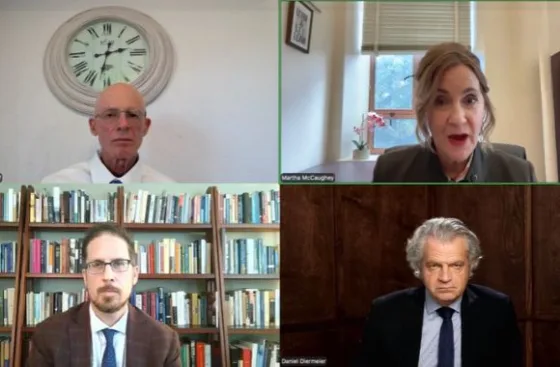
The campus fallout following the October 7 terrorist attacks exposed a crisis in higher education that demands “urgent action,” Vanderbilt University Chancellor Daniel Diermeier said during a panel on academic freedom this week.
While there have been recent “good developments,” such as Yale’s self-critical report, universities “need to do a lot more” to bolster free speech on campus, the chancellor said.
The webinar, hosted by the American Council of Trustees and Alumni, featured leaders from universities that “stand out as extraordinary champions of free expression and diversity of thought,” according to ACTA.
“Purdue University, the University of North Carolina–Chapel Hill, the University of Wyoming, and Vanderbilt University have all achieved scores of at least 18 out of 20 on ACTA’s Gold Standard, thus vastly exceeding the national average of 11 and making them ACTA’s first cohort of Gold Standard Universities,” the event description states.
Diermeier said the recent broader implementation of institutional neutrality is a good start, but the idea has been misinterpreted.
“Institutional neutrality is usually … interpreted as statements by the president … And that’s way too narrow because the point of institutional neutrality … is really the idea that there’s no institutional orthodoxy,” he said.
He added that many universities that have adopted institutional neutrality have been “inconsistent” by still allowing for divestment.
Further, Diermeier said he is worried about the “replacement of scholarly rigor by activism” and “the erosion of standards in fields” like the humanities and social sciences.
“That’s a correlated development, but it is really serious because that’s what happens in the classrooms, that’s what happens in the research practice, and that needs to be addressed as well,” he said.
He also said another issue contributing to the lack of free speech on campuses is that high schools are not preparing students “for such a culture.”
Students are worried they will be ostracized for challenging prevailing viewpoints in class, so “at the root, this is really a problem about trust,” he said.
To help build this culture of trust, the school started Dialogue Vanderbilt, which provides staff and students with tools and opportunities to engage in respectful debate, according to its webpage.
Similarly, the University of Wyoming hosts a Free Expression, Intellectual Freedom, and Constructive Dialogue Program, directed by Martha McCaughey.
McCaughey said she works to ensure faculty are “scholar optimists, but not scholar activists.”
She said they discuss questions such as, “How do you design the rubric that shows students… that a student with a left-wing opinion and a student with a right-wing opinion… is just as likely to get an A because that assignment isn’t grading them for their political views?”
She also said the school recently removed “suspicious language” in an academic policy to protect free expression.
“I think we had said students weren’t allowed to say anything that ‘diminished the worth of another human being.’ There’s a good sentiment behind that, but … it would be very difficult to enforce that … without violating their First Amendment rights,” she said.
Adding to these concerns, Purdue University Interim President Mitch Daniels said higher education is “still a long, long way from living up really to its own original principles in this realm.”
He blamed much of the issue on “trustees who didn’t do their job.”
Echoing Daniels, University of North Carolina Chapel Hill trustee Marty Kotis said trustees are often “rubber stamps” who serve on the board “for the wrong reasons.”
“We’re here to find the blind spots and address them and bring a different perspective into the room,” Kotis said.
He also pointed to social media as another factor to blame for the erosion of free speech on campus, as it has significantly impacted students’ brains and development.
“And so I think we’re gonna have to adjust and factor that in and study how we can overcome this pervasive social media pressure that’s bombarding them every which way,” he said.
Kotis said UNC’s School of Civic Life and Leadership is currently studying this issue and working to combat it.