
 FEATURED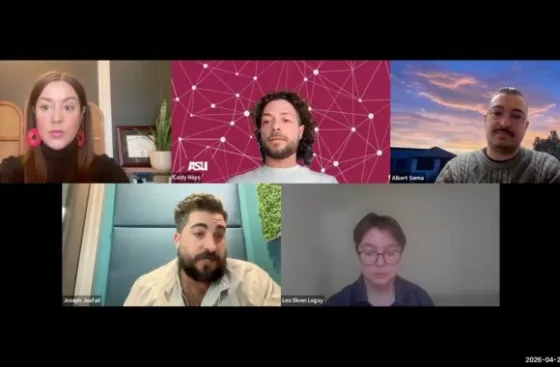
UPDATED
TPUSA ‘focuses a lot on oppressing trans people,’ speaker says
The Center for Media and Communities at Arizona State University hosted an online event on Wednesday during which speakers called for more transgender journalists and criticized “conservative media” for its “politicized” coverage of gender issues.
Chelsea Reynolds, director of the Center for Media and Communities, said the event aimed to “celebrate transness” and counter “harmful narratives that places like Turning Point …. catalyze.”
Reynolds also said transgender individuals need to insert themselves into the journalism sphere to report on national issues affecting the community.
“We need to show up in spaces that sometimes journalists don’t show up in. We need queer reporters on our teams … We need to hire trans people to tell trans stories and to tell other stories, housing stories, health stories, political stories, all the stories,” Reynolds said.
Speaker Tre’vell Anderson, the president of the Trans Journalists Association, said TJA loves to force conservative media outlets “to issue corrections when they are reporting on wild foolishness.”
Anderson said TJA offers a newsletter that provides guidance on how to cover trans-related stories in the news cycle.
For example, one newsletter from several months ago was “about understanding anti-trans misinformation around mass shootings and extremist activities,” the speaker said.
The group also provides information on “how to write using gender-neutral pronouns” and “how to think about properly gendering people,” Anderson said.
Further, Anderson criticized political bias in coverage of transgender-related topics, saying it’s important to distinguish between “politicized language” and stories that ensure the “audience is appropriately understanding what we are talking about.”
When asked about having transgender individuals in newsrooms as reporters, independent transgender reporter Leo Legay said, “we need as many trans journalists as possible in newsrooms, even if they’re not specifically covering these issues.”
Legay added it would be helpful “just to have that perspective in the newsroom or at the editorial level.”
He said Northern Arizona University is doing that “very well.”
Discussing the atmosphere on campuses across the country, Legay criticized Turning Point USA, saying that it “focuses a lot on oppressing trans people and transphobic rhetoric.”
Cody Hays, a “queer media scholar,” suggested journalism schools “stop treating queer coverage as like a one-off diversity workshop … and start treating it as reporting competency.” It should be embedded in the curriculum, Hays said.
Hays also criticized online “queer and trans surveillance.”
“Meta has started to crack down and delete creator accounts, news organization accounts, and sex toy company accounts for violating platform guidelines… Just compare that to some of the content that’s being shared by Calvin Klein and other things that are equally sexualized but not necessarily queer,” Hays said.
Shifting the discussion to legislation, the scholar said a trans bill tracker shows that “30 anti-trans bills have already passed this year, and there [are] 762 currently under consideration.”
“Last year, there [were] over 1,000. So if we look at this from 2021 to 2025, a 568% increase in anti-trans legislation,” Hays said.
Another event speaker also condemned anti-transgender legislation.
Albert Serna, founder of the Los Angeles Center for Investigative Journalism, said some bills masquerade under different names that appear to grant rights to other groups of people at the expense of transgender individuals.
“They’re not outrightly saying, you know, this is a trans bill that we want to pass or trans ordinance. It’s more like parents’ choice, bathroom bills, things like that,” Serna said.
The College Fix reached out to Reynolds for comments following the seminar but did not receive a response.
The event was titled “Telling Trans Stories: Disrupting Sensationalized Media Coverage.”
It aimed to share “reporting strategies” for “LGBTQIA+ journalists” and “de-sensationalize trans issues,” according to its description on the school’s website.
“Prominent narratives sensationalize trans identities, using stories of individual transgender subjects or de-transitioners to frame ‘gender ideology’ as a threat to society,” the description states.
Editor’s note: The spelling of Cody Hays’ name has been corrected.

