
 FEATURED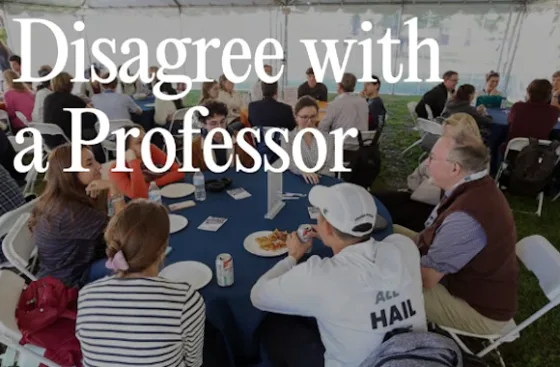
End-of-life treatment should be allowed. Mail-in voting should be banned. The world is safer than ever before. Wildfires should burn without intervention.
These are just some of the hot-button topics Stanford University professors and students recently grappled with over lunch as the independent-minded scholars hosted the “Disagree with a Professor” event at the prestigious institution.
The April 28 event represents a budding new series for Heterodox Academy, a nationwide scholarly group dedicated to advancing and protecting academic freedom, free speech, and constructive dialogue.
For Stanford, it was the inaugural “Disagree with a Professor,” and professors there told The College Fix they hope to see continue it.
“I think the big thing about the event was that it was totally separate from regular classes, so the professors felt free to take strong positions on big questions rather than feeling that everything has to be nuanced and carefully backed up, and the students felt free to push their challenges,” Professor of Classics Ian Morris told The College Fix.
“As it turned out, there wasn’t all that much disagreement in the two groups I was with, but they were still very open and free-form conversations,” Morris said via email.
“One of the big challenges in all kinds of settings is learning how to be comfortable with someone who disagrees strongly with views that we maybe hold very strongly ourselves.”
According to Heterodox Academy, “Disagreement is a cornerstone of intellectual growth, yet many students rarely — if ever — disagreed openly with a professor.”
The academy’s “Disagree with a Professor” program aims to upend that paradigm.
“The conversations I had with students were wide-ranging,” Stanford political science Professor Emilee Chapman told The College Fix.
“We certainly disagreed, but sometimes it was surprising why,” Chapman said via email. “In some cases, it was a matter of how we would balance the trade-offs among different values, and in other cases it was more about how we should interpret the available evidence.”
“People tend to assume that disagreement will be tense and unpleasant, and so they avoid it,” she added. “Either they simply don’t talk to people they think will disagree with them, or they pretend to agree, or they may even mis-interpret what the other person is saying to minimize the disagreement.”
“Some of learning to disagree is just about exposure, but I think you can also learn to disagree better, and by that I mean to disagree in a way that actually helps both people get more out of the interaction,” Chapman said.
Stanford Professor Robert Siegel said he thinks “anything that facilitates productive student-faculty interactions is a good thing.”
“I certainly encourage independent thinking in my classes and I believe that most faculty feel the same way,” said Siegel, a microbiology and immunology professor.
“I really enjoyed talking with the students,” Siegel told The Fix. “I found it particularly rewarding that several students approached me about continuing our discussions.”
When asked about why learning to disagree is important in today’s social or political climate, Siegel told The College Fix that “far more compelling than disagreement, is the ability to marshal data and [the ability to create] compelling arguments that would make for productive resolution of disagreement.”
“So we might reasonably ask, when is disagreement an end in itself? And when does such disagreement result in productive dialog?” Siegel said.
In the sciences, he added, “a great many disagreements can be resolved by proper analysis of existing data or by collecting additional data.”
The “Disagree with a Professor” series was developed by HxA member Mary Kate Cary and her colleagues at ThinkAgain at University of Virginia. The UVA series is billed as “highly popular” among students and faculty there.
“We recently had Mary Kate Cary host an HxA workshop to explain to other members how they could start this series on their own campuses,” Nicole Barbaro Simovski, director of communications for Heterodox Academy, told The College Fix.
“Our Stanford chapter is the first of what we hope will be many chapters to host ‘Disagree With a Professor’ events on campus [and] we will soon release a how-to guide on our website to further assist faculty in hosting these events on their campuses,” she said.
For Professor Chapman, she said that while “a lot of people think disagreeing well is mainly about keeping your cool or finding common ground, and those can be valuable, but disagreeing well I think is really about listening, learning to ask good questions and to check in with the other person to make sure you understand what they’re saying.”
“Jumping in to try to find common ground too quickly can actually get in the way of that,” Chapman said.
MORE: Harvard paid Claudine Gay $1.5M in her first full year after resigning

