FEATURED
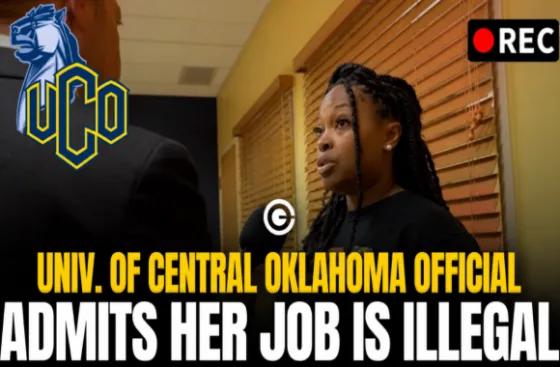
Hidden-camera footage of a University of Central Oklahoma employee discussing how diversity, equity and inclusion activities continue at the school despite a state law restricting it has prompted questions and concerns.
The conservative activism group Accuracy in Media on Oct. 5 published a four-minute edited video showing employee Shatima Bennett telling an undercover investigator for the group that she assists with DEI programming by allowing the students to organize the efforts.
“Technically my whole job is illegal if you want to be honest,” Bennett said in a conversational manner.
She said the law “just made our jobs a little harder.” She is referring to Senate Bill 796, approved in 2025, which eliminated public funding for Diversity, Equity and Inclusion programs at Oklahoma’s public colleges and universities.
But DEI “hasn’t stopped because there are ways that the students are able to honor it,” Bennett said in the video. “These are student-led organizations. That’s kind of how it’s made legal.”
She went on to cite an “MMIP” protest, which stands for Missing and Murdered Indigenous People’s Protest.
“Me as a staff member, I didn’t plan it, all I did was advise our students on how to do it,” Bennett said in the video, which was taken in February of this year.
She appears to be speaking to a young woman off camera who identified herself as a transplant from California who used to work in a DEI office.
Bennett said she did “support” the MMIP protest by walking in it, but she was not the one to put it on “because I’m faculty and staff and I’m paid.”
“I kind of go through loopholes for certain stuff, but it’s still happening,” she said of DEI programming. “Nothing I’ve attempted to do has been completely shut down.”
Neither Bennett nor the university’s media affairs division responded to requests for comment from The College Fix.
When confronted on camera at a later date by Adam Guillette, president of Accuracy in Media, Bennett said “my job is not illegal.” She declined to discuss the issue further on camera.
Currently, Bennett is listed as student engagement coordinator for the Enrollment & Student Success division on her online staff bio page.
Guillette told The College Fix he does not know what Bennett’s job title was before Senate Bill 796 took effect, but that regardless, she has not stopped assisting with DEI programming.
“They just simply change their business cards, change the names of the departments, and keep doing the same work,” Guillette said.
Guillette said the university has not responded to his video. He said he thinks campus officials are “hoping nobody will notice it” and that state lawmakers will not act.
Senate Bill 796 also requires institutions to review their programs for compliance and submit annual compliance certifications.
“If they refuse to speak with journalists on the record, they’re inviting more hidden camera investigations to capture them off the record,” Guillette said.
Guillette said the footage shows Bennett describing how student-led organizations can continue activities that state-paid employees may be restricted from organizing, adding this is why his group has engaged in “hidden camera investigative journalism.”
Guillette rejected criticism that AIM’s videos are heavily edited, saying hidden-camera reporting is an honest form of journalism.
AIM has conducted several dozen undercover video sting operations over the last two years focused on higher education and state lawmakers.
“More than anything, they think they’re talking to an ideological ally,” he said of how employees continue to get caught on camera admitted to DEI activities despite laws banning it.
Guillette said he does not object to student activism but believes staff are often behind it.
“I think student groups should be able to engage in any peaceful activism they would like to engage in,” he said. “However, it’s clear — because we see this in many states — that these student groups are merely the face of activism that’s truly being coordinated by university staffers.”
Asked whether Bennett’s job is illegal, Guillette said that if it is not, “it should be.”
He argued that education should prepare students for careers, not serve as political activism.
“The role of education should be to promote academics and to prepare people for a future career and a successful life beyond university; it shouldn’t be to work as a political activist, creating division and hatred amongst people,” he said.
“If they want to engage in this kind of work, go do it at the Democratic Socialists of America. Don’t do it on my tax dollars.”
Guillette said AIM has released about 65 hidden-camera videos about higher education in roughly 10 states. He said the videos have led to firings and suspensions, including a dean of students at UNC Asheville, five or six administrators across North Carolina, multiple employees in Texas, and a couple in Florida.
He compared the undercover investigations to police body cameras.
“I wish politicians and bureaucrats wore body cameras,” he said. “The next best thing is a hidden camera investigative journalist.”
He said more investigations are planned, including more in Oklahoma.
“We’re very confident that we’re going to be able to deliver accountability to universities across Oklahoma,” he said.
Guillette said one solution for Oklahoma would be to adopt a North Carolina-style DEI ban that extends to curriculum and carries a $10,000 fine for each infraction.
AIM describes itself as a nonprofit that uses undercover journalism and citizen activism to expose what it calls corruption and law-breaking.