FEATURED
‘Forcing students to affirm the university’s views imposes an enforced orthodoxy on campus,’ attorney tells The College Fix
Case Western Reserve University is facing backlash from a free speech organization over a new requirement that student groups align their missions with the university’s core values, including “diversity” and “inclusiveness.”
The Foundation for Individual Rights and Expression sent a letter to university President Eric Kaler on Oct. 15, urging the private Ohio institution to rescind the directive, arguing that it contradicts the university’s own commitments to freedom of expression and association.
The dispute comes from a Sept. 8 email sent to student organizations directing them to transfer their constitutions to a new university-approved template.
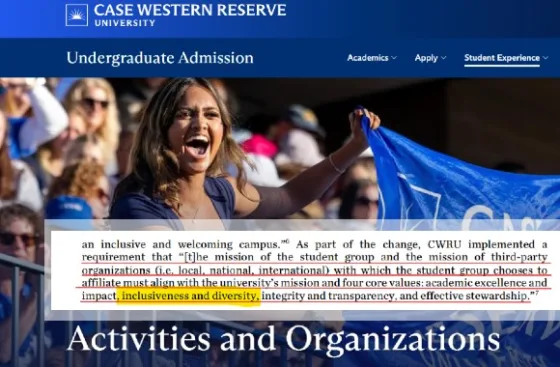
According to FIRE’s letter, the template requires student organizations, along with any outside organizations they affiliate with, to align their missions with the university’s four core values: “academic excellence and impact, inclusiveness and diversity, integrity and transparency, and effective stewardship.”
FIRE argues that the policy places students in a position where maintaining official recognition could depend on whether their organizations agree with the university’s views.
Asked if the requirement could disproportionately affect some student organizations more than others, FIRE Program Counsel Madeline Bartsche told The College Fix, “It certainly will.”
Bartsche expressed concern about the consequences for groups with differing viewpoints, particularly student organizations affiliated with larger political, religious, or advocacy groups.
“Forcing students to affirm the university’s views imposes an enforced orthodoxy on campus,” she told The Fix. “The policy also threatens to strip recognition from groups affiliated with national religious, political, or advocacy organizations merely because CWRU believes the national organizations’ missions diverge from its own.”
Case Western has more than 300 student organizations, including College Republicans, College Democrats, Case for Life, and #MeToo, according to FIRE’s letter. Although these groups represent different political and social perspectives, the university’s new requirement calls for both their missions and those of their affiliated organizations to align with its stated values.
Bartsche said the requirement raises concerns about compelled speech, too.
“As written, the policy appears to require students to affirm CWRU’s views. Compelling students to say what they may not actually believe obviously runs contrary to free speech principles,” she told The Fix.
While Case Western is a private university and is not generally bound by the First Amendment in the same way as public institutions, FIRE maintains that the school’s own policies establish clear expectations for protecting students’ expression.
The university’s freedom of expression policy promises to protect freedom of speech, thought, expression, and assembly. Its student code of conduct also identifies the free exchange of ideas as a core institutional value.
Bartsche told The Fix that the new requirement is difficult to reconcile with those promises.
“CWRU cannot square this new viewpoint based requirement with its stated commitments to freedom of expression, thought, and assembly. Recognizing students’ right to hold and express opinions means the right to hold and express their own opinions, not merely those of campus administrators,” she said.
FIRE’s letter argues that students should be free to organize around their own beliefs, and compares the requirement to a hypothetical university policy mandating that student organizations endorse patriotism or denounce communism to receive recognition.
The campus legal group argues that the underlying problem would remain the same regardless of which values the university chose to promote.
In response to questions from The College Fix, Case Western’s media relations office confirmed receiving FIRE’s letter.
“We have received and are in the process of reviewing their concerns,” the office stated in an email last week.
The university did not respond to questions about how the policy would be enforced, whether organizations with differing views could lose recognition, or whether administrators were considering changes to the requirement.
FIRE requested that Case Western provide a substantive response by the close of business on Friday. On Monday, FIRE’s media relations office told The Fix it had not received a response from the university yet.
Bartsche said the issue also extends beyond Case Western to broader questions about the independence of student organizations at private universities.
“These types of viewpoint based requirements for student group recognition undermine freedom of association for students across American college and university campuses,” she told The Fix.
MORE: Case Western Reserve University offers paid social justice fellowships