FEATURED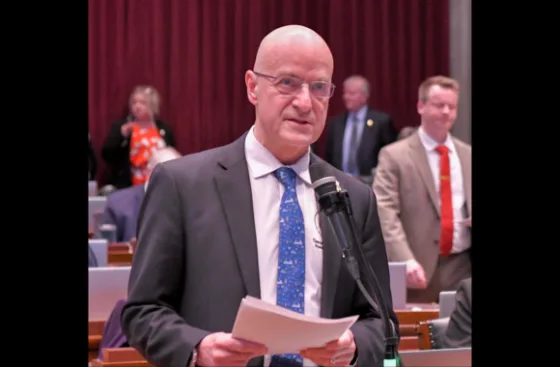
Expert says vagueness and viewpoint discrimination in law create legal problems
Missouri has adopted a new definition of antisemitism to combat anti-Jewish discrimination and harassment in public education. However, a leading free speech group says the definition runs afoul of the First Amendment.
The law, which will go into effect for this upcoming school year, requires public schools and universities to treat antisemitism as any other kind of racial discrimination. To this end, the legislation uses the International Holocaust Remembrance Alliance’s “working definition” of antisemitism.
That definition, now legally incorporated under House Bill 2061, says antisemitic comments can include comparing Israel’s actions to that of Nazi Germany. It is similar to a federal bill called the Antisemitism Awareness Act. The bill drew criticism from free speech advocates who criticized its overly broad prohibitions, and even from some Jewish conservatives such as the Daily Wire’s Ben Shapiro.
According to the IHRA’s website, antisemitism constitutes “a certain perception of Jews, which may be expressed as hatred toward Jews.”
“Rhetorical and physical manifestations of antisemitism are directed toward Jewish or non-Jewish individuals and/or their property, toward Jewish community institutions and religious facilities,” the definition continues.
HB 2061 adopts the definition and some of its examples, notably criticism of Israel. Such criticism must be “similar to criticism toward any other country” to not be considered antisemitic.
The bill’s supporters argue that the legislation is needed to protect Jewish students from unjust discrimination and harassment.
“Jewish students that have nothing to do with what is happening in Israel and have no influence or impact on what is happening in the Middle East should be able to go about their studies without fear, harassment or intimidation,” the bill’s sponsor George Hruza, a Republican state representative, The College Fix via email on May 16.
Hruza (pictured) said “almost one half of Jewish College students hide their Jewish identity for fear of harassment simply for being Jewish.”
“We heard many examples of antisemitic behavior from Missouri students during the public hearings,” he continued. “Some students had to change schools or transfer to a Jewish school to get away from antisemitic harassment.”
Six of Hruza’s family members, including his maternal grandparents, were killed at the Auschwitz concentration camp during the Holocaust.
Sarah Perry, the vice president for Defending Education, praised the new law for establishing a “targeted anti-harassment and anti-discrimination policy, not a broad bias-response mechanism.” Her group has been critical of bias response teams and sued to stop them.
“It focuses on prohibiting conduct that meets the legal threshold for harassment or discrimination—specifically, actions that materially impede students’ or employees’ ability to participate in educational activities or create a hostile environment—while treating antisemitism with the same rigor applied to other protected characteristics, such as race,” she wrote in a statement to The College Fix on May 18.
Rabbi Ze’ev Smason, the vice president and chairman of the Missouri chapter of Coalition for Jewish Values, said his organization was “instrumental in bringing HB 2061 into law,” noting long efforts to testify and advocate for the bill’s passage.
For CJV Missouri, the central reason for supporting the bill is that “if antisemitism isn’t defined, harassment and discrimination of Jewish students would continue.”
“It does not prohibit criticism of Israel or restrict political viewpoints, and it does not give schools license to punish students or faculty for expressing opinions on public issues,” Rabbi Smason said.
The bill’s opponents agree the state government should seek to address antisemitism in education. However, they also argue that the law conflicts with free speech rights and ultimately undermines anti-discrimination efforts.
“A law is unconstitutionally vague when ordinary people would have to guess at its meaning or would easily disagree about its application,” Michael Hurley told The Fix via email on May 16. He’s the government affairs counsel at the Foundation for Individual Rights and Expression.
Hurley cited the Supreme Court case Grayned v. City of Rockford where the court ruled that legislation must “give a person of ordinary intelligence a reasonable opportunity to know what is prohibited, so that he may act accordingly.”
According to Hurley, the antisemitism definition “offers no clear guidance as to what speech or conduct is prohibited. A dozen campus administrators could interpret that definition in a dozen different ways, inviting uneven application that will chill protected expression.”
In addition to vagueness, Hurley argues that some of the examples constitute viewpoint discrimination, such as comparing “contemporary Israeli policy to that of the Nazi regime.”
“Americans frequently draw such comparisons to other governments, including our own,” Hurley wrote. “A special exception for Israel is inherently viewpoint discriminatory.”
“Embedding a viewpoint-discriminatory definition into enforcement policy risks collapsing the essential distinction between protected expression on the one hand, and unlawful discriminatory conduct on the other,” he added.
Hurley also pointed out that even the IHRA definition’s author, Kenneth Stern, warned governments against using the definition in a New York Times op-ed in 2016.
Bill sponsor says law does protect free speech
In his comments to The College Fix, Hruza addressed the argument that his legislation conflicts with free speech, noting that it proactively considers conflicts.
“The bill explicitly protects free speech in 3 distinct places,” Rep. Hruza wrote. “The bill does not regulate antisemitic and otherwise offensive speech.” Rather, under the law, public schools must “address antisemitic behavior (not speech) that harasses and intimidates Jewish students.”
Hruza gave examples to illustrate his point, noting the distinction between speech and harassment.
“A table with antisemitic material, misinformation, disinformation or demonstrating with various antisemitic or racist slogans on signs or through a megaphone is protected speech (as long as proper permits are obtained),” the state representative explained.
“Stopping a Jewish student in the hallway and telling him: ‘You dirty Jew, we will get you for all your crimes’ will not be permitted and the public schools will have to address it,” he added.
However, the bill’s protections for free speech do not satisfy Hurley’s concerns.
“No disclaimer can cure the vagueness and overbreadth of a definition that singles out certain political viewpoints as evidence of discriminatory intent,” he explained. “In practice, institutions still over-enforce to avoid investigations, penalties, or political scrutiny.”
“We agree that antisemitic discrimination, like all forms of discrimination, is a serious problem that the state should address,” he continued. “However, the approach taken by H.B. 2061 risks undermining both constitutional free speech protections and anti-discrimination law.”