
 FEATURED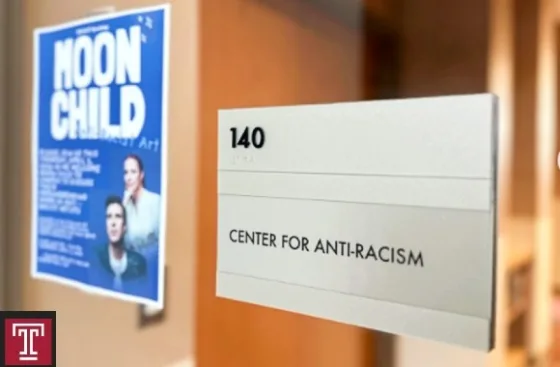
ANALYSIS: ‘Taxpayers shouldn’t be forced to subsidize divisive DEI garbage,’ higher ed reform leader says
An “anti-racism” research facility created by Temple University nearly five years ago still does not appear to have published any research and only has hosted a few events, according to a College Fix analysis.
The Philadelphia university’s Center for Anti-Racism, funded by $1.3 million in state tax dollars, was constructed inside an existing building in 2021. Despite multiple attempts over the past month, no one involved with the center or the university’s media relations team responded to The Fix‘s requests for comment on its activities in recent years.
Corey DeAngelis, research fellow at The Heritage Foundation, criticized the center’s reliance on taxpayer funding in a recent interview with The Fix.
“In this case, taxpayers deserve a refund after being swindled by Temple’s Center for Anti-racism,” he said via text.
“Taxpayers shouldn’t be forced to subsidize divisive DEI garbage,” DeAngelis told The Fix. “The education system was built to bring communities together and create a more cohesive society, yet DEI only fans the flames of division and rips us apart.”
Even though the center lists research as part of its mission, its website does not mention any published scholarship or research projects.
Timothy Welbeck, an attorney, professor, scholar, and hip-hop artist, serves as the center’s director.
The Fix conducted a search of published academic works by the center’s “professional team,” of which Welbeck is the only individual listed. The Fix searched on the center’s and university’s webpages and on Google Scholar, but did not find any research attributed to Welbeck or the center since it opened in 2021.
Welbeck did publish an essay for Emory University’s Canopy Forum in 2024. His personal website described the essay as an “Academic” work. The essay was titled “We Have Come into His House: The Black Church, Florida’s Stop WOKE, and the Fight to Teach Black History.”
Welbeck did not respond to multiple requests for comment over the past month. The Fix asked if the center had published any research and why the $1.3 million was necessary to get it started, but he did not respond.
Welbeck previously deferred to a university communications director when asked for comments by The Fix in 2024.
The center’s Instagram page did advertise several events over the past year, including talks by therapist and leadership coach George James and social psychologist Evelyn Carter, both of whom discussed their new books.
No upcoming events are currently listed on its website.
However, the center has not updated its “news” page in almost two years. The last article is from November 2024, marking its second anniversary.
“Two years ago, Temple University affirmed its commitment to fighting racism through focused efforts on advocacy, programming, research and training when it officially opened its Center for Anti-Racism.
“Today, that mission is alive and well,” the article begins.
The last mention of the center in the university’s newsletter, Temple Now, was November 2024 when it celebrated its second anniversary with a book discussion from Khalil Muhammad, author of “Condemnation of Blackness: Race, Crime, and the Making of Modern America.”
Temple’s media relations team did not respond to multiple requests for comment from The Fix in recent weeks, asking about the center’s research and activities. The Fix also asked for permission to visit and photograph the center on campus, but did not receive a reply.
University spokesperson Stephen Orbanek told The Fix in 2024 that the center was planning additional “programming and scholarship.”
As The Fix reported at the time, “the center’s work has largely consisted of conferences and speakers. The $1.3 million state-funded center appears to operate out of a room in Mazur Hall, a pre-existing building on campus.”
The Center for Anti-Racism was devised in 2020 as “a response to the murder of George Floyd and national calls for social justice and racial equity,” according to its website.
Pennsylvania state Rep. Malcolm Kenyatta, a Philadelphia Democrat, awarded the grant to Temple to construct the center. His office did not respond to The Fix’s requests for comment through his website.
However, Rashard Dawson, a fellow and ambassador for Project 21, criticized the center, calling it a “slush fund with a nameplate.”
“$1.3 million. Three years. Four events and not one published study. That’s not a research center, it’s a slush fund with a nameplate, and funding it off the public’s back ought to be illegal,” he told The Fix via email.
Dawson works with Project 21, an initiative through the National Center for Public Policy Research that promotes “the views of African-Americans whose entrepreneurial spirit, dedication to family and commitment to individual responsibility have not traditionally been echoed by the nation’s civil rights establishment.”
He told The Fix: “Pennsylvania has kids who can’t read at grade level, and that same money could have actually taught them. Instead the state spent it convincing minority students they’re permanent victims with no power to think for themselves or overcome a single obstacle.”
“That’s not justice. It’s the soft bigotry of low expectations, and it fails the very kids it claims to serve,” he said.
DeAngelis, a national advocate for education reform with Heritage, expressed similar concerns with the center’s mission and lack of activity.
“We should be investing in creating productive citizens instead of encouraging students to blame all their failures on everyone else. DEI produces a negative return on investment by pitting people against each other based on immutable characteristics,” he told The Fix.
MORE: Temple U. $1.3 million state-funded ‘anti-racism’ center hosts a few events

