FEATURED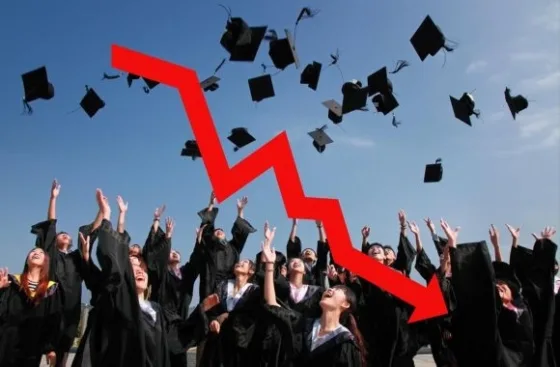
Third-party data isn’t always reliable, expert says
International student enrollment is projected to drop by nearly 111,000 students this fall, which could cost the U.S. economy $3.4 billion and nearly 40,000 jobs, according to NAFSA: Association of International Educators.
“This downturn reflects the convergence of several headwinds: declining application volumes, persistent visa appointment bottlenecks, and newly restrictive immigration policy changes,” the NAFSA report states.
NAFSA is a lobbying group for international education and university exchange programs. The group’s projections might miss crucial context, some say.
A spokesperson from the Center for Immigration Studies told The College Fix that declines in international enrollment are not necessarily a bad thing.
“When the government begins enforcing the rules of an immigration program, people who were planning to misuse that program have less incentive to come,” Marguerite Telford said.
She also said third-party data isn’t always reliable because private organizations and government agencies measure different datasets.
While private reporting counted roughly 1.1 million foreign students in 2024, official Department of Homeland Security tracking, which includes work authorization programs like Optional Practical Training, showed over 1.5 million active records.
Moreover, accurate conclusions cannot be drawn until ICE releases the delayed 2025 and 2026 annual Student and Exchange Visitor Information System reports, she said, adding that reporters should press the agency on when this critical public data will be published.
“Finally,” Telford said, “there is a broader issue that deserves attention: the consequences of foreign-student programs cannot be measured simply by counting how many students are enrolled.”
“We need to know how many are actually studying, how many are working, where they are working, whether they are complying with the terms of their status, and whether sensitive technology or intellectual property is being transferred through these programs,” Telford said.
She added that “there are also national-security concerns involving foreign students and researchers that cannot be reduced to an enrollment statistic.”
Commentary from the Heritage Foundation similarly warns that “American students at our top universities are being exposed to a critical mass of foreign students, learning about their values and political systems, and then incorporating these perspectives into our political culture.”
The conservative think tank pointed to the wave of campus protests following the Oct. 7 terrorist attacks against Israel.
“It is telling that the universities with the most radical protests are also among those with the largest international enrollments,” the commentary states.
“Educational exchange is working, just not in the direction that American policymakers imagined when they created visa programs for international students,” it states.
On the other hand, migration advocates argue that falling international enrollment causes long-term economic damage.
Migration Policy Institute spokesperson Michelle Mittelstadt told The Fix that “international students have long been a pipeline for the U.S. to gain access to some of the most highly skilled and sought-after workers for the future.”
She said that the reduction in enrollment makes other countries more desirable destinations for international students.
In addition, the American Council on Education pointed The College Fix to its recent report in which it opposes the Trump administration’s decision to eliminate “duration of status” for international students.
Instead of staying for the full length of their academic program, students will now receive a fixed four-year admission period and must apply for an extension if they need more time.
ACE is a major higher education lobby in Washington that represents college presidents.
Sarah Spreitzer, the group’s vice president of government relations, said, “Nobody’s arguing that DHS shouldn’t be able to track who’s here and why,” according to the report.
“But a four-year clock doesn’t match how degrees actually work, especially in fields like medicine or the sciences. We’re going to see students and institutions scrambling to make this fit, and some of them just won’t be able to,” she said.
Similarly, NAFSA leader Fanta Aw stated in a LinkedIn post that driving international students to “more welcoming countries” comes at a great cost to all Americans.
“There is ample capacity in this country for their innovation, perspectives, and ambition. International student contributions benefit American ingenuity, economic prosperity, and national security,” she said.
The drop in enrollment coincides with tighter foreign student restrictions under the Trump administration. A December 2025 executive order imposed targeted limits on 39 countries without exceptions for F-1 or J-1 visa holders.