
 FEATURED
Demand comes amid questions over religious status and international students
Texas officials have ordered a Dallas-based Muslim university to cease operations, citing compliance and certification concerns amid controversy over the school’s acceptance of international students and its religious identity.
Although most online criticism flags the university’s religious identity, state officials remain largely focused on regulatory compliance in their demands, asserting it is not a legitimate, authorized university in Texas.
The Texas Higher Education Coordinating Board, under the direction of Texas Gov. Greg Abbott, issued a cease-and desist letter May 7 to Texas American Muslim University at Dallas.
The letter directed the university to “cease all operations,” stating the institution is not in compliance with the state’s licensing requirements for higher education institutions.
“Texas will not allow illegal educational institutions to operate in our state,” Abbott posted on X on May 7.
This process is “standard operating procedure when an entity is alleged to be offering degrees or courses that lead to degrees in Texas and is not authorized to do so,” Bobbi Kessler, media affairs coordinator for the Texas Higher Education Coordinating Board, told The College Fix via email.
Mayor’s support raises concerns
Currently the university’s website appears completely offline.
The shutdown comes as Amir Omar, mayor of Richardson, a suburb of Dallas, publicly endorsed the university.
In a video posted to X on May 4, Omar stood in front of university-branded posters and expressed his desire for the university to expand to “another campus,” adding he would help promote it by connecting it to industry partners.
Omar did not respond to The College Fix’s request for comment via email asking whether he was aware the university lacked authorization at the time of his endorsement.
Founder defends university operations
Shahid Bajwa, founder and chairman of the institution, as well as a member of the university’s Board of Trustees, told The College Fix that the university is working to comply with state regulations.
Bajwa said the university is officially registered with the Secretary of State of Texas as “Texas American Muslim Institute for Technology at Dallas,” and is operating as a “doing business as” designation, while working to gain 501(c)(3) status.
According to Bajwa, the university started its first semester in October 2025 and its second semester in March 2026, but does not currently grant degrees, certificates, or credentials, and does not charge tuition, rather deriving funding primarily from donations.
In regard to the university’s religious identity, Bajwa told The College Fix that the inclusion of Muslim in the university’s name is “an expression of our founders’ identity.”
He added that this is not discrimination, and is instead aligned to the practices of other faith-based institutions across the United States.
Bajwa further confirmed that the university will require Islamic Studies as a component of the curriculum, making up approximately 30 percent of coursework.
“Our goal is to showcase the positive contributions of Muslim scholars to science and knowledge, enriching the academic experience for all students,” he told The Fix.
The university is “actively engaging” with state officials to ensure full compliance, Bajwa said.
Name dispute with Texas A&M
The Muslim university is also facing a separate challenge from Texas A&M University over its branding as “TexAM University.”
“Similar variations create confusion and mislead the public,” Texas A&M said in a news release.
“When another organization uses similar branding, particularly in the same educational space, we must act to protect the value of those marks,” said Chancellor Glenn Hegar of Texas A&M.
Questions surrounding international admissions
Though state action has largely focused on compliance with state law, there has been growing controversy surrounding the university’s advertisement to international students.
The Dallas Express News reported May 7 that the Muslim university “is advertising heavily” to international students.
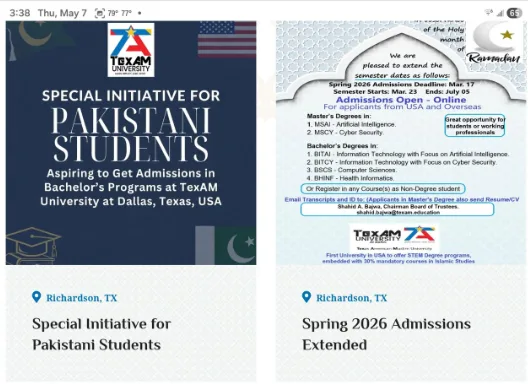
A user on X shared a picture of the university’s website. The website listed a “special admissions event” for Pakistani students who are “aspiring to get admissions in bachelor’s programs” at the university, and a spring 2026 admissions flyer stating that the university welcomes overseas applicants.
However, Bajwa told The College Fix that the university does not “offer, assist or advise international students” with visa sponsorship or OPT opportunities following graduation.
MORE: Harvard investigates Republican club for filming Muslim event on campus

