FEATURED
ANALYSIS
A University of Illinois-Chicago professor with an annual salary of nearly $300,000 is no stranger to bashing capitalism and what she calls the “ruling class.”
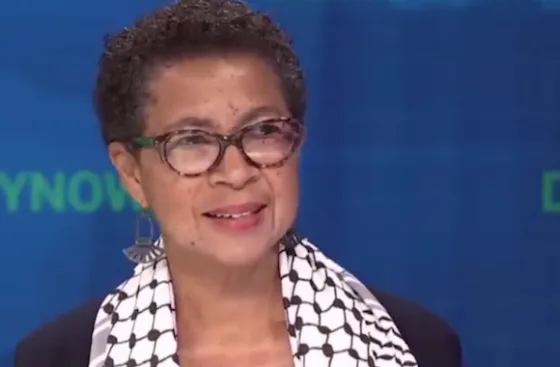
Most recently, Professor Barbara Ransby spoke on “Black Left Feminism and the Fight Against Fascism” at the Socialism 2026 conference in Chicago. There she said the United States is “on a fascist trajectory” under “an authoritarian government that would like to impose a full fascist agenda.”
“It’s not just your comrades who get put into jail, it’s you go to get them out of jail and you and the lawyers get put into jail,” the professor said, referencing the “Stop Cop City” protest during which protesters and lawyers from the National Lawyers Guild were imprisoned.
“That is a leveraging, a violent leveraging of power, which ruling classes resort to when they get desperate,” Ransby said. “It is not a move out of strength. It is a move out of weakness.”
“In other words, the old con game is not working anymore, so we have to move, we have to escalate,” she continued, before clarifying that she was not speaking about herself.
Ransby, a “Distinguished Professor” in her university’s Departments of Black Studies, Gender and Women’s Studies, and History, has over the decades played a vocal role in advancing socialist ideas in the U.S. through celebrated scholarship that decries “racial capitalism” from a black feminist and socialist perspective.
“Capitalism as we know it exists because of white supremacy as an ideology that undergirded it, that helped to justify it, that fueled it around the world and certainly in this country,” she said in a 2019 talk, citing slavery, Jim Crow, and forced migrations, and arguing racism, white supremacy, and capitalism are intertwined.
In the same talk she said “capitalism is an infinite growth model on a finite planet … and increasingly capitalists have pillaged and plundered as much as they can pillage and plunder and are essentially destroying the very Earth that they too have to live on.”
She goes on to say a different model of “production,” “distribution,” and “resource cultivation” is needed.
In 1998, the professor helped convene the Black Radical Congress, an organization dedicated to “broad progressive social justice, racial equality and economic justice goals.”
At the height of the Black Lives Matter movement, she championed it as a way for the Left to collectively challenge “racial capitalism and state violence.” She also authored a book in 2018 titled “Making All Black Lives Matter: Re-imagining Freedom in the 21st Century.”
At the University of Illinois-Chicago, Ransby launched and served as founding director of the Social Justice Initiative to promote “connections between academics and community organizers doing work on social justice.”
Her books include “Ella Baker and the Black Freedom Movement: A Radical Democratic Vision” and “Eslanda: The Large and Unconventional Life of Mrs. Paul Robeson.”
Earlier this year, she wrote the afterword for the 2026 revision of “SNCC: The New Abolitionists,” written by prominent socialist historian Howard Zinn.
After her comments from the socialism conference went viral on social media recently, several users pointed out that Ransby’s salary indicates that she is, in fact, part of the upper class.
OpenPayrolls data shows that Ransby earned nearly $285,000 from the university in 2025, with an additional “other pay,” such as benefits, listed at nearly $20,000.
“This is 249.9 percent higher than the average pay for university and college employees and 267.2 percent higher than the national average for government employees,” the website states.
Stuart Smith, investigative analyst at the Manhattan Institute, said he doubts public figures such as Ransby have any qualms about being well-paid socialist thought leaders.
“I do not think they have a moment of cognitive dissonance over it,” Smith told The College Fix. “As long as they are not billionaires, they are still in solidarity with the people.”
He added that Ransby and her peers overlook “their white-collar status,” seeing themselves instead as “intermediaries” working from within the system to support the socialist movement.
Smith, who has posted Ransby’s comments from the socialism conference on X, pointed to examples of other leftist professors, such as Melissa Charles of California State University and Lorgia García Peña of Princeton, calling universities “their best shot at power.”
In one article, Charles wrote of utilizing university resources “to develop the capacity for our ongoing struggle against imperialism, colonialism, capitalism, and neocolonialism.”
At last year’s socialism conference, Peña said her goal was to use her school’s money to “dismantle the university.” She reportedly “described Princeton as ‘the colonizing, racial-capitalist, white-supremacist institution that pay[s] my salary.’ She instructed attendees to ‘get the university’s money to do the work you wanna do to dismantle the university within.'”
Neither Ransby nor the University of Illinois-Chicago’s media relations department returned The College Fix’s request for comment.