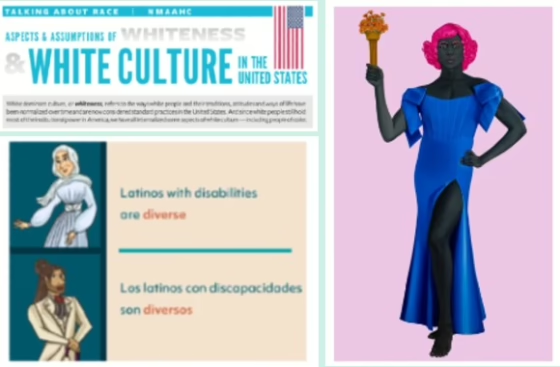
CAPTION & CREDIT: Smithsonian exhibits that the White House identified as problematic; White House/Smithsonian
One professor says the president’s goals are a ‘white nationalist project,’ another says it’s a much needed reform to the ‘woke takeover’ of museums
The Trump administration’s scrutiny of Smithsonian exhibits has prompted criticism from a number of scholars over the past week, including a Princeton University professor who described it as part of a “white nationalist project.”
However, at least one scholar praised the president’s attention to the matter, saying “a woke, revisionist history” has taken over many museums.
On Thursday, the White House published a list of exhibits and intended exhibits in the Smithsonian’s museums that it believes inject leftist politics into American history.
One was a series by the National Museum of African American History and Culture about “whiteness” and “white dominant culture” in the U.S. The exhibit (pictured) described “the nuclear family,” “work ethic,” and “intellect” as “white qualities rooted in racism,” according to the White House.
In another example, the National Portrait Gallery had planned to display a “painting depicting a transgender Statue of Liberty” (pictured); however, the artist withdrew it.
Last week, the president also called for a review of the Smithsonian based on concerns about its exhibits pushing leftist ideologies
“Trump isn’t trying to ‘erase history,’ he’s looking to reverse a woke movement that has indeed rewritten the American story to highlight suffering rather than providing a balanced picture of our past,” Elizabeth Weiss, a professor emeritus of anthropology at San José State University, wrote Monday at the New York Post.
But others disagreed.
Princeton University Professor Eddie Glaude told MSNBC that Trump believes America is a “white republic.”
“I think it’s very clear that he’s trying to tell a story of America that coincides with his political ambitions, his own conceptions of America as a white republic,” Glaude said in the Sunday interview.
“So we can’t tell a story about our failings because those stories call into question our inherent goodness and our divine mission,” the history professor said. “He’s seeking a history that confirms his politics in so many ways, it’s a politics that’s rooted in a white nationalist project, and we need to call it for what it is.”
Some of the exhibits the White House identified Thursday had to do with what Trump described as an overemphasis on slavery, The New York Timesreports:
The unsigned list from the White House was the latest in the president’s effort to overhaul the Smithsonian, which oversees 21 museums, libraries, research centers and the National Zoo. Last week, the Trump administration sent Mr. Bunch a letter saying that eight of its museums had a 120-day deadline to replace whatever the administration considers “divisive or ideologically driven language with unifying, historically accurate and constructive descriptions.” Mr. Trump also said this week that the Smithsonian was “out of control” and focused too much on “how bad slavery was.”
But Professor Robert Luckett at Jackson State University told WAPT News 16 that museums shouldn’t “gloss over” the bad parts of U.S. history.
“Telling a whole story, a comprehensive story that doesn’t just gloss over the bad things in our past but understands how those bad things inform who we are today as American citizens is incredibly important work, and that is work the Smithsonian does,” Luckett said when asked about the president’s comments.
But Weiss, writing at the NY Post, said that in order to present an honest account of history, museums shouldn’t “afraid to showcase and celebrate American achievement, which includes ending slavery.”
“The problem with modern museums is not just about the obsession with slavery; it’s also about dishonestly painting all of American history as evil and full of horrors — with little or no redeeming qualities,” she wrote.

 BUZZ
BUZZ