EDITORS' CORNER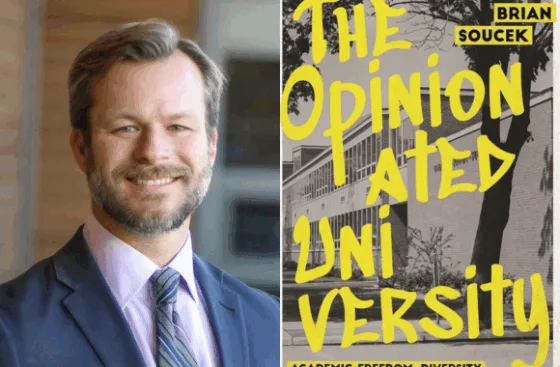
OPINION
A University of California professor is challenging the idea of institutional neutrality and says it can undermine the work of higher education – and in a way, he has a point.
The idea of institutional neutrality gained prominence with the oft-cited “Kalven Report” from the University of Chicago in 1967. “Since the university is a community only for these limited and distinctive purposes, it is a community which cannot take collective action on the issues of the day without endangering the conditions for its existence and effectiveness,” the report stated.
University of California Davis Professor Brian Soucek recently published a book on this topic and related issues such as academic freedom. He spoke to Inside Higher Ed about his thoughts on institutional neutrality and his book “The Opinionated University: Academic Freedom, Diversity, and the Myth of Neutrality in Higher Education.”
Asked if he thinks “it’s possible for a university to stay truly neutral,” Soucek (pictured) said, “To me, what that means is that every time a school that has adopted a Kalven report–style neutrality pledge is choosing whether to speak or not, they are necessarily having to decide whether a given issue goes to the core of their mission.”
“And since the mission of a university is one of the most contested value choices that universities are ever making, I don’t think neutrality gets us very far,” the law professor said.
“Every university is making non-neutral choices about those kinds of issues,” he said in another part of the interview, explaining the impetus for his book. “With the calls for institutional neutrality, I just couldn’t even wrap my mind around what it meant for a university to be neutral when it’s constantly and necessarily making these kinds of choices that go to the very core of its mission.”
Universities can, in my opinion, have values and goals without strictly violating institutional neutrality. The idea, as I understand it, is that schools will not take positions on issues outside of their mission.
For example, Harvard University would be within its rights to criticize funding cuts by the Trump administration, since that affects the school’s mission. However, the school should not comment on, say, a controversial police shooting in Minnesota, because that does not directly affect its operations.
However, universities have struggled to maintain their institutional neutrality promises, and for that reason, I do agree with Professor Soucek on the feasibility of the pledges.
For example, Syracuse University took an “institutional neutrality” pledge in 2024. Within three days, its accounts posted in support of LGBT “pride.”
Similarly, The College Fix found more than half of schools with such pledges openly celebrated “Pride Month” last year.
Perhaps the problem is even the supporters of institutional neutrality say there’s no issue with a school taking a stance on LGBT topics, even if they do not directly affect the university’s mission.
“Institutional neutrality doesn’t automatically mean institutional silence. A simple ‘Happy Pride Month’ message—much like a ‘Happy Fourth of July’ post—doesn’t inherently violate a university’s commitment to neutrality,” Foundation for Individual Rights and Expression’s Connor Murnane previously told The Fix.
This of course ignores that LGBT issues remain a heated topic in American discourse and politics and means something much different than wishing someone a “Happy Fourth of July.” If “institutional neutrality” means schools can openly support the LGBT agenda then it really does not mean a thing and should just be scrapped altogether. Better for a school to be honest and say it takes stances on all sorts of issues than lie.
Soucek, the University of California professor, also argues that universities take stances all the time when it comes to hiring and scholarship.
“Tenure decisions are deeply viewpoint-based about the quality of one’s work,” he told Inside Higher Ed. “Hiring decisions are going to have to take into account judgments about whether somebody’s scholarly views are good ones or not.”
This shows another problem with “institutional neutrality”: It is difficult, if not impossible, for a school to not have some stance on issues.
Take the University of Michigan.
The regents announced in October 2024 that “the University will maintain a position of institutional neutrality on political or social issues and events not directly related to its internal governance.”
Wow, that sounds great. Except it’s practically meaningless, because the university runs various “anti-racism” centers and research grants, meaning it takes an institutional stance on what scholarly topics are worth studying.
As I wrote previously:
The school has a National Center for Institutional Diversity Anti-Racism Collaborative which recently announced applications are open for its “Anti-Racism Research & Community Impact Faculty Fellowship and Anti-Racism Graduate Research Grants.”
But this is clearly taking a “position” on “contested political or social matters.” The university is explicitly endorsing the “anti-racist” approach to racial matters and funding its work.
And that work also, by extension, endorses certain “political” or “social” views.
Professor Soucek and I may disagree on the value of “anti-racism” research (or not, I don’t know), but I think we would both agree that this is an example of a university taking an institutional stance.
Universities take positions all the time, and while I wish they would take into consideration the wide breadth of views and do more to openly promote debate and various viewpoints, I don’t think a pledge is going to do much. After all, schools will simply violate the pledge whenever they want and nothing will really change at the institutional level.
What is needed is top-down reform to promote viewpoint diversity and open debate, not halfhearted promises (which are not promises at all).