
 FEATURED
Key Takeaways
- Professor Ofer Raban filed a complaint alleging the Oregon Law Review rejected the Israeli professor's article due to his nationality.
- He alleges that editors believed publishing it would be seen as endorsing Israel, even though the article was about environmental law.
- Raban criticized the university for a lack of transparency, alleging it has refused to release the results of an investigation into the matter.
- A university spokesperson says it typically does not release records regarding personnel issues due to federal privacy law.
The details of a University of Oregon investigation alleging anti-Israel discrimination by the Oregon Law Review are unknown as of yet, with one professor saying the institution has refused to reveal the results.
Ofer Raban, a professor at the University of Oregon School of Law, said he filed a discrimination complaint with the university’s Office of Investigations and Civil Rights Compliance in February. In it, Raban alleged the Oregon Law Review rejected a professor’s article for publication because he is Israeli.
Raban told The College Fix last week that he was notified in June that the results of the university’s investigation into his complaint would not be disclosed.
“University of Oregon informed me that it will not disclose to me — or to the public — the results of its investigation. The email referred to some unnamed ‘university policy,’” Raban told The Fix.
University spokesperson Angela Seydel neither confirmed nor denied whether the investigation has been completed in response to The Fix’s inquiry.
“We have no further information that we can share with you,” Seydel responded via email Monday.
As of June 18, the investigation was still on-going, a university spokesperson told The Fix at the time.
“The facts of this matter are still under review by the Office of Investigations and Civil Rights Compliance. Commenting before the conclusion of the review would be inappropriate,” university spokesperson Eric Howald said in the June 18 email.
Since then, however, Raban told The Fix that the university has yet to release any of the findings or any “adverse consequences to any of the personnel involved in that illegality.” He said it remains unclear why the university will not release the investigation results.
Raban said a request was sent to the university’s office of public records last month asking for the results of the investigation.
“The Office did not deny the university’s obligation to release the records, and only asked for a few weeks to collect the information,” Raban said. Earlier this month, “in a clearly disingenuous move, the Office released the complaint form that I myself wrote – omitting everything else. It seems that the University is bent on suppressing the investigation — legally or not.”
Seydel, the university spokesperson, told The Fix on Monday that the university “does not typically release the existence or results of investigations to protect the privacy of those involved based on personnel policy and the Family Educational Rights and Privacy Act (FERPA).
“A redacted record of a complaint to the university may be available via a public records request, as it was in this case,” Seydel wrote.
Earlier this summer, Raban described his discrimination complaint on The Volokh Conspiracy blog at Reason, alleging the law review refused to publish an article written by an unnamed Israeli professor, who holds an American law degree and has been teaching intermittently in the U.S.
The incident occurred in late 2024 when an Oregon Law Review editor recommended the Israeli professor’s article for publication, but senior editors rejected it, according to Raban (pictured).
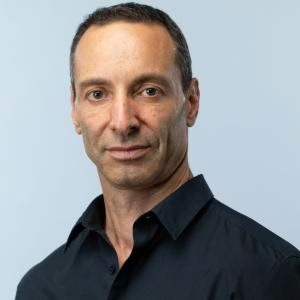
According to a statement he gave to Professor Jonathan Turley’s blog, “a second law review editor rejected the recommendation because the author was a faculty member at an Israeli university.
“The law review management agreed, claiming that publishing the article would be perceived as an endorsement of Israel in the Israeli-Palestinian conflict—although the article dealt with environmental law and had nothing to do with that conflict,” Raban alleged.
He also alleged that the law review leaders dismissed initial concerns over discriminatory publishing practices.
“When the original reviewer objected that this may amount to unlawful discrimination, the matter was taken to a high-ranking law school official,” Raban stated.
“A meeting was held, and the official reportedly gave the green light to the discrimination. At least two law school administrators, possibly more, were aware of the stated basis for the rejection and connived in it,” according to the professor. “A concerned member of the law review (who did not attend the meeting) was told that the law school’s administration had cleared the discrimination.”
Raban told The Fix that the university’s present position and refusal to publish the investigation findings is a “hypocritical attempt to bury the issue.” He cited previous controversial episodes involving university law professors that were met with fully reported investigations and public condemnations by the university.
Raban also expressed concerns about other incidents of “documented discrimination” and the university’s apparent bias in the ongoing Israeli-Palestinian conflict.
For example, he said, one professor assigned Al-Jazeera, “a well-documented source of misinformation about Israel and an arm of the terror-supporting state of Qatar,” as the exclusive source of information for a Middle East journalism class.
Additionally, several UO departments hosted Eman Abdelhadi, a pro-Palestinian activist, for a speaking event in February. Abdelhadi delivered the talk “Palestine and the Future of Campus Activism.”
“The invitation and sponsorship of this speaker, who denies Israel’s right to exist and had celebrated the October 7 atrocities, is a real low for the University of Oregon,” Raban said. “It boggles the mind that the University sees fit to invite and pay for a speaker who preaches the destruction of Israel and celebrates terrorism.”
When asked about these examples, a university spokesperson told The Fix the institution seeks to give a platform to opposing viewpoints.
“The university respects the rights of all students and employees to speak their mind within the boundaries of university policies,” Howald said. “We are committed to supporting our students and employees while fostering respectful and productive conversations about the local and global challenges.”
Howald said the university hosted Jewish author Yardena Schwartz to discuss her book “Ghosts of a Holy War” in the same month that Abdulhadi visited campus. Additionally, Jewish writer and filmmaker Aaron Davidman was on campus for a screening of his film ”Wrestling Jerusalem” and a group discussion in January.
But Raban told The Fix there have been other incidents of antisemitism on campus as well.
These include “harassment of Jewish and Israeli students at the university and its dorms—including banging on doors late at night, tearing decorations from dorm doors, drawing swastikas, refusing to cooperate with Israeli students on class assignments, and many other such forms of latent or explicit hostility,” he said.
In November, the university investigated incidents in residence halls, including the drawing of swastikas and the removal and defacing of “items supportive of Israeli hostages taken by Hamas and supportive of Jewish students” from Jewish students’ dorm rooms, according to a UO campus safety office report.
Around the same time, state news sources also detailed reports of “a swastika drawn next to a picture of a Jewish student and what one family described as a ‘Hitler-style’ mustache drawn onto the student’s face.”
Raban said such biased practices significantly impact higher-level education in America.
“There is no doubt that anti-Zionism— a species of antisemitism that denies the right of the Jewish people for self-determination in their ancestral land—is shockingly common in American universities,” he told The Fix. “There is also no doubt that it affects American education – including legal education.”
He also raised concerns about the example that these practices demonstrate to UO law students through “outrageous double standards and discriminatory enforcement.”
“Surely these are the wrong pedagogical messages for our next generation of lawyers and judges,” Raban said.

