
 FEATURED
OPINION: Universities can accommodate advocacy, but political recruitment shouldn’t be professors’ objective
University of Chicago Professor Eman Abdelhadi, half-sister of Michigan’s U.S. Senator-elect Abdul El-Sayed, has described the university as “a place to build power.”
In her account, students, faculty, and university workers can exert pressure together to transform the institutions in which they study and work.
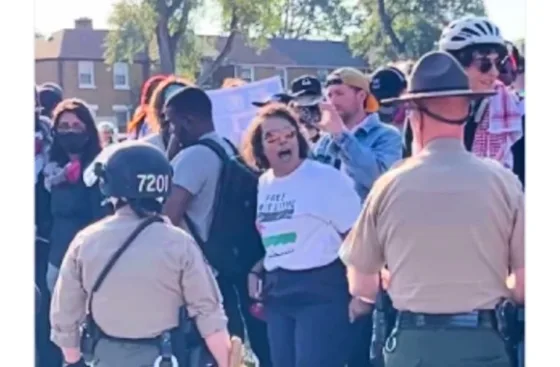
She demonstrated this pressure last October when she was arrested for allegedly spitting on police officers during an anti-ICE protest. Next week, she’s scheduled to appear in court over two felony aggravated battery charges. She is pleading not guilty.
But her approach to political activism raises a question that extends beyond any particular cause: What happens when a professor views the university, including the students she is responsible for educating, as a resource for building political power?
Abdelhadi has articulated a broader strategy for political organizing within universities.
At the Socialism 2025 conference, Abdelhadi characterized her university as “evil” and “a colonial landlord.” However, the university also gives her access to thousands of people she could potentially mobilize, and her students need her, she said.
There’s a distinction here that matters. Professors are free to engage in political activism, but they also occupy positions of authority over students whose education should equip them to develop and question their own convictions, including those that differ from their instructors.
From campus protest to political power
In a 2024 interview with Spectre, Abdelhadi discussed how different groups within universities could contribute to political movements.
She argued that students are particularly well positioned to take political risks because their time at university is temporary and many have fewer personal obligations, such as mortgages or children.
Abdelhadi praised campus encampments for disrupting university operations and imposing costs on institutions. She described them as “important hubs for people within the movement to connect with each other,” adding, “They became important spaces for political education, re-energizing the struggle.”
Looking beyond students, she said Faculty and Staff for Justice in Palestine chapters also “can challenge all the rules and regulations that universities have wielded against their students.”
She also discussed the economic power of unions and raised the possibility that educators across Chicago could “coordinate a work stoppage” around a demand concerning Palestine.
“We need more power than public opinion; we need to turn that public opinion into structural leverage to force through change,” she explained.
Abdelhadi is describing more than political expression on campus. She envisions turning the university’s communities, relationships, and organizational structures into sources of political power. For someone who also holds academic authority over students, that distinction warrants scrutiny.
A university remade for what purpose?
Abdelhadi’s ambitions also include overhauling the whole purpose of the university.
In “Barricades at the Ivory Tower: The University as a Site of Struggle,” published in the journal Gender & Society in March, she presented universities’ treatment of Palestinian solidarity activism as evidence of deeper institutional failures.
She called for a “radical” reshaping of academia that involves building political power through coordinated action among students, faculty, staff, and surrounding communities.
The problem is, where does education fit into that vision? Universities are supposed to be places where political ideas are studied, challenged, and debated, including ideas that faculty members themselves strongly support.
How Abdelhadi’s model would preserve the independence of teaching and scholarship, particularly when students disagree with the political objectives being pursued, deserves examination.
Where are the boundaries?
In July 2025, following public attention to Abdelhadi’s remarks at the socialism conference, the University of Chicago announced an investigation. It emphasized faculty responsibilities to maintain classrooms open to differing viewpoints and to develop students’ rigorous critical-thinking skills.
The university’s Professional Conduct Policy also establishes expectations concerning intellectual merit, academic requirements, professional boundaries, and responsible oversight.
These standards matter because an invitation to political participation from someone who evaluates a student’s work carries a different weight from an appeal by a fellow activist.
Students depend on professors for instruction, assessment, mentorship, and professional opportunities. That relationship does not prohibit political advocacy, nor does Abdelhadi’s public activism establish that she has compromised her teaching. But it does make the boundary between education and political organizing especially important.
The purpose of teaching is not to secure agreement with an instructor’s political commitments. It is to equip students to evaluate evidence, challenge assumptions, and reach conclusions independently, even when those conclusions conflict with their professor’s beliefs.
Universities can accommodate political advocacy without making political recruitment an educational objective. Professors must remain free to advocate their convictions while ensuring that the students entrusted to them remain free to develop their own.
Anna Miller is the spokesperson for Protect Our Campus, a nonpartisan organization that documents antisemitism, extremism, and institutional accountability concerns in academic and public-facing spaces. Through research, public outreach and direct engagement with institutions, Protect Our Campus works to expose harmful conduct and strengthen accountability.
MORE: El-Sayed’s sister, a U. Chicago professor, says family has ties to Muslim Brotherhood

