FEATURED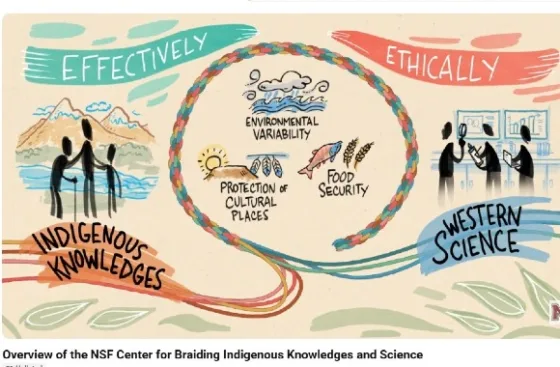
Scholars should respect ‘connections with all beings, including those considered inanimate by Western science,’ center says
A $30 million, taxpayer-funded research center at the University of Massachusetts lists “heart-centered” practices and connection with inanimate beings as a part of its approach to “braiding Indigenous knowledges” with scientific research.
However, the Center for Braiding Indigenous Knowledges and Science has not responded to repeated questions about the specifics of its research and the ways it is spending the National Science Foundation award. The university received the $30 million grant in 2023 to headquarter the research center. Its projected end date is 2028.
Among its more recent work, the center’s leaders created a “collective values statement” to guide scientists’ work.
These “values” include “heart-centered practices” that “center our hearts and emotions in our work.”
The statement also tells scientists to respect “connections with all beings, including those considered inanimate by Western science.”
And the center supports “rightful redistribution,” meaning “obligations to rebalance historically broken and dysfunctional relations that marginalize the perspectives and representation of indigenous peoples.”
The Fix contacted the center’s leaders twice within the past two weeks, asking what “heart-centered” practices look like, but none responded. The university’s media relations office also did not respond to two emails from The Fix asking about the grant spending and the center’s research.
The National Science Foundation media relations office also declined to comment and deferred The Fix to the program’s principal investigator.
This is not the first time the center’s leaders failed to respond. In 2024, The Fix also reached out for comments several times, but did not receive a response.
Allen Mendenhall, a research fellow at the Heritage Foundation, said he was not surprised the school chose not to respond.
Speaking with The Fix recently, Mendenhall said public universities are aware of the “increased scrutiny” that diversity, equity, and inclusion programs are facing, and are “reluctant to invite additional attention to controversial initiatives.”
He said Massachusetts Attorney General Andrea Joy Campbell has issued guidance that indicates DEI programs are still “permissible” under state and federal law. Massachusetts also joined other Democratic-led states to challenge federal attempts at curtailing DEI programs.
But blue states’ decisions to embrace policies that many view as “ridiculous and ideologically driven” have consequences, Mendenhall told The Fix. Now, southern institutions are becoming more attractive to students who wish to “escape the tyranny of Blue States and their ideologically homogenous universities,” he said.
The UMass center’s director, Sonya Atalay, was an editor of the 2020 book, “Archaeologies of the Heart,” which could offer a clue about what the center means by “heart-centered” practices.
In Chapter 1, the authors discuss making archaeology speak to the whole person by considering “the powerful roles of emotion, love, and connection, though not at the expense of rigor.”
Scientists have been “acculturated … to separate the intellectual mind from the physical body, a position which assumes there is an objective world to be studied and that humans must remove themselves from that world to find the truth,” the chapter states.
The book also critiques the “Western scientific value of neutrality as false and invalid.”
The editors credit “feminist philosophers of science, critical theorists, and Indigenous and postmodern scholars” for discrediting claims of “objectivity and scientific authority.”
To them, heart-centered archaeology means beginning “with the assumption that social inequality exists,” and that the social scientist’s job is “to position her work consciously and to practice a rigorous self-reflexicity in its conduct.”
In another chapter, Atalay wrote that research practices that put less “emphasis on extraction, separation, and alienation” and more on “gifting, relationality, and a socially just and loving society” are “desperately needed in our capitalist patriarchal society.”
Similar ideas are promoted in a UMass Amherst video, published in May, that describes the mission of the center.
The Center for Braiding Indigenous Knowledges and Science “examines how to effectively and ethically braid Indigenous and Western science research, education, and practice related to the urgent and interconnected challenges of adaptation to environmental variability, food security, and preservation of cultural heritage and place,” according to the video.
The goal is to initiate “a fundamental transformation of how research is done,” and not just at the University of Massachusetts, the video states.
The center has regional research hubs located across the United States, Australia, and the Pacific Islands, most of them affiliated with other universities. These hubs conduct research on their local “community needs” alongside local leaders.
“Regional hubs propose either Place-Based studies, which address community-identified research related to environmental variability, cultural places, and/or food security, or Indigenous Research Foundations projects which focus on establishing research foundations either before or as part of a Place-Based study,” the center website states.
Another clue about the center’s work comes from one of their co-lab leaders, Kisha Supernant, who contributed to a 2025 article in the journal Museum Anthropology that analyzes repatriation regulations in Canada. The article stated that non-Indigenous institutions should “no longer” be in charge of conflicts about the repatriation of museum artifacts, and that “Indigenous heritage professionals” should lead instead.
Meanwhile, Ora Marek-Martinez, the interim director of the center’s Southwest hub, criticized “colonial-based research” in a presentation at the Pontifical Academy of Sciences in 2024.
A professor of anthropology at Northern Arizona University, she spoke about the “insidious process of settler-colonization” destroying “Indigenous knowledge” by relegating it to “myth or superstition.”
Marek-Martinez said a guiding framework they can use to overcome “colonial-based research” is the Land Back Movement, which is “the return of Indigenous lands to Indigenous Peoples.”
She also said that braiding Indigenous knowledge with science means decolonization, “the process of deconstructing colonial ideologies about the superiority and privilege of Western thought.”
MORE: Scholars refuse to provide details on $30M effort to ‘braid’ indigenous knowledge into science