
 BUZZ
BUZZ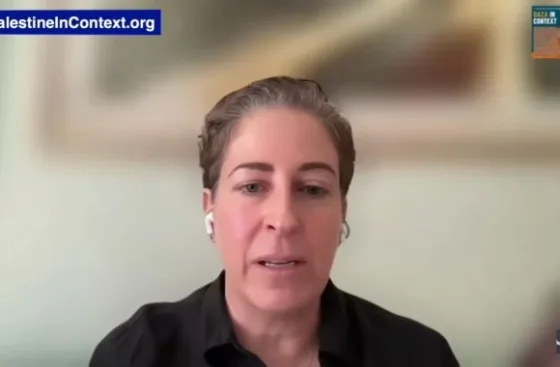
Universities censor discussions about racism, gender and sexuality, professor says
The U.S. and Israel are built on “white supremacy” and “Jewish supremacy” respectively, and universities suppress criticism of the countries’ “colonial roots,” a professor said during a roundtable on “resistance” on campus this month.
Asked about how students and faculty are punished for activism, Scripps College professor Lara Deeb said universities defend the settler-colonial and supremacist foundations of the U.S. and Israel, according to the Middle East Research and Information Project, which hosted the event.
“I think one way to think about the alliances that we’re seeing, as well as the forms of repression, is to remind ourselves that the United States and Israel are settler-colonial states grounded in white supremacy (in the US) and Jewish supremacy (in Israel) and that institutions of higher education in both places are colonial institutions invested in repressing criticism of those colonial roots,” she said.
The anthropology and Middle East studies professor said U.S. universities have suppressed discussions about “the genocide of Native Americans” and “anti-Black racism and also gender and sexuality.”
She added that discussions of gender and sexuality are sidelined because “we forget that heteronormative binaries are one of the structures put into place by the settler state on this continent.”
Deeb believes this is a result of universities trying to “control the narrative” told about the settler state. However, she described the rise of ethnic studies and gender studies as a major “failure” of that control.
Another such failure, she said, is evident in the generational shift in attitudes toward Palestine, which gained significant momentum with the 2024 campus encampments.
“The fact that the repression is so intense right now is because those alliances and those encampments and the accompanying shift in educational paradigms is a symptom of the university’s failure to control faculty and students,” the professor said.
She also drew parallels to the Middle East, noting the targeted killings of journalists and academics amid regional conflicts, and suggested that similar attempts to control the narrative are unfolding in the U.S.
While some people are “connecting the dots” and “reducing self-censorship,” many are overwhelmed by the “multi-pronged assault,” she said.
“[I]t’s Palestine, but it’s also transphobia, it’s also anti-Black racism, it’s also ICE attacks on non-citizens. I think they’re trying to figure out: Where do I put my energy?” Deeb said.
She suggested that activists now need to “mobilize” their “alliances” more broadly outside academic institutions.
New York University professor Andrew Ross, also participating in the roundtable, criticized the government’s “anti-woke” agenda for hindering advances in gender and sexuality.
He blamed this agenda on heightened “transphobia,” adding that “gender fluidity seems to be the most destabilizing of all social tendencies for the ‘Moral Majority.’”
The roundtable event, titled “The University Is a Site of Struggle,” brought together scholars and activists to discuss political struggles on U.S. university campuses.
MORE: Trump admin seeks to root out $1 billion in ‘ghost student’ fraud

