BUZZ
BUZZ
UPDATED
‘Queer content’ should be incorporated ‘into coursework, discussions and assessments’
A pair of University of Southern California professors recently presented “a bold framework” for incorporating “drag pedagogy” into K-12 teacher trainings.
The abstract for Theodore Burnes’ and John Pascarella’s paper “Centering celebratory drag pedagogies in queer- and genderqueer-evasive K-12 educator preparation programs” asserts that anti-drag sentiment “has negatively impacted school environments.”
But the profs offer a “framework” for how the “centraliz[ation]” and “celebration” of drag pedagogy “in the preparation of aspiring teachers, counselors, and school leaders” can “transform school environments’ relationship to sexuality and gender expression.”
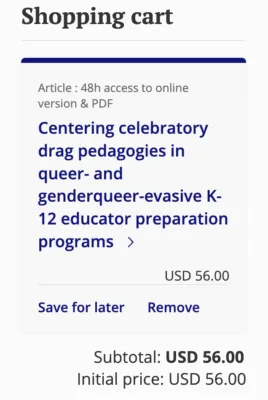
For a mere $56 you can read the entire study from the International Journal of Qualitative Studies in Education:
According to a USC Rossier School of Education press release, the authors contend drag pedagogy “can promote creativity, belonging and critical self-reflection.”
Burnes (pictured), who according to his faculty page “is passionate about creating learning environments for therapists-in-training that infuse a commitment to social justice,” said drag pedagogy “offers educators a joyful and liberating framework for helping students express who they are and understand others with empathy and respect.”

Pascarella, “an expert in teacher education reform, racial equity, and digital media literacy” and chief academic officer for the campus Race and Equity Center, said “future educators are being asked to lead in environments shaped by fear and misinformation,” but drag pedagogy “invites them to lead instead through courage, compassion and joy.”
The study makes use of queer theory-based “autoethnographic methods” (“an autobiographical genre of academic writing that draws on and analyzes or interprets the lived experience of the author and connects researcher insights to self-identity, cultural rules and resources, communication practices, traditions, premises, symbols, rules, shared meanings, emotions, values, and larger social, cultural, and political issues” — see here), resulting in a “five-component” plan for the celebration of drag.
These include “embrac[ing] fluidity and ‘messiness’ in the process of social transformation,” “recogniz[ing] gender and sexuality as inherently political topics that demand reflection and advocacy,” and ditching the notion that gender is binary and replacing it with a “gender continuum.”
In addition, “queer content” should be incorporated “into coursework, discussions and assessments.”
The professors argue that the “embrace” of drag pedagogy can help teachers and other school officials to “create safer and more affirming spaces for all students.”
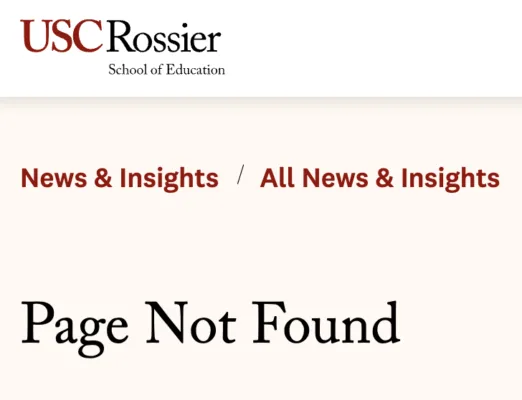
UPDATE: Earlier this week, USC took down the press release about Burnes’ and Pascarella’s paper; the link now directs to the Rossier School of Education’s main “News & Insights” page. The archived link says “Page Not Found”:
The College Fix asked Rossier Director of Media Relations, Promotion and Publicity Ellen Evaristo and Executive Director of Communications Eric Olsen via email why the article was removed, but did not receive a response.
MORE: Harvard hires drag queen ‘LaWhore Vagistan’ to teach ‘Queer Ethnography’