FEATURED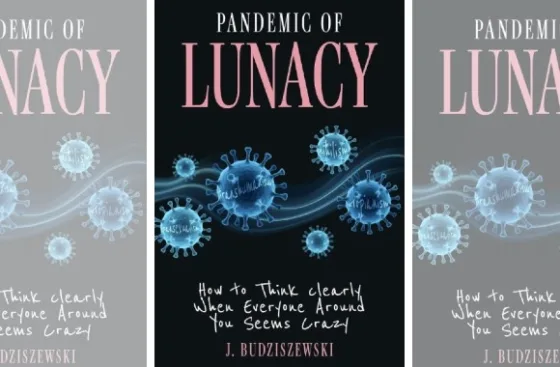
ANALYSIS/OPINION
Out of one pandemic came thoughts about another for a University of Texas at Austin professor.
Unlike COVID, however, the pandemic that philosophy professor and Christian author J. Budziszewski considers in his new book is a culture-wide sickening of the mind.
The book, “Pandemic of Lunacy: How to Think Clearly When Everyone Around You Seems Crazy,” published in February, confronts a wide variety of “lunacies.” It examines where culture has gone wrong on family, sexuality, happiness, religion, government, and more than 20 other topics. But it also offers a model for getting out — and hope for the future.
“Though I teach philosophy, ‘Pandemic of Lunacy’ is written for ordinary people. I simply try to model sane thinking,” Budziszewski told The College Fix.
A prolific Christian author, Budziszewski has been teaching ethics to college students – both in the classroom and through his writing – for more than four decades. His past books include “How to Stay Christian in College” and “What We Can’t Not Know.” He also runs the blog The Underground Thomist.
In a recent interview with The College Fix, the professor spoke in-depth about his new book, the educational system, and his advice to students who want to escape these “lunacies.”
The College Fix: What first gave you the idea for this book?
Budziszewski: We all passed through the terrible COVID pandemic. But there’s a much worse pandemic that people don’t talk about as much. It’s a pandemic of lunacy. Most people are able to identify one of the crazy ideas which are circulating, or even several of them. They don’t necessarily recognize that those crazy ideas are connected. Or perhaps they think these ideas are just silly, or that they don’t matter because they don’t hurt anyone.
COVID could make people sick. Well, some crazy ideas also can make you sick. For example, some people want to disfigure and mutilate children in the name of affirming them. The pandemic of lunacy isn’t spread body-to-body by means of viruses, but mind-to-mind by means of crazy ideas. They are contagious. They are dangerous. And they have to be taken seriously.
So that’s what the book is about. It’s to encourage people to reconnect with their common sense, and to give them some hope.
TCF: You make the point that it’s not just the left that swallowed these lunacies, and you have some strong critiques for conservatives and Christians as well. Talk to me about that.
Budziszewski: A lot of the lunacies in the book might be considered left-wing. But often, what people mean by calling themselves “moderate” is that they are only moderately lunatic, and what they mean by calling themselves “conservative” is that although they reject the newest lunacies, they want to conserve the ones they have already swallowed.
A few of the lunacies I discuss are actually more prominent on the right. For example, libertarians are more likely to fall for the idea that there is no such thing as the common good, just as people on the left are more likely to fall for the lunacy that the purpose of the government is to take care of all our needs.
I’ve tried to target both sides. I don’t target Christians directly, but I might be said to indirectly target Christians who haven’t thought their faith through, or who sit passively as lunacies spread through society, thinking, “It’s no skin off my nose. This doesn’t have anything to do with me.”
TCF: One of the things I was thinking through as I was reading your book is how hard it is for all of us to admit our own faults. We want to believe we’re right. And when our own beliefs are challenged, it’s hard. So, what we can do to help restore a culture of sanity?
Budziszewski: Let’s speak of the moral realm first. Let’s say that you’re my friend, and I’ve treated you very badly. I’ve called you names. I’ve accused you of all kinds of things that you didn’t do. Now I have two choices here: I can either repent, or I can dig in.
If I’ve done wrong and dig in, I immediately acquire a motive to believe ideas which seem to give me an excuse. For example, I might start thinking that right and wrong is all relative anyway, or that they are all in the eye of the beholder – whatever seems to gets me off the hook. This is called motivated irrationality: I accept poor arguments over better arguments, because it gives me some advantage to do so. It helps me to ignore my conscience.
One of the important things in this book is simply to look at ourselves honestly and repent.
Back during the colonial period in the United States, when we believed that England was treating us in a tyrannical fashion, the most important mode of political discussion was political sermons. On the days that legislators took their seats after being elected, they asked prominent local ministers to come and address them about their political duties under God. Among other things, these ministers asked whether it is compatible with the will of God to resist tyrants, and their answer was very interesting.
They said, yes, we may resist them. We must follow God and not men. But then they added that if we had not already become corrupted ourselves, probably God would not have permitted us to fall victim to tyranny. They asked their Americans to consider the corruption of their own lives. Have we bribed judges? Have we neglected the widow and the orphan? They said that unless we clean up our own house first, we won’t have a snowball’s chance on a hot summer day of receiving help from God against tyranny.
TCF: I’m curious, is there a specific story or example from your life you can point to that made you realize how crazy society has become? Is there a moment where you just thought, ‘Wow, this is getting bad’?
Budziszewski: Many, many moments.
I’m glad to say that I have a lot of very sane students, but I have a lot of students who want to be sane but who nevertheless say the looniest things. Two years ago, I was trying to explain that there are some things that it’s really impossible not to know. Some of these things concern what is right and wrong, and others concern what is the case.
Giving an example of something we can’t not know about what is the case, I said that everyone knows at some level that nothing can both be and not be in the same sense at the same time, and no sentence can’t be both true and false in the same sense at the same time. A pleasant young woman in the class asked, “Why not? It seems like some sentences can be both true and false at once.”

I replied, “In that case, perhaps the sentence you’ve just spoken might be both true and false at once. It’s true that sentences can be both true and false at once, and also it isn’t true that sentences can be both true and false at once.” She was stunned, and said, “Wait. What?”
Now her bit of craziness was probably innocent error. She had simply never thought things through. But some errors aren’t so innocent. Here’s one I found much more disturbing. One day I was chatting with someone who was, it turned out, a psychotherapist. Explaining her approach to her work, she said that one of her axioms was that “Everyone has his own reality.”
I asked, “Do you mean that people have different opinions about reality?” She said, no, no, no, – I didn’t get it. So, I asked, “Well, do you mean that there might be something that’s true about me but not true of the other person, for example, I’m married to Sandra, but you’re married to Frank?” She said, no, no, no – I still didn’t get it.
We went round and round. Finally I said, “It sounds like you’re saying that each person lives in a different universe.” She answered, “That’s right! They do!”
Now that’s lunacy. If we really were in different universes, we couldn’t talk with each other at all. Even our disagreement would be meaningless, because something true in her universe might be false in mine. If that really was her attitude, she had no business being a psychotherapist, because instead of helping people out of lunacy, she was guiding them into it.
TCF: And I think we’re seeing more and more of that from the professional class, because of higher education. Not everybody, I mean, there are certainly some good professors like you out there. So, how much blame do you put on higher education for adding to the lunacy – or making it worse?
Budziszewski: I put quite a bit of blame on higher education, but I don’t put all the blame there. The legal profession has let us down. Many of our religious institutions have let us down. Many other institutions have done so, too.
In universities, part of the problem is that those who wield institutional power try to shut out people of every view except one. This, in turn, makes the people of that view intellectually lazy, because they can get away with teaching by assertion instead of by the presentation of arguments. Intellectually lazy professors have an incentive to allow their students to be intellectually lazy, too.
But it isn’t just that. Many of my college students, even the brighter ones, aren’t really prepared for what I would call college-level reading, because they weren’t taught how. Don’t get me wrong. They can read an article and say, “Here is what the author believes.” But all too often, they are unable to tell me, “Here are the author’s reasons for his belief.” That’s deeply troubling.
I read some of the letters that my dad wrote home to my mother when he was overseas during World War II. He had only a high school education, but he expressed himself much more clearly grammatically and coherently than an awful lot of college-educated people do now.
The problem isn’t only the pandemic of lunacy. We’ve also let our standards drop. We could teach logic, reason, and tell our students that if they want to become wise, they have to consider arguments opposed to their views too.
TCF: What advice would you give to college students in particular, especially when they’re in this environment of lunacy and they’re getting it from professors and peers? How can they start climbing back up in the mountain toward sanity? What would you say to a student that comes to you frustrated saying, ‘I feel like I’m going crazy watching the world around me go crazy’?
Budziszewski: First, they can make friends with other students who want to learn how to think clearly. Some student groups are really excellent. They form readings groups, and invite speakers who help them think things through. This needs to be encouraged. There’s not enough of it.
Second, disordered thinking is connected with disordered life. I’ve been very excited to find that although the campus lifestyle is still pretty dissolute, some students are sick of that. They realize that the prevalent sexual disorder isn’t good.
Consider the student organization the Love and Fidelity Network. It has chapters on dozens of campuses, probably more than a hundred by this time, all over the United States. Who would have thought that students would organize to encourage each other in the practice of chastity? I’m deeply impressed.
But my point is that living a more orderly life is going to help them to think more clearly, too. It’s hard to think straight when your mind is immersed in impurity.
Third, don’t expect the university to provide a proper liberal education, grounded in Western civilization. That used to happen. It rarely does anymore. Even courses on Western civilization are often taught from a “woke” perspective which views Western civilization as bad.
So often, a student will come to me and say, “I’ve fulfilled all the requirements of the university, and I’ve done pretty well in my classes, but it seems to me that I haven’t been educated. What can I do?” I usually suggest things to read.
Don’t just pick up the latest trash novel off of the rack. Don’t just browse Tik Tok. Read Jane Austen, Dante, and Dostoevsky. Read books like Aristotle’s Ethics, Augustine’s Confessions, the dialogues of Plato, the Screwtape Letters of C.S. Lewis, and the Gospel of John. Read Chesterton, Shakespeare, and Pascal. Read Tolkien’s Lord of the Rings; don’t just watch the movie. Think about what you read. I might add that the Intercollegiate Studies Institute offers a series of student guides to the major disciplines, most of which are very, very good.
Students of mine who read those things are so cheerful about it. This kind of reading is so wonderful and so much fun.
So, three things: Get your life in order. Associate with other students who want to get their life and their thinking in order. And read things that are going to give you a true liberal education, even if your professors won’t do it.
Editor’s note: This interview has been lightly edited for length and clarity.
MORE: ‘Embolden Christ followers’: Counteract USA launches faith-based student ‘cells’ nationwide