FEATURED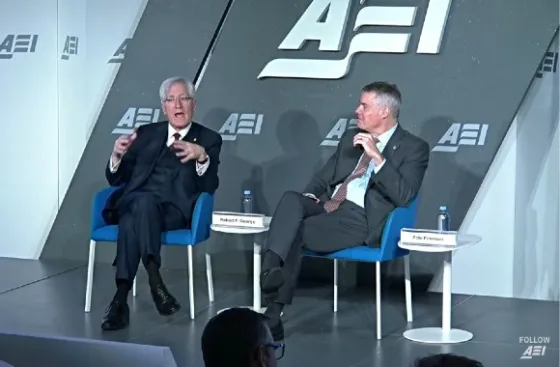
Key Takeaways
- Princeton Professor Robert George said cancel culture and bad ideas about 'hate speech' originated on college campuses and then filtered into the broader culture.
- To reform, George said universities should encourage students of different opinions to develop relationships and engage in civil, intellectual discourse.
- The professor pointed back to the ideas of Founding Father James Madison who believed, 'Only a well-instructed people can be permanently free people.'
“What happens on campus doesn’t stay on campus. For better or for worse,” Princeton University Professor Robert George said during a recent talk about how free speech ideas in higher education have filtered into the broader culture.
George, a well-known conservative, spoke Friday at the event “Faithful Free Speech: From Campus to the Hill,” hosted by the American Enterprise Institute and Faith and Law, a non-partisan organization that serves congressional staff, integrating faith and policy. AEI is a think tank based in Washington, D.C. that defends human dignity and prioritizes the values of the nation’s founding.
Pete Peterson, dean of Pepperdine University’s School of Public Policy, spoke with George about the founders’ intention behind the First Amendment in connecting religion and speech.
George, the McCormick professor of jurisprudence at Princeton, quoted the Declaration of Independence, which says human beings’ rights are “endowed” by God.
“In other words, the role of government is to secure rights that government did not create,” George said. “Those rights don’t come from the hands of kings or presidents or parliaments or Congresses or Supreme Courts. They come from no merely human power.”
The government’s job is to secure these rights by making sure “people do not become predators against each other, that people don’t violate each other’s rights,” he said.
Recalling a quote from James Madison, George said, “Only a well-instructed people can be permanently free people. And the way we gain instruction is not simply by going to school. That’s important. It’s very important. But that’s not the only way.”
George continued, “We gain instruction by engaging with each other, by trading reasons and arguments, by doing business with each other in the proper currency of intellectual discourse.”
He urged Americans to pay attention to what is happening on college campuses because “what happens on campus really is vital to what happens in the broader society.”
He gave the example of how “hate speech” is now widely considered to be an exception to the First Amendment, an idea that began on college campuses.
George said his students at Princeton are high achievers, valedictorians and top-level SAT scorers. But when he teaches Constitutional law and asks what types of speech are not protected by the First Amendment, they often mention “hate speech.”
“There is no such category which in our Constitutional jurisprudence constitutes an exception, and for very good reasons,” he said.
“We don’t want the government deciding what counts as hate speech and shutting down some people’s ideas and arguments on the grounds that they are hate speech. That idea began on campus, and it’s now spread throughout the culture. And it’s a very, very bad idea,” George said.
Peters brought up an observation by Greg Lukianoff, founder of the Foundation for Individual Rights and Expression, who once said that Americans are awakening from the mistaken belief that such ideas are limited to college campuses.
Agreeing, George said cancel culture and speech restrictions are now influencing corporations and public policy.
“For better or for worse, what happens on campus seems in our society to profoundly influence lots of other areas of life. Sometimes what happens in corporate boardrooms is a result of what ideas or practices that began have their origins on campus,” he said.
To counter “hate speech,” George said the answer is more speech: “It’s not the government stepping in. It’s not walking away and refusing to listen.”
Another way to counteract “cancel culture” is for universities to fulfill their mission as truth-seeking institutions by encouraging students to establish relationships with others who hold different opinions, he said.
Drawing on his relationship with Cornel West, a Democratic socialist and Dietrich Bonhoeffer Chair at Union Theological Seminary, George shared how their mutual pursuit of truth and shared religion bridge the gap between their deep political divides.
Together, they recently published a book, “Truth Matters: A Dialogue on Productive Disagreement in an Age of Division,” which George recommended young people to read.
At Pepperdine, which emphasizes civil discourse as part of its mission, Peterson said he sees friendships and even, on rare occasion, marriages result from healthy discussions with people of other viewpoints.
Still, George recognized that threats to free speech emerge from more than just the left or college campuses.
He brought up recent comments that U.S. Attorney General Pam Bondi made after the assassination of conservative leader Charlie Kirk. Bondi suggested that hate speech is not free speech — a position that George rejected.
“My former student, Ted Cruz, God bless him,” George said, referring to the U.S. Senator from Texas. “Ted, who studied Constitutional law with me at Princeton, immediately and unequivocally condemned Pam Bondi’s claim that there was a distinction between free speech and hate speech.
“And I thought to myself, oh, be darned. Ted was paying attention in class that day,” George said.
MORE: National conservative student group demands ‘Contract for Safe Campus Dialogue’