
 FIX EXCLUSIVES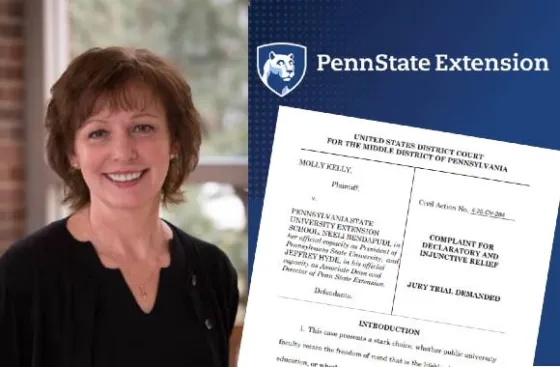
Attorney says public universities must be viewpoint neutral in their employment decisions
A Penn State University educator alleges the public institution twice denied her a promotion because she didn’t “demonstrate sufficient ideological commitment to the University’s prescribed DEI orthodoxy,” according to a lawsuit filed this month.
“The University’s promotion decision was explicitly grounded on participation in an ideological program,” Reilly Stephens, senior counsel and director of amicus practice at the Liberty Justice Center, told The College Fix in a recent email.
Stephens’ legal center is representing Molly Kelly, an extension educator and scholar of enology, the science of winemaking, at Penn State’s Extension School. Kelly has been teaching at the university since 2018, and is still employed there, according to her bio.
The extension, operated through the public university’s agricultural college, offers “science-based” educational materials, workshops, conferences, and other resources to members of the community, including farmers and small business owners.
However, Kelly’s lawsuit alleges Penn State’s Promotion Dossier Review Committee rejected her for a promotion twice in 2024 for not complying with its DEI goals.
The decision against promoting her was not due to lack of professional accomplishments, which include the securing of grant funding, numerous peer-reviewed articles, and the development of educational programs for the university, according to the lawsuit.
The committee explicitly stated that its denial was due to “[m]inimum diversity training hours,” and Kelly’s use of an “old affirmative action and non-discrimination statement,” the lawsuit alleges.
The committee also mentioned “no evidence of efforts to reach underserved audiences” even after she did “site visits and provid[ed] technical expertise to LGBTQ and Greek Orthodox-owned businesses,” according to the case.
The lawsuit alleges Kelly’s First and 14th Amendment rights were violated by the ideological litmus test laid out in Penn State Extension’s promotion system criteria.
The criteria include: “outstanding ability to design programs that are culturally sensitive,” “[r]obust evidence of program impact with underrepresented audiences,” and “the ability to see other points of view.”
In an emailed statement to The Fix, Stephens said the Constitution requires public institutions to be “view-point neutral” in their employment decisions.
“Dr. Kelly was not denied on the merits of her substantive work, but on her failure to advance a particular political agenda,” Stephens said.
The lawsuit additionally alleges that this non-neutral viewpoint constitutes “thought-policing” and the penalization of “constitutionally protected exercise of conscience” as the public university was “demanding a confession of genuine ideological conversion, not merely participation in professional development activities.”
Wyatt DuBois, a spokesman for Penn State’s Office of the President, said the university “does not comment on pending litigation” when contacted for comment about the lawsuit.
The Foundation for Individual Rights and Expression declined to comment. Neither the American Association for Access, Equity, and Diversity nor the American Civil Liberties Union responded to The Fix’s requests for comment on the lawsuit.
MORE: Arcadia U. launches racism minor to train students in ‘antiracist advocacy’

