
 FEATURED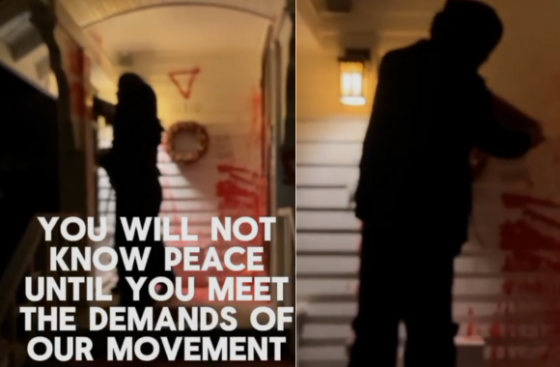
Police have yet to identify the pro-Palestinian vandals who caused $7K worth of damage to the home of University of Washington’s former president, according to police reports obtained by The College Fix through a public records request.
The Fix recently obtained the police report and notes for Seattle’s investigation into the November 14, 2024 attack on Ana Mari Cauce’s home and car. This attack followed a similar pro-Palestinian vandalism at the university’s mansion, which is available for use by the school’s president on October 28, 2024. Cauce retired last summer.
The vandals spray painted the front of her house and her car, then slashed three of her tires. They left messages including “FREE PALESTINE” and “ANA MARI COMPLICIT IN GENOCIDE,” among other pro-Palestinian messages,” The Fix previously reported.
“The movement will continue to apply pressure to Ana Mari until UW cuts ties with war profiteers such as Boeing, and divests from the Zionist entity,” one message also stated, referring to Israel. President Cauce supported a ceasefire in Gaza but opposed Israeli divestment, according to Fox 13.
The Seattle Police Department ultimately closed the case in April 2025 after being unable to identify suspects, despite months of investigation, video review, and several search warrants, according to the new police reports.
SPD had multiple search warrants for cell phone records, social media data, and surveillance footage. The police obtained records from AT&T and T-Mobile for cell phones present in the area at the time of the attack. However, law enforcement determined the phones were in the area because they belonged to residents and were not traceable to the vandals.
According to the police report, at least seven suspects were involved in the vandalism of Cauce’s private residence and vehicle. Vandals spray painted her home and vehicle with red paint and slashed three tires.
Sarah Mulloy, the reporting officer, reviewed security footage from Jane Addams Middle School, which is across the street from Cauce’s residence. The Fix attempted to connect with Mulloy for an interview, but ultimately was unable as she is on medical leave.
The report details the quick maneuvers of the vandals to attack Cauce’s home.
Two suspect vehicles arrived near the residence after 2 a.m. on November 14. Suspects exited the vehicles, vandalized the home and car, then were picked up minutes later after the vehicles circled the block multiple times.
Mulloy described the activity as organized, with coordinated drop-offs, pickups, and a lookout on foot. The lookout had repeatedly walked past Cauce’s residence before and after the vandalism.
The SPD investigators also reviewed video from nearby schools and businesses but were unable to identify license plates or suspects.
The same day of the vandalism, someone fraudulently ordered a Domino’s pizza and delivered it to Cauce’s home. The order was placed online using her name, address, phone number, and an old university email account. Sending unsolicited pizzas to someone’s address is a tactic of intimidation – a similar ploy in 2025 directed at federal judges prompted a U.S. Marshals’ investigation.
Police determined the pizza order originated from an IP address routed through a foreign-based server, so it could not be traced.
Again that day, someone sent a threatening email to Seattle police falsely claiming responsibility for murders and threatening a mass shooting at the University of Washington. SPD confirmed the threat was not credible and that Cauce and her spouse were safe.
In the report, Mulloy noted similarities between the November 14 attack and an earlier vandalism on September 27 that occurred on campus. The report also mentioned the October 28, 2024 attack on the university’s presidential mansion. Seattle police believe the incidents may be connected, but they could not confirm a common suspect.
Due to the detective remaining on medical leave, the police department told The Fix it is unable to answer questions about the case at this time. The Fix asked whether the vandalism incidents were connected or coordinated, whether the case remains open, and whether activists were further investigated.
During the investigation, Cauce told police she feared for her family’s safety. She and her spouse reported emotional distress and difficulty sleeping.
Cauce did not respond to several requests for comment from The Fix in the past month asking if the university has done enough to protect her and her family and if she believes the attacks were politically motivated. The Fix also emailed Cauce’s spouse, Professor Susan Joslyn, to ask about the situation. She did not respond to an email sent on Jan. 19.
University spokesman Vic Balta told The Fix “[t]he University takes the safety of University leadership and the entire UW community very seriously” and directed questions to SPD.
‘Clock is ticking,’ pro-Palestinian group threatens
As previously reported by The Fix, the vandalism was posted on the Escalate_Seattle Instagram account. It posted photos and videos of the attack and warned that “the clock is ticking” unless UW cuts ties with Boeing and divests from Israel.
Escalate Seattle did not respond to several requests via email and Instagram for comment from The Fix in the past month asking about their endorsement of an “autonomous group” at President Cauce’s residence, the damages caused, or whether targeting university leaders advances their goals.
Pro-Palestinian groups, including Zaytoon UW, Students United for Palestinian Equality & Return UW, and UW Faculty & Staff for Justice in Palestine also did not respond to several requests for comment from The Fix in the past month asking if they believe actions like these harm or help Palestinian solidarity.
The groups also did not respond to questions about any information on these incidents and if they condemned the vandalism and threats directed at the UW president.

