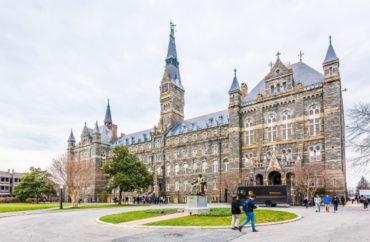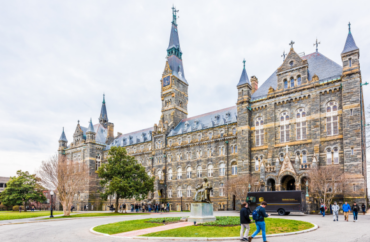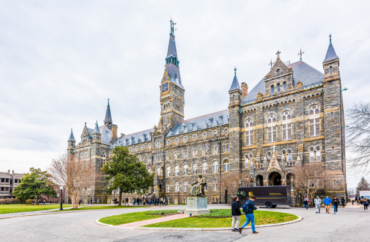
Georgetown University

Move over Skull & Bones, there’s another clandestine student group making waves.

A so-called “secret society” at Georgetown University recently prompted a campus uproar, and The Washington Post’s Ian Shapira sums up the brouhaha nicely:

The anonymous blogger discovered the secret society’s internal e-mails and gleefully published the most amusing material: members deliberating over which ties to wear (Brooks Brothers, of course) and another insider venting about the “extremely left-wing tilt” of the Georgetown University campus tour.

The blogger’s bombshell: The top candidate for student government president was a secret-society member. Published online just days before the election late last month, the exposé sent the campus into an uproar. Web traffic at the Hoya, the student newspaper, surged from an average of 2,500 daily page views to a record 32,000 that day. And the candidate linked to the secret society, Jack Appelbaum, was narrowly defeated.

At Georgetown, only one organization can inspire that kind of mayhem: the Second Stewards Society. The all-male group, which doesn’t identify its members or detail its activities, has long been a source of rumor and controversy on the 104-acre campus, where some students harbor suspicions that group members are pushing a right-wing political agenda — charges the Stewards call absurd.

Apparently the Stewards have a long and distinguished career of making waves and causing controversy on campus.

Click here to read more.

CLICK HERE to Like The College Fix on Facebook.

{ 1 comment }

Two prominent activists have launched a campaign on college campuses to argue that the federal government ignores “right-wing violence” while it unlawfully targets environmentalist protestors.

Journalist Will Potter, often accompanied by notorious animal rights activist Jake Conroy, has visited several universities over the last few months to tell students and professors – including law school students and educators – that the FBI is abusing the 2006 “Animal Enterprise Terrorism Act” to target and jail animal rights activists and other social justice protestors.

They claim law enforcement officers use the law to convict non-violent protestors as “eco-terrorists,” but meanwhile don’t prioritize capturing “right-wing extremists” who commit heinous crimes against minorities. They use Conroy – convicted under the act – as a prime example.

Underscoring their campus speeches, Potter’s 2011 book “Green Is The New Red” is frequently becoming required reading on many colleges campuses, including: Georgetown University’s “Politics of Terrorism and Political Violence” course; University of Denver’s Sturm College of Law’s civil rights litigation class; American University’s social justice course; Northern Arizona University’s politics and protest course; and at other colleges, according to a compilation on Potter’s website.

And while Potter’s rhetoric largely accuses the FBI of targeting so-called left-wing protestors while ignoring what he frequently refers to as “right-wing extremists,” the law has also received criticism by conservative groups that say it goes too far.

“The law has emerged as a central example of how Congress has eroded the legal concept of mens rea, which is Latin for ‘guilty mind’—a long-held protection that says a defendant must know they’ve done something wrong to be found guilty of it,” states a Sept. 2011 article in The Wall Street Journal. “The 2006 act was cited in a joint study by the conservative Heritage Foundation and the National Association of Criminal Defense Lawyers as an example of an overly broad law, particularly the way it clashed with First Amendment free-speech protections.”

A late January speech by Potter and Conroy at Duke University’s school of law echoed those sentiments. They discussed Conroy’s prosecution to raise questions about the violations of protestors’ First Amendment rights.

Conroy was convicted under the Animal Enterprise Protection Act and sentenced to forty-eight months in federal prison. Recently released, he is now completing three years of probation.

Conroy had been a member of the infamous SHAC 7, which campaigned to close a notorious animal testing lab. In his speech, Conroy alleged the Philadelphia-based corporation killed upwards of 500 animals per day and participated in acts of animal cruelty, such as dissecting animals without first euthanizing them.

Conroy said he used an assortment of tactics in the campaign to stop the lab, but denied using any physical violence against people or animals.

“The ‘terrorist’ campaign of the SHAC 7 didn’t involve anthrax, pipe bombs, or a plot to hijack an airplane,” Potter’s website states. “They ran a website. On that website, they posted news about the campaign — legal actions like protests and illegal actions like stealing animals from labs — and unabashedly supported all of it.”

Conroy, in his speech, said his group considered their campaign successful as the corporation’s stock price went from $30 to cents on the dollar, but he added that’s when the trouble started.

He said he was investigated as a domestic terrorist for acts of economic sabotage, as the federal government considers economic damage to a specific corporation in an amount greater than $10,000 to be an act of domestic terrorism.

But Conroy said he saw his involvement in the campaign – maintaining the group’s website and participating in nonviolent demonstrations – as protected free speech.

Conroy and Potter claimed the feds’ priorities are out of whack.

Potter, in his talk, argued “right-wing violence” such as rape, murder, and assault, have increased 400 percent since 1990, yet the federal government considers eco-terrorism America’s greatest threat, citing various government documents.

On his website, Potter loosely defines right-wing violence as crimes directed against ethnic and religious minorities as well as the homosexual community.

“When examined side-by-side with FBI reports on domestic terrorism, the data … shows that the FBI has been either grossly miscalculating, or intentionally downplaying, murders and violent attacks by right-wing extremists, while exaggerating the threat posed by animal rights activists and environmentalists, who have only destroyed property,” Potter states.

Potter, in his speech at Duke University, said American’s First Amendment rights are in jeopardy from the federal government through its use of the Animal Enterprise Terrorism Act, noting the law is used to prosecute nonviolent civil disobedience, citing Conroy’s experience as one such example.

He added individuals who conduct undercover investigations, such as news organizations, to gather evidence or expose animal cruelty can also now be prosecuted as domestic terrorists under the law.

Potter warned attendees that due to the extensive research for his book, conducted using the Freedom of Information Act to obtain hundreds of thousands of documents relating to eco-terrorism, that he is often monitored by the FBI.

He even suggested the feds could be monitoring his presentation, and said FBI agents have previously attended his lectures.

Potter also warned the animal terrorism act could be abused by law enforcement if groups of consumers banded together to choose not to purchase a product and encouraged others to do so as well, thus disrupting a specific corporation’s ability to create a profit.

He said those protestors could be seen as domestic terrorists engaged in economic sabotage. At what point, he asked, does ideology become illegal instead of protected free speech?

Several students appeared visibly upset after the talk.

Fix contributor Jessica Kubusch is a student at the University of North Carolina – Chapel Hill.

Click here to Like The College Fix on Facebook.

IMAGE: The4Mahers1997/Flickr

{ 0 comments }

A Supreme Court decision on whether universities can use race as an admissions factor is expected by June, however the court of public opinion has already weighed in on the matter – and Americans of all stripes stand largely against affirmative action, according to a variety of recent polls.

In those surveys, at least half if not more of those polled voiced opposition to race-based preferences.

Take a Rasmussen national telephone survey, which found only 24 percent of likely voters were in favor of using race as a factor in college admissions, while 55 percent stood opposed, and the rest were undecided. That survey was conducted 11 months ago.

More recently, a survey released in October found that 57 percent of Americans ages 18 to 25 – so-called young millennials – are opposed to racial preferences in college admissions or hiring decisions. In other words, nearly six out of every 10 opposed the practice.

“Although most younger millennials are firmly opposed to affirmative action programs in college admissions, relatively few report that they were hurt in the college admissions process because of their race or gender,” states a report on the results of the survey, conducted by the Berkley Center for Religion, Peace, & World Affairs at Georgetown University and the Public Religion Research Institute.

Results also indicated 47 percent of those in that age group “oppose programs that make special efforts to help blacks and other minorities to get ahead because of past discrimination.”

What’s more, the survey found “support for affirmative action programs diminishes considerably when younger millennials are asked specifically about affirmative action for college admission.”

The same month that survey was released, the Supreme Court heard oral arguments in the case Fisher v. the University of Texas, which deals with race-conscious college admissions in America’s public universities.

Most of academia has expressed support for the University of Texas, which aims to continue its practice of using race as a preferential factor in admissions decisions. Administrators and faculty at elite schools have also chimed in, defending the notion of “diversity” in the classroom. All members of the Ivy League, the nation’s top liberal arts colleges, and other big-name schools, have filed amicus briefs on University of Texas’ behalf.

Yet the higher education community’s overwhelming support for racial preferences is not mirrored by the general public.

This month, the American Enterprise Institute released a political report that compiled public opinion on a variety of issues, including affirmative action. In its publication, the organization cited data from a 2010 survey by the National Opinion Research Center which found that a vast majority of Americans – 81 percent – oppose affirmative action policies that favor African Americans.

What’s more, only between 44 and 62 percent of blacks polled voiced support for various minority preferences, the poll found. AEI’s public opinion analyst Karlyn Bowman notes, in an interview with The College Fix, that results on such a sensitive topic are always swayed by how pollsters’ frame the question.

Nevertheless, she points to perhaps the most consistent of all affirmative action data available, an annual survey by the UCLA-based Higher Education Research Institute. The poll has found that, since 1995 and every year since, roughly 50 percent of college freshmen believe race-based university admissions preferences should be abolished.

“You could balance a glass of water on that line it’s so flat,” Bowman says.

Fix contributor Danielle Charette is a student at Swarthmore College.

Click here to Like The College Fix on Facebook.

IMAGE: Donkey Hotey/Flickr


{ 7 comments }

Shortly after Constitution Day in September, The College Fix reported on a number of scholars who used the occasion to bash the document and what it stood for.

More recently, one of the scholars quoted in that College Fix article, Georgetown University law professor Michael Seidman, has made national headlines for his column in The New York Times titled “Let’s Give Up On the Constitution.”

It read in part that “our obsession with the Constitution has saddled us with a dysfunctional political system, kept us from debating the merits of divisive issues and inflamed our public discourse. Instead of arguing about what is to be done, we argue about what James Madison might have wanted done 225 years ago.”

The Dec. 30 piece has prompted many critical responses in a variety of news outlets. However, Seidman has offered that mantra for a while now.

Here’s an excerpt from The College Fix article on Seidman’s post-Constitution Day comments:

A recent Drake University event featured Georgetown University law professor Michael Seidman, who stated in his guest lecture at the Iowa campus that “we should give up on the idea that we have an obligation to obey the Constitution of the United States,” according to an article in the Times-Delphic student newspaper.

The article also notes that Seidman referred to the Constitution as “outdated,” said countries such as England and Australia, which don’t have a Constitution, have better civil liberty records than America, and “that the Constitution prevents beneficial discussions from taking place in the United States.”

“We need to be clear about exactly what it means to obey a text. The only circumstance in which obedience takes hold is when, but for the Constitution, we would do something else, and only because of the Constitution we would do something that we would not otherwise do,” Seidman is quoted as saying.

Click here to read Seidman’s entire New York Times piece.

Click here to read The College Fix’s entire post-Constitution Day coverage.

Click here to Like The College Fix on Facebook.


{ 1 comment }

Several universities across the nation used recent Constitution Day activities to criticize the founding document, or America in general, despite the fact that the observance calls for civic education and commemoration.

Take for example Harvard Professor Alexander Keyssar’s recent address at Swarthmore College. He used the opportunity to make sweeping criticisms against the United States.

Keyssar’s lecture, named after his book “The Right to Vote: The Contested History of Democracy in the United States,” touched only in passing on the passage of the Thirteenth, Fourteenth, and Fifteenth Amendments. Instead, most of the speech tied today’s voter ID laws, passed largely by Republican legislatures, to the Jim Crow-era.

“The dirty little secret of democracy in America,” Keyssar opined in his speech, “is that not everyone actually believes in it.”

In another example, a recent Drake University event featured Georgetown University law professor Michael Seidman, who stated in his guest lecture at the Iowa campus that “we should give up on the idea that we have an obligation to obey the Constitution of the United States,” according to an article in the Times-Delphic student newspaper.

The article also notes that Seidman referred to the Constitution as “outdated,” said countries such as England and Australia, which don’t have a Constitution, have better civil liberty records than America, and “that the Constitution prevents beneficial discussions from taking place in the United States.”

“We need to be clear about exactly what it means to obey a text. The only circumstance in which obedience takes hold is when, but for the Constitution, we would do something else, and only because of the Constitution we would do something that we would not otherwise do,” Seidman is quoted as saying.

Meanwhile, at Wesleyan University, Judge Stephen Gold delivered a recent Constitution Day talk that appeared to be only tenuously related to the broader mission of Constitution Day. It was called “Imposing Sentence: The Balance Between Affording Discretion and Avoiding Disparity.”

And an article by The Heritage Foundation’s Bronson Stocking took aim at recent Constitution Day event at UC Berkeley, noting that:

“ … the University of California, Berkeley was celebrating the signing of the Constitution with a panel discussion on the topic of ‘the history, growth, and future of America’s prison-industrial complex.’ The title of the event, ‘The Constitutional Crisis of Imprisonment: Mass Incarceration and the Future of America Democracy,’ suggests the direction that planners had decided to steer the conversation. It’s unclear if students emerged from the ‘discussion’ about ‘the prison-industrial complex’ with a rich understanding of the U.S. Constitution.”

Stocking’s article also highlighted an event at Smith College titled “Let’s Start Drama: Bullying and the First Amendment.”

Despite these egregious examples, most universities across the nation respected the Constitution in supportive and honoring ways, from passing out copies of the Constitution, to reading parts of it out loud, to hosting fun and creative game shows and other lighthearted events to brush students up on their knowledge of the historic document.

This year, Amherst College kept things simple, with various professors and students volunteering to read the text aloud. Hillsdale College rang in the Constitution’s birthday in elaborate fashion, with a multi-speaker colloquium and online Constitution 101 lectures for the public at large. Notably, Hillsdale is one of only a few U.S. colleges that forego federal loans and subsidies.

That’s an important fact when considering that a law passed in 2004 requires all American universities that receive federal funds – virtually every college in the nation – to recognize Constitution Day in some fashion.

If recent data is any indication, that’s needed now more than ever.

As an Intercollegiate Studies Institute’s Civic Literacy Report revealed, college students have a truly dismal knowledge of America’s founding and history.

The average college student flunked the 60 question multiple-choice test, administered in 2008.

Of the 14,000 surveyed, freshmen at elite institutions like Yale, Cornell and Princeton actually out-scored the seniors, suggesting a brain drain as students move toward their degrees at the Ivy League and elsewhere.

Fix Contributor Danielle Charette is a student at Swarthmore College.

Click here to Like The College Fix on Facebook.

IMAGE: Mr. T in DC/Flickr

{ 1 comment }