BUZZ
BUZZ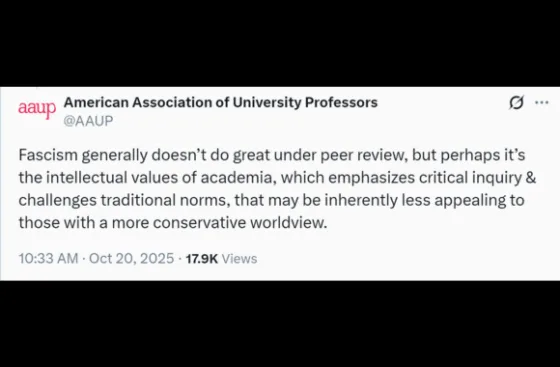
Key Takeaways
- The AAUP faced backlash for its statements regarding the scarcity of conservative professors in academia, attributing the issue to the 'intellectual values of academia' that prioritize critical inquiry, which the group says may not align with conservative viewpoints.
- Emma Pettit highlighted the lack of awareness among professors about academia's left-leaning reputation, prompting discussions about 'viewpoint diversity' and how it is perceived in higher education.
- Critics, including professors and academics, accused the AAUP of being out of touch and elitist, arguing that their statements alienated the American public and failed to acknowledge discrimination against conservatives in academic spaces.
The Association of American University Professors is facing backlash for its explanation of why there are few conservative professors.
Arguments began when Emma Pettit, a reporter for the Chronicle of Higher Education, posted a thread on X highlighting recent articles exploring the idea of “viewpoint diversity,” or ensuring different views are represented in higher education. Pettit mainly posted different links, including from the AAUP’s own publication, but then suggested academia does not realize there is a problem.
“My 2 cents, as someone who covers academic culture, is that I’ve made this point (less bluntly) to professors I interview, who are sometimes surprised they have this reputation,” she wrote on X. “Or they insist higher ed isn’t actually that left-leaning. (To which I say…let’s look at the data.)”
My 2 cents, as someone who covers academic culture, is that I’ve made this point (less bluntly) to professors I interview, who are sometimes surprised they have this reputation. Or they insist higher ed isn’t actually that left-leaning. (To which I say…let’s look at the data.) pic.twitter.com/3RWP2S9po4
— Emma Pettit (@EmmaJanePettit) October 20, 2025
In response, the faculty union offered its own assessment, stating: “Fascism generally doesn’t do great under peer review, but perhaps it’s the intellectual values of academia, which emphasizes critical inquiry & challenges traditional norms, that may be inherently less appealing to those with a more conservative worldview.”

It then clarified: “Conservatives are not fascist. Higher ed should always be a place for rigorous dissent. Yet, far-right authoritarians vowing to ‘aggressively attack universities in this country’ w/ the goal of the annihilation of American higher education as we know it is another thing entirely.”
“The pursuit of knowledge wherever it may lead does not appear to be a goal of the modern conservative movement,” the AAUP said as well.
The X page also began arguing with Greg Lukianoff, CEO of the Foundation for Individual Rights and Expression.
“The self-congratulating fantasy in which a guild that exists to defend a trillion-dollar industry represents the forces of light against any critic—who by the way would have to be a fascist to see the obvious and systemic problems in higher ed—is not only deeply anti-intellectual, it’s childish,” Lukianoff wrote on X.
“Oh Greg, there’s got to be right wing ideologue, Young Americans for Liberty, or Turning Point USA chapter out there that needs your urgent support…,” the AAUP account wrote, along with a yawning emoji.
The AAUP’s comments drew criticism from a number of academics who said the faculty union was off the mark.
“You fools at [AAUP] still have no idea how totally you’ve alienated the American people with your preachy, self-righteous, radical leftist arrogance, do you? How exactly do you think that will go for you,” University of New Mexico Professor Geoffrey Miller wrote. “How exactly do you think that will go for you?
Harvard University law Professor Jack Goldsmith wrote: “perfect, and perfectly revealing, in every detail.”
“Talk about saying the quiet part out loud,” Steve McGuire, a former Villanova University professor, wrote on X.
“What a disastrous position for the faculty union to take,” McGuire, a scholar with the American Council of Trustees and Alumni, wrote further. “And then people will deny that there’s significant discrimination against conservatives in higher ed.”