
 FEATURED
‘I feel there is only one viewpoint “allowed” on campus – the politically correct viewpoint – and this prevents students from learning how to have reasonable discourse with those who hold differing views.’
Just over 40 percent of faculty at the University of Michigan said they have either felt pressure to censor course content or speech or have been censored or self-censored, according to a recent Faculty Senate survey.
The survey is a follow-up to a similar report in 2025 that found more than half of faculty are “self-censoring” their instruction. The most recent report asked faculty about their experiences with censorship and self-censorship in speech and curriculum since the last survey.
Of the more than 700 faculty who answered, 31 percent said they “self-censored” or had their curriculum censored. Another 11 percent said they have “felt pressure” to censor their teaching, but did not act on it.
The Senate Advisory Committee on University Affairs and the Faculty Protections Working Group devised the survey in “light of what we learned” in the 2025 report and “the political challenges that have arisen in the past few months.”
The information gathered from the survey, published at the end of March, will be used to “inform faculty governance: how can we advocate for faculty, what types of events can we offer, etc.,” according to the introduction to the survey.
The College Fix contacted the Faculty Senate and university media relations several times over the past three weeks, asking for comment on the results of the survey as well as the university’s efforts regarding free speech and faculty. Neither responded.
The report did receive attention from one UMich professor online.
“About half of the 700+ faculty who responded said they’ve felt pressure to censor teaching. 226 respondents have acceded to this pressure due to fears of the general climate, student retaliation evals etc,” medical school Professor Kristen Collier wrote on X. Collier declined to comment further when contacted by The Fix.
The survey included dozens of detailed, anonymous comments about faculty members’ personal experiences as well as the statistics.
When asked about the reasons for censorship, professors cited fear due to the general higher education climate as the major reason, including fear of students recording a lecture, bad reviews from students, and student retaliation.
Other responses included fears about their personal information being exposed online. One faculty member commented, “I often just don’t feel up to taking on topics that could lead to doxxing/harassment/unwanted attention.”
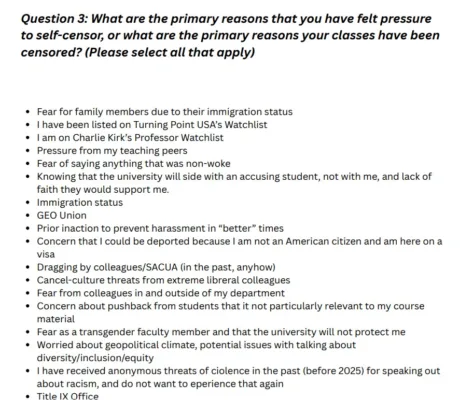
Regarding what exactly is being censored, the professors’ responses largely fell into two categories: diversity, equity and inclusion, and American politics/policy.
When asked “if you self-censored or were censored as an instructor, what were the classroom topics you avoided or restricted?” the top response was DEI, with just over 50 percent choosing that option. Participants were allowed to select multiple options.
DEI was followed closely by U.S. politics at around 47 percent. Other issues near the top included “Middle East/Palestine/Israel,” “Gender,” and “Race/Ethnicity.”
Responses to the survey included mixed opinions about how the university’s DEI-related actions impacted their freedom to speak.
Over the last decade or so, UMich has spent roughly a quarter billion dollars on DEI efforts, according to a report by Higher Ed Dive.
Recently, the university closed its DEI office and ended its DEI strategic plan; however, an analysis found that the public institution is still spending millions on diversity-related efforts, The College Fix reported in April.
In one survey response, a professor suggested that recent scrutiny of DEI is prompting self-censorship:
“By not feeling safe to discuss DEI with my Engineering students, I do not believe I’m fully preparing them for their next chapter in industry or further academic studies. It was not a topic that took up a lot of time in my courses previously, but that context is an important component of an Engineering education.”
However, other comments seemed to push back on the university’s long-time commitment to DEI:
“Students are prevented from hearing alternative perspectives. My goal is to teach them critical thinking that allows them to make constructive choices throughout their lives and as active citizens who contribute to society – regardless of the choice they make. By limiting what types of information a student has access to, we not only fail to teach critical thinking, but we are also putting up barriers to creativity and innovation. We limit what students can imagine. And I believe it’s imagination that pushes social progress and change.”
Regarding the impacts of censorship on students, another professor mentioned fearing not being able to talk about controversial topics:
“One concern I have is that it may become more ‘normal’ for classes to avoid really sensitive topics. Classrooms are one of the best spaces to bring conflicting opinions out into dialogue and I am worried that there are fewer and fewer places to engage in good faith conversations around controversial topics.”
When professors were asked the open-ended question of why they self-censored, several raised concerns about specific university departments or perceived threats on the basis of political views.
Several participants mentioned uncertainty about whether their superiors would support them, presumably if a student were to complain regarding the class. In their own words, professors explained why they self-censored:
“Knowing that the university will side with an accusing student.”
“Most pressure is from the faculty, dean, administration. There is great pressure to comply to ‘their’ way of thinking.”
Of the 30 responses to this specific question, seven mentioned fear or threats from faculty. Several also mentioned having been harassed in the past in some way, either by students, faculty, or offices of the university.
When asked how censorship has impacted their student’s education, participants mentioned the limitations it places on their learning and ability to draw conclusions.
“I believe students have been robbed of the opportunity for fully-orbed discussions of current issues. I feel there is only one viewpoint ‘allowed’ on campus – the politically correct viewpoint – and this prevents students from learning how to have reasonable discourse with those who hold differing views. This misguided approach has played a role in creating the violent intolerance tearing our nation apart.”
One participant commented on the effect of being afraid to present sound, factual information: “I would fail to give them information and strategies based in scholarship that can help them evaluate and respond to misinformation in their surroundings.”
Another commented: “I think the ability to speak freely is the gateway to reason. Without knowing all sides of an argument, we cannot draw a conclusion.”
The survey also asked faculty about censorship in their research and extra-mural speech.
The Fix also contacted the Heterodox Academy and National Association of Scholars twice via email to ask about the survey and larger concerns about faculty censorship, but neither responded.
MORE: Demands grow to censure UMich faculty chair who praised anti-Israel protesters in grad speech
MORE: UMich spends $100K on DEI 2.0 launch: cotton candy cart, hip-hop performance

