FEATURED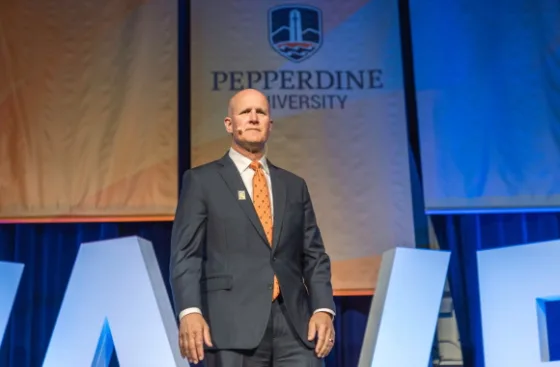
OPINION: Pepperdine President Jim Gash talks culture, faith, and defying higher ed trends in interview with The College Fix
Higher education’s reputation in America has taken a nosedive — especially in the last decade — but several institutions have managed to stay above the fray, maintain excellence, and enjoy continued respect and an untarnished image.
Pepperdine University is one of those campuses. Nestled atop a Malibu hillside overlooking an endless, sparkling expanse of the Pacific Ocean, the private Christian school is known for its stellar academics within a wholesome atmosphere.
“Pepperdine is the kind of campus that God himself would have built if only he could afford it,” Pepperdine University President Jim Gash recently quipped in an exclusive interview with The College Fix.
Pepperdine’s tuition, minus any scholarships, rings in at $72,000 a year, and that doesn’t include housing costs. But what comes with that price tag comes an institution steadfast in its commitment to its Christian identity and mission to foster a vibrant academic environment rooted in faith and open inquiry.
In a candid conversation with The College Fix, Gash delved into the intentional strategies that sustain Pepperdine’s culture, the challenges facing higher education in maintaining moral and intellectual integrity, and Pepperdine’s vision for nurturing purposeful leadership in today’s increasingly secular world.
The College Fix: How has Pepperdine maintained perhaps one of the most stellar reputations in higher education in terms of not only its academics, but also the campus culture and the overall positive, wholesome experience?
President Gash: Institutional culture and vision only maintains its direction and consistency through intentionality. That’s part of what we’re doing in hiring. Personnel is policy. It’s also vision and execution. Who we hire, who we give the baton to, who we give the microphone to, is critically important, which is why I insist on interviewing virtually every single person who comes through Pepperdine who is going to be in a leadership position, to ensure there’s consistency and there’s alignment. Alignment is everything.
Fix: In a recent op-ed in U.S. News & World Report headlined “Can Belief in God Strengthen Academic Freedom” you wrote about how Pepperdine welcomes students of all faith, or no faith, but that Pepperdine is a decidedly Christian institution. How does it manifest itself that way?
Gash: We are unashamedly and unapologetically a Christian institution with no caveats or equivocation, period. How that manifests is every single leader of the institution, every single member of the Board of Regents, the governing board, has a commitment to their Christian faith and living that out as a central part of their life. There aren’t exceptions to those things.
There’s not homogeneity in the faculty, however. If you want to be a tenured-track or tenured faculty member, you have to be an active member of a community of faith. And so we do have people who are non-Christians, Jewish, and a few Muslim professors, who are active members of their community of faith. But they come here knowing and believing and wanting to be part of an institution that values faith as a central part of people’s lives. So they are thrilled to be at a Christian institution, because that means their faith is going to be valued, because we believe in the protection of religious liberty.
Fix: In your op-ed you wrote: “The last 200 years have moved the Western academy toward secular intellectual inquiry. Many universities that began with explicit religious commitments and values now purport to be ‘neutral’ centers of thought, unbound by their founding commitments and freed by secular enlightenment to explore previously unquestionable aspects of truth – such as the existence of God, the nature of moral absolutes and the relevance of the values that inspired their founding.” So many universities have abandoned the concept of right and wrong. Is that what you’re saying there?
Gash: At many secular institutions you will find absolutes that really are just reflective of political positions. There’s a preclusion to questioning them, because if you question the ideological orthodoxy of that particular institution, well then, you’ve got a challenge on getting hired, you’ve got a challenge on getting tenured, you get a challenge on getting funded, and you become an outcast. There’s no dynamic inquiry and discussion seeking truth, because there’s a declaration that truth has already been discovered and established and cannot be questioned. That’s not true at places like Pepperdine, because we believe all truth belongs to God, and therefore we should continue to pursue it. Even if we think we have found what we believe to be right about something, we continue to pursue it, because where we end up, if we’re honest in our pursuit, is where God already is. We find His truth. There’s not my truth and your truth, there’s The truth.
Fix: You also wrote “It’s hard to argue that secular education has been a wholly positive development. The reality is that a ‘values-neutral’ education does not exist. Some set of guiding principles will be at play, whether intentionally or not.” You’re essentially saying that secular education has degraded higher education.
Gash: When I’m talking about secular institutions having their own truth claims, I don’t mean to suggest every single person within every single secular institution. I’m talking about writ large, secularism has harmed the search for truth because it has declared things that are still subject to investigation to be settled. We see this in a lot of political aspects of our world — science is settled on this, or the philosophy is settled on that. As a result, you can’t engage in the search for truth in those particular topics, because that institution, or that department, or that set of researchers, has declared it’s over, the inquiry is at an end.
Fix: Can a student get the best education at a university that, at its core, believes that nothing created everything? What is the ultimate solution to this problem?
Gash: The ultimate solution to the problem of recapturing higher education? I’ll just list a handful of things. First of all is to admit you have a problem, and we’re seeing that now. We’re seeing that institution after institution is either, through their board or through their senior leadership or through their alumni, saying, “Okay, we’ve got a problem, we have gone far afield, it’s time to admit we have a problem.”
Second is, where is it that we’re trying to go? What is our reason for existence as an institution? If you can rediscover that reason for existence, then you know what steps you need to take to get from where you are to where you’re going. And that rediscovery of your purpose as an institution is saying: “We are a place that seeks truth, publishes truth, and prepares people to lead as servant leaders.”
In other words, institutions should be a place of dialogue rather than declaration. We have schools, too many of them, who say “we have declared that X is the truth” instead of convening a conversation. We have shut down legitimate dialogue on real issues in favor of a declaratory statement as to what things are. So I think it is rediscovering how you get to the ultimate search for truth that you are trying to engage in as an institution of higher education, and then hold fast to that without compromise.
Fix: Are there any other themes or points that you want to drive home?
Gash: I’ll give you a little window into each year at Pepperdine. Each year has a theme. Last year was “freedom.” This year is “purpose.” We believe it’s critically important to understand that the foundation of the American experiment is freedom. But this year, with purpose, we also believe that you are made to have freedom for a purpose. It’s not freedom from, it’s freedom for. We’re going to be having a lot of conversations about how one finds one’s purpose, how one is equipped for one’s purpose, and how one lives into one’s purpose. There’s also a scripture that goes with each year as well. This year’s is Romans 8:28: “We’re all called according to His purpose.” That’s part of the culture we talked about. How do you maintain your Christian identity? You have a reminder at every aspect of what matters, in the classrooms, in the dormitories, in worship times. Constant reminders that you were made for a purpose, that you have freedom, that you’re the light of the world — that joy is the posture we’re called to.
This interview was edited for length and clarity.