FEATURED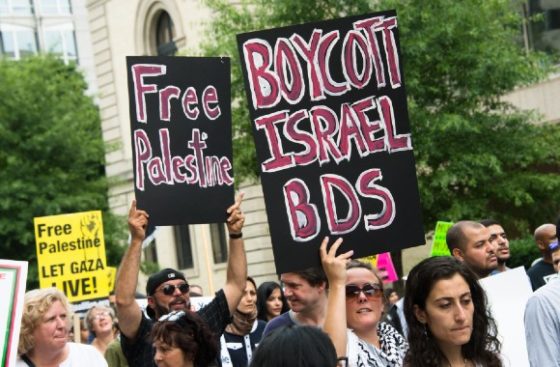
Boycott-supporting faculty are 7-8 times more likely to bring anti-Israel bias into classroom
A decade’s worth of research confirms that faculty support for the Boycott, Divestment, and Sanctions movement reliably predicts spikes in campus antisemitism, a chapter in a newly released book reveals.
“Toward the Last Encampment: Campus Culture and the Jews Before and After October 7,” edited by Alvin Rosenfeld, details the modern-day struggles that Jewish students and faculty endure on college and university campuses.
Contributor Tammi Rossman-Benjamin, director of the AMCHA Initiative, told The College Fix that she and her team performed six studies about antisemitism on college campuses. The AMCHA Initiative is a non-profit dedicated to combating campus antisemitism.
One of the studies focused on the number of faculty who supported the academic boycott of Israel.
She said that faculty involved in anti-Israel advocacy often actively support or publicly endorse an academic boycott of the Jewish state.
“It’s such a clear expression not only of sort of anti-Israel heinousness, but also the willingness and desire to bring that onto campus,” she said.
An academic boycott, Rossman-Benjamin said, aims to “bring a boycott of Israel to your campus” by effectively eliminating opportunities for students to study abroad in or take courses about Israel.
“We correlated that with other measures to see what was the extent to which faculty supported that anti-Semitic advocacy onto campus, into their classrooms and conference halls,” she said.
She said the research showed “an extremely strong, statistically, unbelievably robust association between faculty who support the academic boycott of Israel and faculty who are actually bringing that support into their classrooms.”
Faculty who endorse the boycott are seven to eight times more likely to introduce anti-Israel material into their courses compared to their peers, she said.
“The more faculty boycotters, the more anti-Israel events a department would be sponsoring,” Rossman-Benjamin said.
“We find departments [are] 10 to 12 times more likely to bring anti-Israel speakers if they themselves have an academic boycott supporting faculty in them,” she told The Fix.
She added that the most critical finding from their data is “an extremely strong link” between the number of faculty supporting academic boycotts and a surge in anti-Jewish incidents on campus, ranging from physical assaults to vandalism of Jewish property.
Rossman-Benjamin also told The Fix that she was inspired to start this research after experiencing “departmentally sponsored events that were clearly anti-Israel” as a University of California Santa Cruz faculty member from 1996 to 2016.
“They were clearly sort of taking a position in the Israel-Palestine conflict, and many of them were sponsored by departments,” she said.
She said that in 2007, she witnessed a university event on anti-Zionism sponsored by eight departments, including anthropology, sociology, and history. She said that she didn’t expect these departments to sponsor such an event.
“The event was five anti-Zionist Jews who presented the position that Israel had no right to exist,” Rossman-Benjamin said. “That was the ultimate conclusion of all five of the speakers.”
At the time, she expressed concern that anti-Zionist events were being propelled not merely by student organizers, but with direct faculty involvement and support.
“They were professors from across the country brought together purposely to speak as Jews against the Jewish state and in favor of its dismantlement and of its domination, [by] comparing Israel to a Nazi state and using all kinds of terminology to demonize and to delegitimize Israel,” she said.
Rossman-Benjamin recalled that the speakers accused Israel of ethnic cleansing and apartheid, labeling Zionism as illegitimate, racist, and comparable to Nazism.
“A lot of my students were Jewish professionals with medical backgrounds, and they were in shock,” she said. “We were all in shock. My students were traumatized. I was traumatized. I just couldn’t believe it.”
After the event, Rossman-Benjamin and her colleagues attempted to talk to the department chairs who hosted the event, but did not receive any responses from them. Because of this, she and her colleagues articulated their worries to UCSC’s Academic Senate.
“We’re told that this was academic freedom,” Rossman-Benjamin said. “This use of university resources for political purposes was protected by academic freedom, and that’s when I realized this is really the heart of the problem on campuses.”
The antisemitic incident that she witnessed in 2007 prompted her to begin investigating harassment against Jewish students and faculty on campuses.
She wanted to show that the antisemitic event she witnessed was not an isolated incident, but a widespread reality for Jewish students. This ultimately led her to co-found the AMCHA Initiative.
“Our goal was to expose the systemic problems at the university or colleges and universities that allowed antisemitism to flourish, and then to work to propose solutions to fix it,” she said.
She explained that she wants Jewish students to know that there is always a place for them at AMCHA.
“Those students who want to stand up and are courageous,” Rossman-Benjamin said. “I want to give them all the support they need. Those students who don’t want to stand up, who just want to get an education and go on and have a good life, I want to support them too.”
MORE: El-Sayed’s sister, a U. Chicago professor, says family has ties to Muslim Brotherhood