FEATURED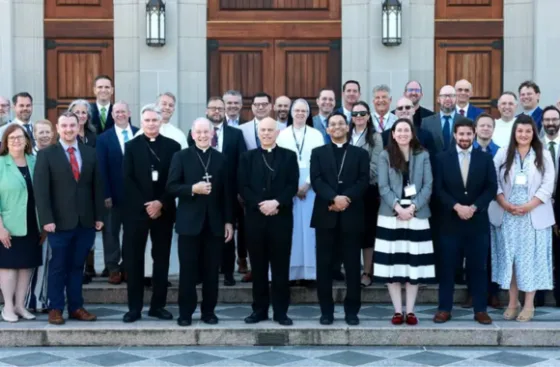
University of Dallas dean says education must be focused on the truth, not secularism
A group of Catholic bishops, professors, and other leaders have formulated seven “cardinal principles” for Catholic education, with a focus on confronting disaffiliation and a lack of belief.
The principles come from a meeting earlier this year, called the inaugural Front Royal Education Summit at Christendom College.
The “Front Royal Statement” addresses the decline in Catholic education, citing the closing of around 100 Catholic schools annually.
“Now is the time to act,” the statement reads, “Do we have the wisdom to read the signs of the times and the courage to respond? Or will we continue chasing secular models of education, treating only the symptoms while we lose still more schools and more young people?”
Several signers of the document gave further insights to The College Fix about the principles, which include the “supernatural end of education,” “nature and dignity of the human person,” “rights of parents,” and “integrity and order of the curriculum.”
Christendom College Professor Jon Kirwan explained the basis: “One cannot teach human beings if one does not know what a human being is.”
The theology professor and director of the school’s educational philosophy center said the summit benefited from bishops and school superintendents who helped craft the statement.
“Led by the bishops and superintendents, we engaged in deep discussion and reflection on four key strategic priorities,” Kirwan said in his email to The Fix. “The enthusiasm throughout the event was enormous. What we learned is that the time is right for coalition-building: knocking down silos, communicating well, and organizing for the common good will be essential.”
A University of Dallas professor said Catholic education needs a reset in his own comments to The Fix.
“I think the statement is trying to address the problem that, in many Catholic K-12 schools, the great heritage of the Catholic intellectual tradition, and the great heritage of Catholic primary and secondary education, tended to drift away in recent decades,” Gregory Roper told The Fix. He is the dean of the Constantin College of Liberal Arts at the University of Dallas.
“Catholic schools at least from the 1960s, if not before, began mimicking the secular and even progressive schools in content and methods,” he said. “Many Catholic K-12 schools are almost indistinguishable from the secular private or even public schools down the street in the content of their curricula and the focus of their education.”
Roper described the Front Royal Statement as a “clarion call to recover the great tradition of Catholic education, to reunite faith and reason, and to carry that forward into the middle of the 21st century.”
He said one of his biggest takeaways from the first inaugural Front Royal Summit was “the joy of seeing so many leaders from all different walks of life–primary and secondary school leaders, important thought leaders, university academics, five important bishops, and more–come together to assert that the Land o’ Lakes statement was a mistake, and that aping progressive education in content, curricula, and pedagogy in Catholic schools has led us nowhere.”
The Land O’ Lakes statement is a 1967 document created under the guidance of former University of Notre Dame president Fr. Theodore Hesburgh. It stated that Catholic universities should have “have a true autonomy and academic freedom in the face of authority of whatever kind, lay or clerical, external to the academic community itself.” The goal was to boost the academic prestige of Catholic research universities.
But Roper says that academic quality and adherence to the Catholic faith are not mutually exclusive.
“People want the depth and richness of a Catholic education, for themselves and their children, that is intellectually rich, grounded in a robust and joyful sense of the Faith, and leading from the historical riches of Catholic education into the present day and the future,” Roper told The Fix.
A theology professor at the University of St. Thomas in Houston explained why he signed the document.
“Most Catholic education has forsaken the notion that education has a supernatural end and must be pursued as the transmission of a living Catholic culture,” David Deavel told The Fix.
“That these are the first and last of the seven principles of the statement is no accident,” Deavel said. “These two pillars shape then entire nature of education and prevent it from becoming merely a this-worldly concern that is either a mere transmission of this-worldly skills or (even worse) the transmission of a culture alien and opposed to the Catholic culture.”
Deavel told The Fix that the two principles of supernatural purpose and Catholic culture inform his work as a professor: “Those two bookend principles should shape one’s approach to the whole process of teaching.”
He said his class begins with prayer. He also said he wants his students to understand “that academic rigor and reading is important, but that the personal and the cultural are just as important in this task.”
Bishop James Conley of the Diocese of Lincoln also signed onto the document, as did Bishop Earl Fernandes of the Diocese of Columbus. Neither responded to requests for comment, with Bp. Conley’s office indicating he was out of the country.
Among the skeptics of the documents, and noticeably absent from the signers, is the Cardinal Newman Society.
In a LinkedIn post, President Patrick Reilly explained that while the statement is “beautiful,” and “says much that needs to be said,” his group saw “no need for new ‘cardinal principles’.”
“A few dozen individuals hammering out ‘cardinal principles’ over a couple days (or drafted beforehand by a select few), to which The Cardinal Newman Society is now supposed to align all our work, is not our style,” Reilly wrote. “We are careful about strategic planning and determine our own path, with prayer and often healthy disagreement with our allies in the reform of Catholic education. I told this to the organizers beforehand.”
When asked if his group would pursue any amendments to the Front Royal Statement, Reilly told The Fix: “The organizers pre-drafted a statement, which was given to participants to discuss for a couple days, and then it was quickly released and promoted. It’s a final publication.”
Reilly also pointed The Fix to his group’s own guiding principles.
“Still, overall the Statement presents a strong and beautiful vision for Catholic education, which The Cardinal Newman Society advocates each and every day and which is most sincerely modeled by the Newman Guide,” he wrote on LinkedIn.
In response to the criticism Professor Deavel told The Fix: “I have great respect for the Cardinal Newman Society and do not mind if they want to stick to their own statements.”