
 FEATURED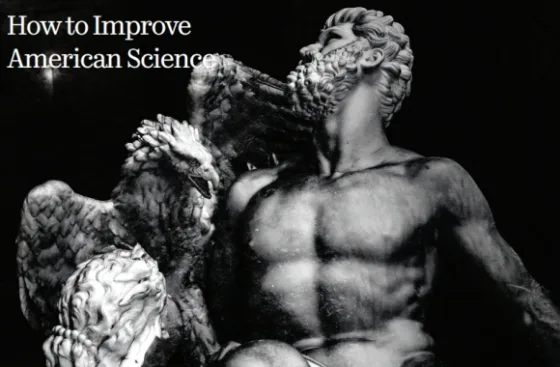
‘Prometheus Program’ seeks to restore scientific integrity with dozens of policy recommendations, but some question role of too much federal oversight
A center-right group of national scholars is calling on the federal government to implement a series of reforms needed to restore excellence, accuracy and trustworthiness to higher education science programs and academic research efforts.
The National Association of Scholars recently rolled out “The Prometheus Program” report, which spells out dozens of ways in which both university leaders and lawmakers can tackle the myriad of problems facing science, from funding issues to ideological biases.
“The Prometheus Program aims to rebuild American science, above all by university reform, to search for truth, depoliticize research, and secure American security and prosperity,” said report author David Randall, NAS director of research, during an April 21 webinar debuting the report.
The plan aims to provide practical solutions to revive the quality of American science within universities and beyond, covering a variety of subjects, from the crisis of research irreproducibility to the use of artificial intelligence in the field.
The association in its report argues the policy recommendations reflect a nonpartisan quest for accuracy and truth.
“We do not take positions on what the actual scientific results are,” it states.
Randall said the topics focused on throughout the report, such as climate change research, the irreproducibility crisis, and university finances, justify policy intervention.
“The Prometheus Program focuses on issues that matter enough to justify policymakers’ attention,” he said.
For example, the report states the federal government “should not fund research that is not publicly accessible, and therefore cannot be reproduced.” It adds funding policies should ensure that “all federal grants go to researchers who follow the best practices of research integrity.”
Regarding environmental studies, the report suggests lawmakers “require the EPA to use and require reproducibility methodologies.”
“Activist pressure has severely distorted environmental science education and research,” the report states. “‘Environmental Science’ has been transformed into ‘Environmental Studies,’ which subordinate scientific inquiry to political activism and the promotion of environmental hysteria.”
Other topics the report gives recommendations on include: genetics, human reproduction, pharmaceuticals, disease control, and computer, physical and psychological sciences.
“American policymakers should restore all policies that treat these mental illnesses as mental illnesses, rather than a form of ‘gender identity,'” the report states “Individuals suffering from these conditions deserve compassion and treatment that encourages them to align their beliefs and understanding of themselves with biological reality.”
Another big concern flagged is “implicit bias,” which basically assumes that every policy has some sort of negative effect on some sort of identity group.
“Ideologically extreme advocates have sought support from implicit bias theory and the Implicit Association Test (IAT), which purport to provide scientific evidence that most or all Americans unconsciously engage in biased conduct,” the report states, adding laws have been established to combat the alleged bias.
“These laws and regulations generally require so-called ‘anti-racist’ conduct to counter ‘implicit’ or ‘unconscious’ bias—which rigorous social scientific research has revealed is imaginary,” the report states.
“Policymakers should rescind all laws, regulations, and programs based on implicit bias theory.”
Under recommendations for nuclear energy, the report advocates for the construction of nuclear power plants. Lawmakers should also “facilitate the replacement and refurbishment of existing nuclear power plants, so that America’s nuclear sector doesn’t age into obsolescence,” it states.
As for artificial intelligence, the report offers numerous suggestions, including tying funding decisions to colleges and universities to ensure they “take active measures to prevent the use of AI by faculty and students to cheat and skim.”
It also recommends establishing “a permanent commission dedicated to reporting on threats to liberty from AI” that works to balance national security with freedom and other concerns.
Much of the webinar focused on what members of the National Association of Scholars say is the growing concern about the irreproducibility crisis, with mounting evidence that suggests large proportions of research are not reproducible and lack accuracy.
“The worst crises in science policy and science education generally occur in the areas most profoundly distorted by progressive politics,” the report states. “Since progressives frequently turn tentative scientific research into articles of faith, any policy that restores proper scientific procedures to these areas must have a political effect.”
The webinar included three professors who offered a mix of praise and constructive criticism of the report. They argued that while the recommendations have good intentions, generating a new onslaught of federal reform regulations might not be the best idea. Instead, they said, institutional reform should come from within.
“I don’t want policymakers dictating or prohibiting any particular line of research,” said panelist Roger Pielke, senior fellow at the center-right American Enterprise Institute.
Panelist Brian Volkman, director of the chemical biology program at the Medical College of Wisconsin, also said part of the problem with trying to replicate other studies is the NIH won’t fund such efforts.
“The review panels will generally, if not punish you, at least dismiss that as not being path-breaking and not being high-impact enough to justify being awarded a grant,” he said.
Barry Smith, professor of ontology at the University of Buffalo, expressed skepticism toward programs to promote replication studies.
“The idea that we can solve problems by promoting replication and reproducibility is, I think, a very difficult idea to realize,” he said. “It’s difficult because you are dealing with human beings, and every group of human beings that you have to deal with is going to be different.”
But Randall said something must be done to reform science in America today.
“The first Prometheus brought fire to mankind. Today’s Prometheuses and tomorrow’s must launch us to the stars,” Randall said. “American science should and must claim the future.”
MORE: Mathematicians want conference moved due to Trump’s ‘unbridled hatred of immigrants’

