
 FEATURED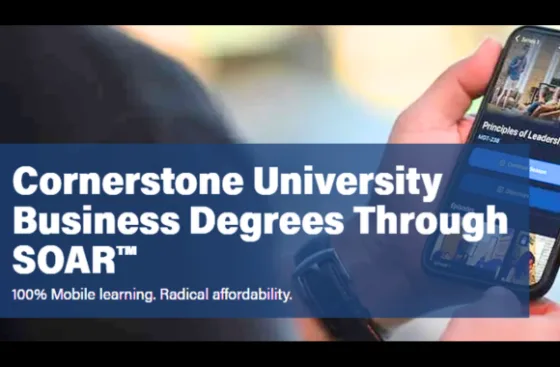
Ideal candidate is working adult who wants to fit in school in between job responsibilities
A Christian university in Michigan is pioneering a set of business degrees that can be completed “100%” on a smartphone. The president of the university spoke further to The College Fix about how the program, which has already graduated students, will work.
Cornerstone University, located in Grand Rapids, is offering an associate’s degree and bachelor’s degree in strategic business management along with a master’s in organizational leadership through its new program.
Students pay a fixed rate of $2,400 per four-month term or $3,750 for the graduate level work. The intended audience is working adults.
According to the program’s website, SOAR aims to remove the financial barriers of traditional higher education by providing an affordable tuition structure where students “pay at least 50% less than other private online colleges.”
To achieve this, the platform prioritizes providing a “flexible schedule” driven by “engaging microlearning” through original podcasts, videos, audiobooks, and presentations developed by Cornerstone faculty. The goal is “to help students soar in all aspects of career and life.”
Their ultimate goal is to deliver a “real-world impact” where adult learners can “Apply new skills directly in your current job for immediate results or upskill your team if you are an employer.”
Cornerstone administrators say that moving away from a traditional physical setup does not mean compromising on substance.
Gerson Moreno-Riano, president of Cornerstone University, explained that early beta testing led to immediate changes in app navigation and media playback based on user preferences.
“SOAR has benefited tremendously from a deeply committed beta test group that provided substantial feedback on the app’s functionality,” Moreno-Riano told The College Fix via an emailed statement. “Their insights have shaped numerous refinements to the platform, ensuring it truly meets the needs of adult learners balancing education with work and family responsibilities.”
According to Moreno-Riano, users specifically requested clearer pathways to monitor their progress.
“Early beta testers expressed a strong desire for multiple, intuitive pathways to reach their grade book and to move seamlessly from activity to activity,” Moreno-Riano said. “We took this to heart and refined the navigation architecture accordingly.”
The university also adjusted its video and audiobook player because students “consistently shared that they wanted the ability to revisit particular segments of a video or audiobook before” taking tests.
“In response, we modified the media player so that, after the initial viewing, playback controls appear, allowing students to fast-forward, rewind, or scrub directly to the section they want to revisit,” Moreno-Riano noted. “This small but meaningful enhancement has empowered learners to take greater ownership of their study process and engage more deeply with the material at their own pace.”
The Fix asked about the flat-rate subscription of $2,400 per four-month term and how SOAR’s team helps students optimize their subscription and achieve a return on investment.
To prevent students from stalling in a deadline-free environment, the university utilizes data analytics and advisors to map out daily goals.
The university president said “academic success coaches” will regularly monitor student progress and help them reach their goals.
The course content mirrors that of the university’s traditional programs.
“For example, rather than administering a traditional 100-question unit exam, students engage with a series of micro-assessments—typically five questions at a time—that collectively achieve the same learning outcomes while fitting naturally into the rhythm of a busy adult learner’s day,” Moreno-Riano said.
The final exam includes role-playing scenarios where students might act as a manager, supervisor, or HR director, Moreno-Riano said.
The president said that “this approach moves well beyond rote memorization or definitional responses, instead asking students to apply their learning to realistic, real-world situations.”
Cornerstone University has already received positive feedback from students.
“One of our students shared with us that she regularly travels for several days each month for her job, and during those days it was virtually impossible for her to keep up with her usual intended coursework progress,” Moreno-Riano told The Fix.
This differed from her past attempts to graduate college:
<BLOCK>With previous college attempts, she would fall “behind” in her coursework during those weeks and miss deadlines, which would cause her to lose grade points and the motivation to try to catch up. With the SOAR model, she simply adjusts her own determined pacing and knows that the days before and after those trips require a different catch-up pacing. <BLOCK>
The lack of physical materials ultimately allows these students to work on the move.
“And since she doesn’t have to travel with any textbooks or extra devices to keep up with SOAR coursework, she can listen to her audiobooks, podcasts, and videos within the phone app while at the airport and in between client meetings,” Moreno-Riano said.
However, critics of mobile education question whether complex frameworks can be effectively absorbed on a smartphone screen without traditional long-form reading and writing.
Harvard researcher says similar models have been successful
Kathleen deLaski, an education researcher at Harvard University, said it will take some time to measure the success of the program.
When asked about the unique nature of a phone-first model like the one in the SOAR program, deLaski told The Fix that the industry is entering uncharted territory regarding mobile degree efficacy.
“This is the key question, and I think we’ll have to wait for the early rounds of engagement and outcome research to see how students respond to a fully phone-first degree,” deLaski said. “It sounds like many of the early enrollees are transfers or “stop out” students who also have experience in traditional programs so they will provide good comparative survey data.”
She noted that similar online models have proven successful when student support is prioritized.
“We do know that fully online, self paced competency degree programs (like Western Governors University) get high marks from students,” deLaski added. “The WGU model provides a personal coach, which I hope SOAR is also providing.”
She said “non-traditional students” typically need “encouragement and tutoring and accountability.”
deLaski, who wrote a book that examined microcredentials, certificates, and other alternative forms of education, says ultimately employers will need to see real skills from graduates.
“As a corporate partner, I’d want to see the curriculum and how students’ mastery of the skills I care about are measured and showcased,” deLaski added. “And of course how the students perform in internships and job interviews.”

