FEATURED
Several public universities across the nation continue to require students to take courses embedded with progressive ideologies and activism despite state laws banning DEI practices, according to a recently released report.
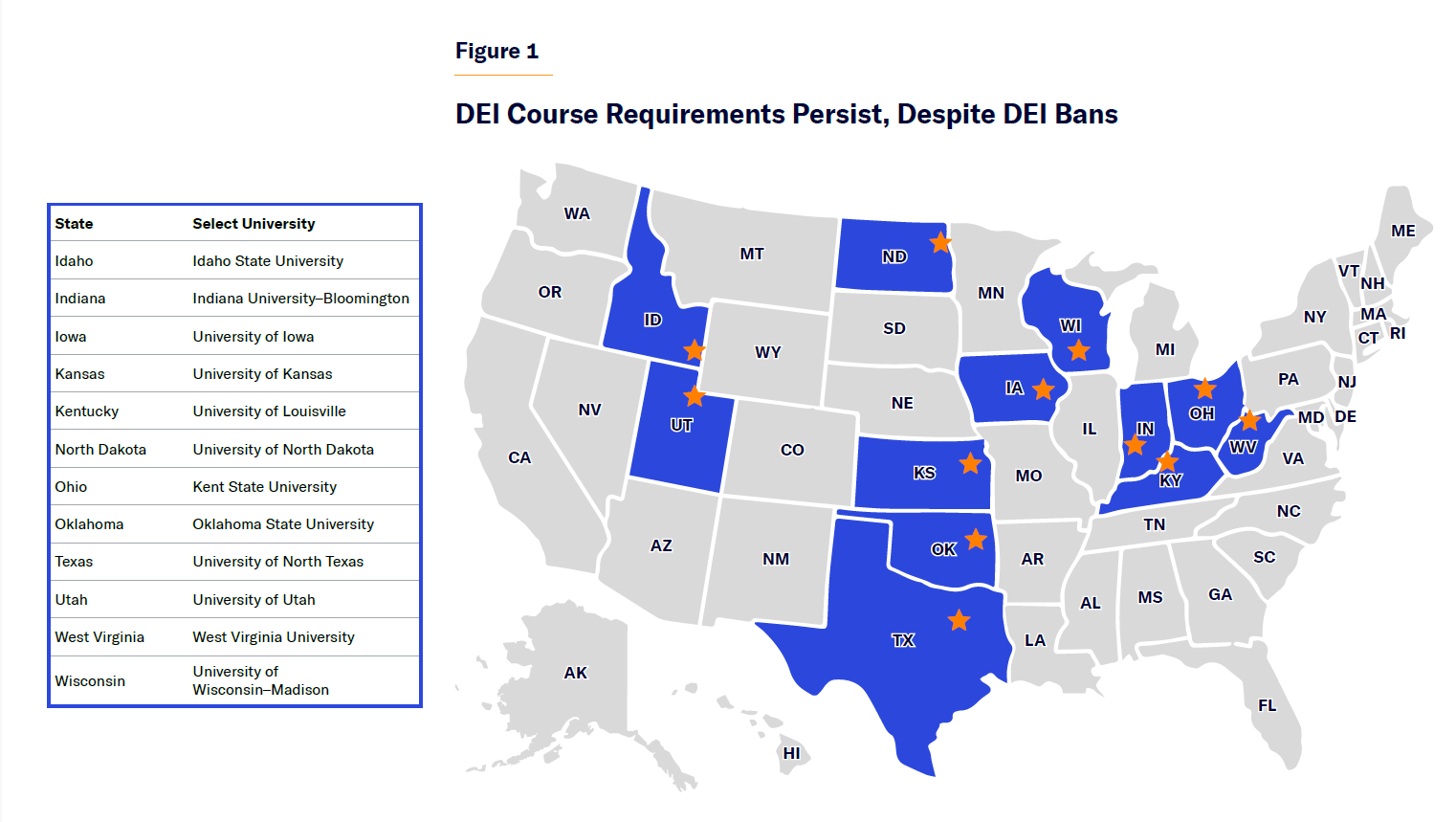
In total, diversity requirements, whether embedded in general education courses or as stand-alone graduation mandates, were found at universities within nearly a dozen states with DEI bans on the books, the report states.
Campuses flagged include: Idaho State University, Indiana University–Bloomington, University of Iowa, University of Kansas, University of North Dakota, Oklahoma State University, University of North Texas, University of Utah, West Virginia University, and the University of Wisconsin–Madison.
Some of the diversity requirements are embedded in general education courses, others are stand-alone graduation mandates.
Campus leaders “have abused their role as custodians of students and stewards of taxpayer dollars by blurring the line between education and activism, especially in introductory coursework or in required courses necessary to fulfill general education requirements,” wrote Neetu Arnold, an analyst for the Manhattan Institute who penned the report.
Titled “Correcting the Core University General Education Requirements Need State Oversight,” Arnold argued “universities must ensure that general education courses are academically rigorous and broadly applicable, as opposed to advancing one political worldview.”
Arnold, in an interview with The College Fix, said the “purpose of general education is to give students a shared foundation of knowledge across major fields and to help them understand how different disciplines evaluate evidence and truth.”
“That means general education should include the humanities, social sciences, and natural sciences, along with core skills like writing and quantitative reasoning,” she said via email. “The problem today isn’t that universities ignore these areas—it’s how they cover them. General education requirements have become bloated and confusing, often filled with niche or ideologically driven courses.”
Arnold cited the University of Alaska treatment of “decolonizing teaching practices” as an educational innovation. She also listed several ideologically driven general education courses offered in various universities, such as “Perspectives in Lesbian, Gay, Bisexual, and Transgender Studies” at the University of Kansas.
She argued in the report that increasing state oversight is needed to revise general education requirements and realign them “with their core academic and civic missions.”
According to Arnold, while states already do exercise a certain degree of oversight when it comes to general education, they are often very broad in their requirements, mainly regulating subjects, total credit hours, and rules for transferability between state schools.
“State governments need to remember that there are other stakeholders in public higher education: taxpayers and students,” she wrote. “Universities must prove that a course is intellectually valuable and how it benefits students.”
Removing all DEI and social justice courses would pose some legal problems against academic freedom. Arnold’s report presents a more diplomatic approach: “Ending diversity course requirements, placing stricter standards on general education course qualifications, and periodically reviewing courses all address politicization and the quality of courses while preserving academic freedom.”
Arnold used Florida as a case study for this approach.
In 2023, a law was passed in Florida prohibiting “the state’s core general education courses from promoting historical distortions and political agendas.” A review process is now also required for all general education requirements in any of Florida’s public universities.
SB 266 also gave more oversight power to Florida’s Board of Governors and State Board of Education, allowing them the final word on what courses may be included as general education.
Following its implementation, Florida’s public universities saw a near 60 percent decrease in what courses could be considered as qualifying to meet general education course requirements.
“Departments that are particular hotbeds for activism and controversy were most likely to have their classes removed from the general education list,” Arnold reported.
Courses removed from the status of general education included “Be a Social Justice Activist: #Activism, Intersectionality, and Social Movement Organizing, “Latin American and US Latinx Theatre,” and “Diversity and Inclusion in Sports Organizations.”
Reached for comment, some university spokespeople for campuses named in the report argued they should not have been included.
For example, Kent State U. said the report, which was published Dec. 18, came out after the Faculty Senate voted in late November to eliminate the diversity course requirement, which the university’s Board of Trustees approved Dec. 11.
“At that point, the requirement was removed from the 2025 University Catalog and from all undergraduate students’ degree audits,” a spokesperson told The College Fix via email.
And Rebecca Walsh, director of communications for the University of Utah, told The Fix her university does not run afoul of state law despite its mandate.
“The ‘diversity course requirement’ is in compliance with HB 261’s exception for academic work. The university defines those classes which qualify as courses exploring different life experiences and ways of thinking, including diverse viewpoints,” she said via email.
Walsh also listed examples of classes that met the university’s diversity course requirements, such as “Diversity in American Literature,” “Human Exceptionality,” and “Social Divisions & Cultural Understanding.”
MORE: Audit demanded after claims that MIT faculty hiring sidesteps DEI ban