FEATURED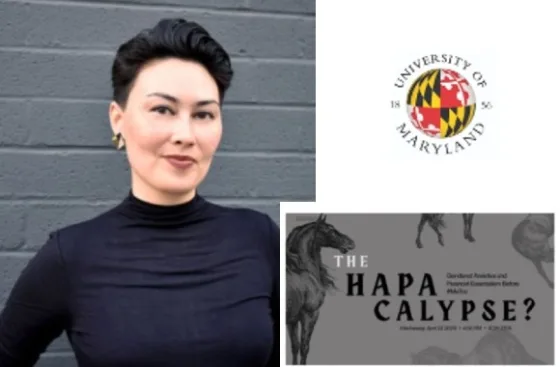
Gender studies professor’s new book ‘traces the ways Asian Americans have either sought to or failed to contend with US imperialism and its unrelenting violence’
A Duke University gender studies professor connected biracial Asian/white identities to U.S. “imperialism” and “unrelenting violence” during a recent talk at the University of Maryland.
The talk by Professor Anna Storti, “The Hapacalypse?: Gendered Anxieties and Paranoid Existentialism Before #MeToo,” was hosted April 22 by the Department of Women, Gender, and Sexuality Studies.
Storti’s talk, which included excerpts from her new book “Torn: Asian/white Life and the Intimacy of Violence,” focused on the “tensions that surround mixed race identity and interracial desire.” Her book “traces the ways Asian Americans have either sought to or failed to contend with US imperialism and its unrelenting violence.”
As examples, she discussed the cases of convict Daniel Holtzclaw and mass murderer Elliot Rodger within the context of the “Hapacalypse.”
The “Hapacalypse” is a theory that was introduced prior to the #MeToo movement in 2015. It came from the subreddit “r/hapas” when a user suggested that biracial Asian/white people in the 21st century will be responsible for increased levels of “violent outbursts.”
The Reddit user argued that this would be caused by “millions” of half-Asian children being exposed to “massively unbalanced interracial dating,” “constant attacks on Asianness by Asian women in relations with White men,” and “Asian masculinity” being “categorically attacked from the beginning.”
When those “very different stories” are “brought together,” Storti told her university audience they “can help distinguish the rather simple suspicion at the heart of the Hapacalypse theory: That something bad is happening.”
“Whether someone is a survivor or a perpetrator, there is an undeniable tension in being a person born in a moment where justice hinges on the contrast between evidence and believability,” she continued.
The “larger point” is that “if evidence is a requirement for believability in the context of sexual violence, it also plays a key role in racial reform. That is, whether one’s race is believable or not,” Storti said.
“Like survivors, some people who live Asian/white lives never outrun the accusations that they are not who they say they are,” she told those in attendance.
Storti said that while the “Hapacalypse” theory could be debated as “real or exaggerated,” it could also “help articulate how and to what end assumed proximity to whiteness disciplines the new face of the millennium and of the Asian century.”
In her “interrogation of such a theory,” Storti asked two questions: “Is the Asian/white subject the harbinger of the end of the world? Or is empire’s subject striking back?”
Storti mentioned the “empire” several times in her talk to describe the “subtle” and “overt” ways the United States’ predominantly white culture may influence other cultures both domestic and foreign.
The first part of Storti’s presentation discussed Daniel Holtzclaw, a former Oklahoma City police officer who was convicted of 18 counts of on-duty sex offenses involving eight women, according to a 2016 NPR report.
Storti said that during the trial, “journalists correctly identified the race of the all-white jury and the thirteen black women who came forward.”
“Holtzclaw’s race, however, escaped such visual accuracy. Rife with error, media coverage before, after, and during the conviction exposes the irregularity for which Holtzclaw was racialized,” Storti said.
Storti suggested that Holtzclaw being born a single child in Guam to a Japanese mother and German-American father, the law enforcement culture he was raised in, and his inability to get drafted into the NFL culminated in a desire to compensate for his “partial whiteness” by committing those acts.
The second part of Storti’s presentation discussed Elliot Rodger, who murdered six people and injured more than a dozen others before killing himself in 2014, near the University of California, Santa Barbara, according to the Los Angeles Times.
In his 137-page manifesto, Rodger stated the reason he committed those attacks was because of his failure to attract women, which he blamed them for.
“Undiagnosed, Rodger’s mental health remains to be the subject at fault even as the scholars who set forth to analyze socialization of mass shooters are keen to note the killer’s likelihood of being white men who harbor narcissistic, racist, xenophobic, and misogynistic views,” Storti said.
“As we know, Rodger exhibits each of these attributes, his Asian heritage is his only marker of difference,” Storti said.
It is that difference that Storti said “demands” her “repeating that Rodger loathed being Asian, wishing that he was like the other fully white kids that he was trying to fit in with,” despite his “ego manufactured by a place of insecurity.”
Storti juxtaposed Holtzclaw and Rodger with the cases of performance artist Emma Sulkowicz and writer Chanel Miller.
All four figures were of Asian/white descent. However, she said both Sulkowicz and Miller chose to “turn to the arts to take on the traumas sourced by violent men.”
Regarding the “Hapacalypse” theory, Storti described it as, “in no uncertain terms,” one of “paranoia and perhaps exaggeration.”
“Like sexual violence, race is nonconsentual. Subjected by race and empire, Holtzclaw and Rodger felt torn, wronged by their racial form in and of itself, torn between embracing and disavowing their Asianness,” she said.
At the end of her presentation, Storti opened the floor to questions.
One attendee asked how her book “Torn” fits into survivor studies and “survivorhood through culture.” In her response, she said she believes the Violence Against Women Act was “problematic” for feminist activism because it “links a certain level of safety, security, and rescue to police and policing.”
Tying that to the Holtzclaw case, Storti said, “We have to unlearn and retrain even the folks who are the most feminist and anti-imperialist what safety looks like … and how that abolitionist vibe of just destroying, destruction, and then rebuilding could potentially help form a new way to think about how we keep each other safe.”
Another attendee asked Storti how the “American empire” tends to “occupy” not just “overseas” places but “gentrified” places, too.
Storti said there’s an “obvious connection” to “U.S. imperialism” in most of the cases she mentioned, and cited Holtzclaw’s parents meeting in Japan while his father was stationed there by the Air Force as an example.
However, Storti said she has also been looking for more “subtle” examples of “empire,” such as whether “someone walking down the street and saying you’re hot for an Asian” counts, and what the “Asian women body” represents in “the larger context of the United States.”
MORE: Cal State professor worries Victorian literature studies promote ‘white feminism’