FEATURED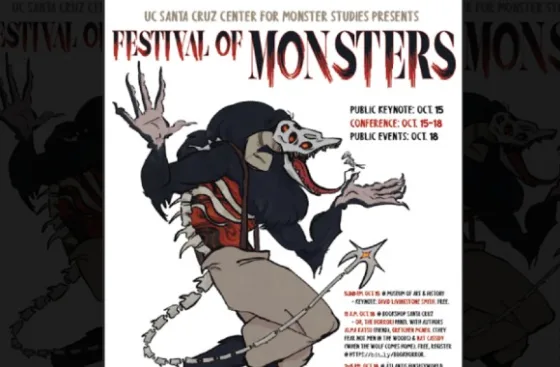
Monsters ‘are mirrors that allow us to confront our own biases,’ according to university
The University of California at Santa Cruz hosted its third annual Festival of Monsters academic conference last week with panel talks on topics such as “cannibalism,” “eugenics,” race, and feminism.
The festival is hosted by the public university’s Center for Monster Studies. The center, run by artists and scholars, focuses on exploring the concept of monsters to understand some of the “most challenging problems” of today, including “race, religion, social justice, and environmental threats.”
Monsters “are mirrors that allow us to confront our own biases, and to develop the empathy we need to combat them,” the website states.
These mythical creatures also present “a unique site for analyzing geopolitics, popular culture, scientific discovery, technology, and understandings of the human,” according to the center’s website.
However, when asked for comment on the academic conference, Mark Bauerlein, a professor emeritus of English at Emory University, had a different view about why a university would host events such as this one.
“With enrollments plummeting in humanities areas, mainstream departments and centers will go far into youth world to attract warm bodies,” Bauerlein, a senior editor of First Things, told The College Fix. “Call this project another dying gasp by an institution going down.”
The university’s media relations office and the center’s directors did not respond to several emails from The Fix over the past three weeks requesting more information and comment on the conference.
Director of the Center for Monster Studies Michael Chemers explained how the subject can be used to understand today’s political climate in a recent interview.
“At the end of the day, it’s about othering people based on characteristics like gender, race, ethnicity, religion–and then using that monsterization as an excuse to commit atrocity against those people,” Chemers told Lookout Santa Cruz.
Many of the panels and speeches at the conference focused on race and gender issues.
One of the keynote speakers, Kimberly Lau spoke about the connection between “monstrosity” and “white heteropatriarchal masculinism,” according to a Contingent Magazine article.
Lau told the audience that today’s culture often makes monsters out to be “desirable or sympathetic,” but “there is cause to reintroduce fear of the monster in order to counteract the rise of the monstrous manosphere,” according to the report.
Lau is a literature, gender and sexuality studies professor at UC Santa Cruz, and author of “Body Language: Sisters in Shape, Black Women’s Fitness, and Feminist Identity Politics” and “Specters of the Marvelous: Race and the Development of the European Fairy Tale.”
Jeffrey Jerome Cohen, the dean of humanities at Arizona State University, also gave a keynote speech about the history of the research topic called “Monster Theory at 30.” His scholarship includes the book “Of Giants: Sex, Monsters, and The Middle Ages.”
Some of the panels included “Never Let Go and Black Monstrous Motherhood,” “Exploring Cannibalism and Intimacy in Dahmer-Monster and the Animated Short, Edmond,” and “Snacking in Hell: Hunger, Eating and Non-Consumption in Dante’s Inferno.”
One panel “Don’t F*** with These Women” included scholars who have written about witchcraft, “fembot” horror, and “bad girls.”
According to the university website, the three-day conference also covered topics such as classic monsters, child monsters, and “Black women and monsters.” The conference also featured a talk on the topic “Chicanix Nuclear Gothic,” which examines the history of nuclear testing in Hispanic-populated areas.
The conference ended with a “role-playing” game called “Blood on the Clocktower” in which participants tried to determine which player was the “demon” in disguise.
MORE: Harvard hires drag queen ‘LaWhore Vagistan’ to teach ‘Queer Ethnography’