FEATURED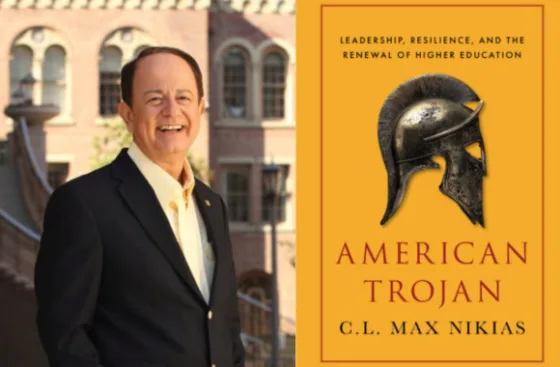
OPINION: Max Nikias’ book calls on university leaders to respect free speech
Universities should not “protect students from hurtful ideas” but “protect their ability to live and learn in a community of scholars,” according to Max Nikias, the former president of the University of Southern California.
Nikias lays out his vision of how higher education needs to change in his new memoir, “American Trojan: Leadership, Resilience, and the Renewal of Higher Education” out now from Encounter Books. The publisher provided a copy to The College Fix.
Nikias served as university president from 2010 to 2018. He came to America in the 1970s from Cyprus following the Turkish takeover of the country and the resulting restrictions on travel.
His memoir details the university leader’s time in the military, education, and success as an expert on signal processing.
The book too has several good insights on current problems in higher education, particularly free speech and open debate.
Commenting on antisemitism concerns, Nikias says “Students – no matter their personal or political beliefs – should never have to hide their identities or beliefs in order to feel safe.”
He also criticizes excessive political activism by professors. Some scholars, he writes, “spend more time on a daily basis branding themselves on social media platforms and promoting their activist agendas than focusing on serious academic scholarship.”
In the book he highlights how he made sure to bring in different speakers with both liberal and conservative views.
Unfortunately, most of this good advice might be lost to the average reader, or even an interested college official, as it comes near the end of the book. The length of the book, nearly 500 pages, is largely driven by an excessive number of stories and granular details provided by Nikias.
For example, 354 pages in, as the book should probably be wrapping up, Nikias emphasizes how during one fundraising campaign he “wanted to establish transparency and accountability with our quarterly reports.” That may be good advice for a fundraising manual for university leaders, but seems out of place so deep into the book.
Other parts of the book are likely to raise eyebrows among conservative readers.
After the terrorist attacks on Sept. 11, 2001, Nikias, then the dean of the engineering school, made it a priority to ensure Indian students continued to enroll at USC. Why? We’re never quite told why that was the priority.
As engineering dean, he also prioritized female hires.
“We needed to recruit more women,” he writes, commenting on the lack of female faculty in the engineering department. The department made it a “priority” to hire more female professors. Nikias writes that the DEI initiative was a success.
Still, the book has other strong sections, including Nikias sharing his views on immigration and NATO. The beginning of the book provides fascinating details on geopolitics in the 1970s and highlights how Nikias overcame adversity to become a successful leader.
The book would probably be best split into three separate works.
First, a memoir discussing his life and academic background along with advice for current higher education controversies and how he responded to problems throughout his leadership tenure. A second book could be sent just to donors and other friends of Nikias, as he spends a good amount of time in the book name dropping various major donors.
A third book might be directed just at university development officers and other fundraisers, explaining how to raise a lot of money (which Nikias had a skill for doing).
The “American Trojan” has a story worth telling – it’s just unfortunate it might get lost among the excessive length of his book.