FEATURED
Brad Wilcox, a sociology professor at the University of Virginia, recently launched the Go Get Married Project, an initiative targeted at Gen Z that features research on the topic and an interactive map where users can see marriage and singleness statistics across the U.S.
“We aim to help young people understand the growing value of marriage, how to date more successfully with an eye towards marriage, and advance policies and civic efforts to help them marry,” Wilcox told The College Fix.
The director of the initiative, he believes that while many young adults hope to be married one day, they “do not know how to get there.”
One reason for this is an increase in online platforms and a decrease in social institutions, which makes it harder for young people to meet and form connections, Wilcox said in a recent email interview.
Young people also are more career-driven, and academia promotes work-centered mindsets in students, he said.
“Messaging on campus consistently emphasizes career advancement over all else,” Wilcox said. “Some corners of academia are also pushing misguided ideological hostility to marriage and family formation.”
The Go Get Married Project is a research-based initiative through the Institute for Family Studies, which Wilcox founded. According to the institute’s website, the new project will highlight scholarly research on “the benefits of stably-married family to individuals, couples, their children, and wider American society.”
The project will continue to review “data on marriage, family formation, and life outcomes” with the goal of “provid[ing] resources for a rising generation of Americans considering how to get married and establish a stable family life,” according to the website.
One of the new resources the project made available is The Marriage Map, an interactive tool showing marriage statistics across the U.S.
The tool, which launched Aug. 26, shows which areas have the highest marriage rates and singleness rates for young adults in a region. It also allows users to apply filters such as sex, age, and religious affiliation.
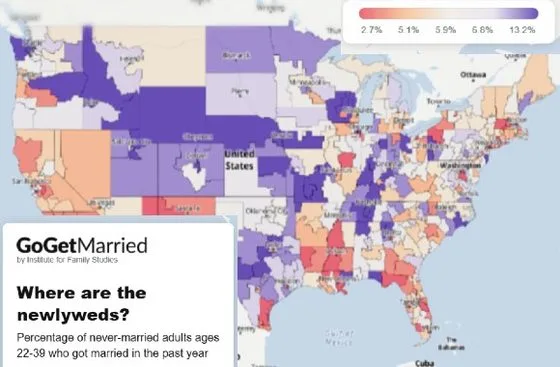
According to the map, the Provo area in Utah and the southern suburbs of Indiana had the highest rates of new marriages among individuals aged 22 to 39.
The new project comes several months after an institute report examined the “dating recession” by surveying more than 5,000 young adults in 2025.
The survey found that only about one in three young adults are actively dating, most struggle with self-confidence when it comes to dating, and most want to date with the goal of “forming serious relationships … and creating emotional connections.”
Other surveys have found low interest in marriage among young adults. For example, a CNBC/Survey Monkey poll in July found only 37% of 4,130 Gen Z respondents believe marriage is “integral” to their lives.
Another survey from the Pew Research Center in 2023 found that 67% of high school seniors desired marriage, compared to 80% in 1993, a decrease of more than 16%.
The Go Get Married Project provides resources to encourage young people to get married in the hopes of reversing negative trends.
The Fix asked Wilcox how he would respond to people who might claim the project is merely pushing right-wing or Christian agendas.
He responded by pointing to “an abundance of data on the importance of marriage and stable families for mothers, fathers, and their children.”
One institute report, published in 2025, found that married individuals are nearly twice as likely to report being “very happy” with their lives compared to those who are not. They are also more likely to be in a better financial situation heading into retirement.
Additionally, the study found a “30-percentage-point happiness gap between married and unmarried Americans.”
Wilcox also believes marriage benefits children.
“All of the data show that children raised in stable, married families perform better emotionally, behaviorally, academically, and spiritually than their peers who come from more volatile upbringings,” he said.
One of the statistics featured on the institute website says that children who do not have two married parents in the home were almost three times more likely to be suspended from school and twice as likely to repeat a grade.
Another statistic says that the children of married parents are less likely to need counseling services for mental health challenges.
Founded in 2009, the Institute for Family Studies is a scholarly research organization that Wilcox began to promote strong marriages and families.
“The primary reason for this project is to address the biggest social crisis of our day: an entire generation struggling to date, marry, and form a family,” Wilcox said.
MORE: Harvard scholars: Marriage makes women happier and healthier